
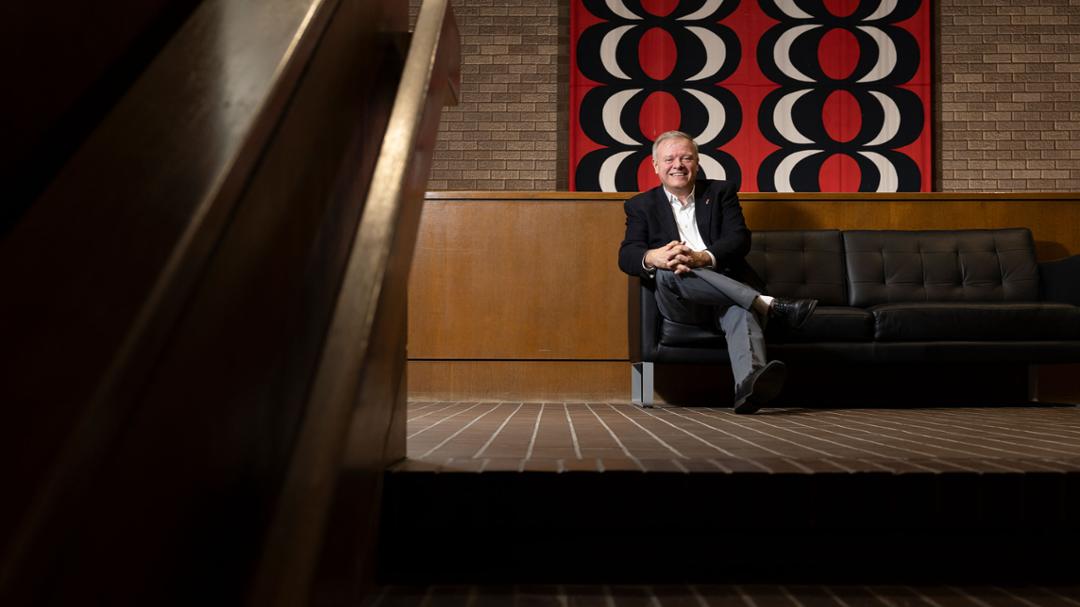

At Texas Tech’s Veterans Law Clinic, retired Col. Mark “Max” Maxwell is training the next generation of attorneys to advocate for those who served.
Veterans in need of assistance from the U.S. Department of Veterans Affairs (VA) are often left to navigate a complex legal system on their own. The pathway to filing a claim or an appeal is often paved with legal processes most people struggle to understand without proper guidance.
In West Texas, geography creates an additional hurdle. The few legal resources available to veterans can be several hours away and are typically income-based, meaning eligibility depends on how much a person earns. That leaves some veterans in a gap, earning too much to qualify for low-income assistance but too little to afford a private attorney.
That changed when the William A. Brookshire Foundation made a $1.6 million contribution to Texas Tech University and established the university’s first Veterans Law Clinic, the only pro bono clinic in West Texas dedicated solely to veterans.
At its helm is retired Col. Mark “Max” Maxwell, a VA-accredited attorney and Army veteran with more than 35 years of service as a uniformed officer and civil servant.
Maxwell possesses the composure of a soldier, but it is evident his experience has also taught him that strength does not always mean stiffness. While he can appear stoic at times, his jovial, optimistic nature shines through in his interactions with others.

“I believe that people naturally have goodness and want to help each other,” he said without hesitation, as if stating an obvious truth. “And when you give them a mission that helps people, it invigorates them.”
It was that assurance and pride in his fellow service members that kept Maxwell focused as he toiled to close a gap no one else had.
Rising to the Occasion
For years, students in the Texas Tech School of Law encountered veterans through the school’s other legal clinics, but without a clinic built specifically for veterans’ law, students lacked the tools to fully serve them. Professors Geoffrey Corn, the George R. Killam Jr. Chair of Criminal Law and director of the Center for Military Law & Policy, and Dwight McDonald, a clinic fellow in the Family Law/Housing Clinic and Criminal Defense Clinic, identified the need and imagined what it would take to meet it.
Around the time the clinic idea was taking shape, Dean Quinn, a two-time Texas Tech alumnus and a director at the Brookshire Foundation, was working with the foundation to expand their support of veterans’ programs to more universities.
The foundation’s namesake, William Brookshire, worked to put himself through college to earn a Ph.D., and he never forgot that his opportunities were made possible by those who served in the military. His daughter, Lori Garrison, and her husband, John, who now lead the foundation as president and vice president, saw the same character and work ethic in Texas Tech students that Brookshire embodied and had always supported.
With the idea in mind and funding secured, the only thing left was to find the right person to build the clinic.
Corn already knew who that person should be. He had served alongside Maxwell for 21 years in the U.S. Army, and he had been Maxwell’s instructor during his advanced course for judge advocates.
At the time, Maxwell was nine years into a job he loved as the principal deputy legal counsel for U.S. Africa Command in Stuttgart, Germany. However, he had always had a desire to teach, so when the opportunity to lead the clinic came knocking — true to his nature — Maxwell didn’t hesitate.
After a 14-hour flight, Maxwell found himself in Lubbock fielding interview questions on his teaching philosophy and research. It was the kind of back-and-forth he’d missed in law school, but he was most looking forward to his meeting with the students later that day. A 30-minute meeting with them stretched to nearly two hours as they pressed him on how he planned to build a clinic from nothing.
“It was phenomenal,” he said, still impressed by his experience a year later. “The students were inquisitive and sharp, and they wanted to know how I intended to, as I like to say, build the plane mid-flight.”
After his interaction with the students, he was sold. He called his wife seven time zones away to tell her that if they offered him the job, he would accept.
Two weeks later, Jack Nowlin, dean of the School of Law, called with good news.
Preparing for Takeoff
Maxwell found himself staring at a large, blank whiteboard. After 35 years of service, he was used to structure and clear procedures. Now, backed by the dean and his colleagues, he had the freedom to build the clinic his own way.
“I thought, ‘What have I gotten myself into?’” Maxwell said. “Nobody was there to tell me what to do. The roadmap was mine.”
With only two months before he had to open the clinic, he grabbed a dry-erase marker and mapped out his plan of attack.
Unlike other clinics that had an income-based referral system, there wasn’t a built-in client pipeline for this program. So, Maxwell started by launching a tactical effort he affectionately calls his “charm offensive.”
He reached out to nearly every veteran support organization in the region he could find, setting up meetings, handing out business cards and flyers he designed himself, and spreading the word about the clinic’s existence.
At the same time, he built the clinic’s infrastructure from scratch, creating intake forms, a case-management system, HIPAA-compliant processes and a curriculum for students who had never touched veterans’ law before.

He also had to decide what the clinic would do. Rather than specializing in one area, Maxwell built the Texas Tech Veterans Law Clinic around three: VA compensation and benefits, military discharge upgrades and correction of military records. This approach allowed him to help more veterans while providing students with a comprehensive educational experience.
Piece by piece, things started to fit together. And with the clinic’s foundation set, the final step was selecting the students who would pave the way. With the selection pool spanning second- and third-year law students, and only seven seats available in the clinic’s first year, the process was competitive.
The students started with a written application, followed by a face-to-face interview with Maxwell. Not only was he looking for students with servant hearts dedicated to veterans, but he was also looking for key traits he knew would translate into great attorneys after graduation.
One of those traits was emotional intelligence. He needed to know that his students were able to work through cases and handle denials without losing sight of their clients. Furthermore, students needed to exhibit the doggedness and grit vital for advocacy work.
“Working with a client is not always happy and joyful,” said Maxwell. “Sometimes it can be difficult, and I have to get a sense of whether students can handle that stress. I need to know that they’ll be there for the client and not drop the ball on them.”
In addition to their required coursework, students spend an additional two hours a week in Maxwell’s lecture and are required to spend six hours a week in the office scheduling client interviews, reviewing case files that can be well over 300 pages, researching medical literature and building a cohesive narrative.
“Never underestimate grit,” said Maxwell. “It’s the source of success. Experience is great, but if you have someone with grit, I’ll take them every time.”
Two of the seven students who made the cut were Lettie Morris and Aaron Sharpe, both of whom applied in their second year of law school.
Morris grew up in a ranching community an hour east of Austin and is the first in her family to take her education this far. She had the resolve that was needed for this type of advocacy work.
Sharpe’s connection to the clinic was also personal. His grandparents served in the military, and he volunteered at a summer camp for children whose parents died in the line of duty. Supporting service members and their families was something that always stuck with him, and when he heard about the clinic, he turned in an application without a second thought.
It was the kind of dedication and conviction Maxwell knew he could count on throughout the year.
Building the Plane Mid-Flight
Neither the students nor Maxwell knew exactly what they were walking into. In addition to ironing out the kinks expected of a newly established clinic, Maxwell had to figure out how to teach an area of law to students who had no prerequisite in it, while also balancing a growing client load. It was, as Maxwell likes to say, “building the plane mid-flight.” A term the students became quite familiar with over the year.

To ease students into their new responsibilities, Maxwell paired them up to take on cases together. Despite these partnerships and the support of their mentor, the students were working on real cases, and the fear of saying the wrong thing weighed heavily on them.
Through fidgeting hands, long pauses between questions, and moments of uncertainty, Maxwell stood by them, reminding them what he believed they were capable of.
“I remember in our very first class he told us that any accomplishment was going to be ours to make, and any mistakes were going to be his,” said Morris.
That single line took the fear out of the room, and it became the standard Maxwell held himself to all year.
“Part of my job is being a role model,” said Maxwell. “When you telegraph your faith in the students, it translates into action. Once they give that commitment, it’s transformative because now they’re vested. It’s now their clinic, and they own it.”
Alongside his mentorship, students quickly picked up on his welcoming nature. As the students found their footing, the relationships within the clinic started to change. Friendships formed and students checked in on each other’s cases unprompted. Before long, a culture of camaraderie became the new standard. They had built a network of people they could rely on, and for Maxwell, that was a major victory.
“When you are in a cohort of this nature, it creates lasting friendships,” said Maxwell. “When you work together, you have a common mission, and much like the military, you find those people that have similar grit.”
Taking the Controls
Maxwell’s experience, coupled with his humility, shaped the way he taught. His goal had always been to share the joy of being a lawyer and help his students become the best lawyers they could be, regardless of the area of law they pursued. Moreover, he wanted them to know he valued their input enough to say he was learning from them just as much as they were learning from him.
“I tell them I consider them co-counsel,” said Maxwell. “I am the one who’s the accredited attorney, but when it comes to a case, we are equal. I want their thoughts, because sometimes, even if it’s different than how I think, it could be the solution. They, too, hold the keys.”

As trust developed, Professor Maxwell became Professor Max and, not long after, just Max. As formality melted away, so did the students’ hesitancy, giving way to self-assurance, and for Maxwell, that shift was a milestone.
For Morris, it showed up in the scope of what she took on. In the fall semester of the clinic’s first year, she was part of a team of students who wrote an amicus brief to the U.S. Court of Appeals for the Federal Circuit, arguing that a veteran with a Military Sexual Trauma (MST) claim should have been prioritized in the VA system – a right established by Congress for MST victims through the Military Sexual Trauma Accountability Act. The client had been waiting four years for a hearing before her case was heard, and their brief helped move it forward.
To Maxwell, these moments were invaluable.
“There are very few feelings more gratifying than watching the light bulb go off,” said Maxwell. “For them to take something and to bring it to a posture better than you yourself would be able to, and having the humility to know, ‘Yeah, they’re actually better than I am.’”
Serving Those Who Served
As word of the clinic spread through the veteran community, the students had no shortage of opportunities to put their knowledge into practice. Soon enough, students were assigned between four and six cases, including at least one from each area of clinic focus.
While Maxwell holds his students to a high standard, he is equally insistent they know that the most valuable quality the clinic provides isn’t always a winning case. It provides the opportunity to be heard.
He recalled a memory from early in his career, while representing the government in a deposition, when he asked the plaintiff what she wanted out of the case. She told him she just wanted someone to listen. This sudden revelation set the tone for the rest of his career.
“I think what is invaluable is that you are working with a live person,” he mused. “A lot of times the greatest victory that we get from a case is that we sit down and we listen. We just listen, and people don’t always understand the power of that.”
As a veteran himself, Maxwell says the gratitude clients express carries a weight that runs deeper than words.
“The common bond with veterans is that we all raised our right hand and swore an oath to the Constitution,” said Maxwell. “I know what I endured and what my wife endured when I was deployed. I’m very mindful of what people go through and what impact it has on them.”

For Morris, the work feels personal, too.
“It’s so special to be able to help the people who were so willing to serve our country,” said Morris. “I had one client I felt connected to because he reminded me a lot of my family members who were in the service. He’s so willing to focus on helping other people, but it’s hard for him to accept that for himself. In my mind, this work is some kind of thank you to them for making that sacrifice.”
Eyes on the Horizon
A year ago, Maxwell found himself staring at a blank whiteboard with a directive to build something from nothing. With the help of the inaugural class of students, that whiteboard is full of the first names of veterans who found someone on their side.
Now in its second year, Maxwell found a way to build upon that momentum. The clinic has expanded to take on eight new law students, along with the addition of two fellowship positions held by Morris and Sharpe, now tasked with shepherding the next generation of law students at the clinic.
“The people who want to work in the veterans’ clinic are people who really care about the work they’re doing,” said Morris. “Everyone has an emotional reason why they wanted to be in that clinic, and getting to stay a part of that community is really important to me.”
Looking ahead, Maxwell sees room for additional growth, perhaps with the addition of a paralegal or staff attorney. But he wants that growth on his terms.
“I don’t want to become so detached that I run the clinic like a law firm,” said Maxwell. “Helping veterans is critical, but my priority is helping these students become lawyers. That is something I want to hold onto for as long as I’m here. I want to continue to be available to these students and shepherd them through this process.”
The Fuel
Looking back over the past year, those involved remember that none of it would have happened without the Brookshire Foundation’s investment. For Morris, that support created an extraordinary opportunity where students gain experience while feeding it back into the surrounding community.
“They found a way to advance our education while benefiting the surrounding community,” said Morris. “If I hadn’t found this clinic, I wouldn’t have had anywhere close to the law school experience I’ve had this past year. It completely changed my trajectory, and it’s going to impact my third and final year of law school.”
Sharpe hopes to continue the foundation’s legacy of stepping up and filling a gap in the system by empowering the voices of those who need it most.
“The Brookshire Foundation saw a need and met it, and we’re trying to emulate that spirit in the clinic,” said Sharpe. “So many veterans come in and are just so happy someone is here for them. The Foundation set that tone from the start, and Max carried it through.”

Maxwell is especially appreciative of the Brookshire Foundation’s support because it allowed him to focus on the students.
“It has been an absolute joy to see the people they’ve become,” said Maxwell. “They’re wonderful, and watching their resolve in turbulent times has been rewarding. We don't all have great days. Some days are bad for clients and for yourself. But they have that emotional intelligence and grit to balance it out.”
But the students gave Maxwell something he hadn't expected in return.
“I was stunned by the impact that these seven students had on me,” said Maxwell. “People think teaching is a one-way street, but it’s not. I’m 60 years old, and this is my third career. I’ve seen a lot, done a lot, been to a lot of places, and the bottom line is that I can say I grew. I took away things I was not expecting. That is a reward that just leaves me speechless.”