
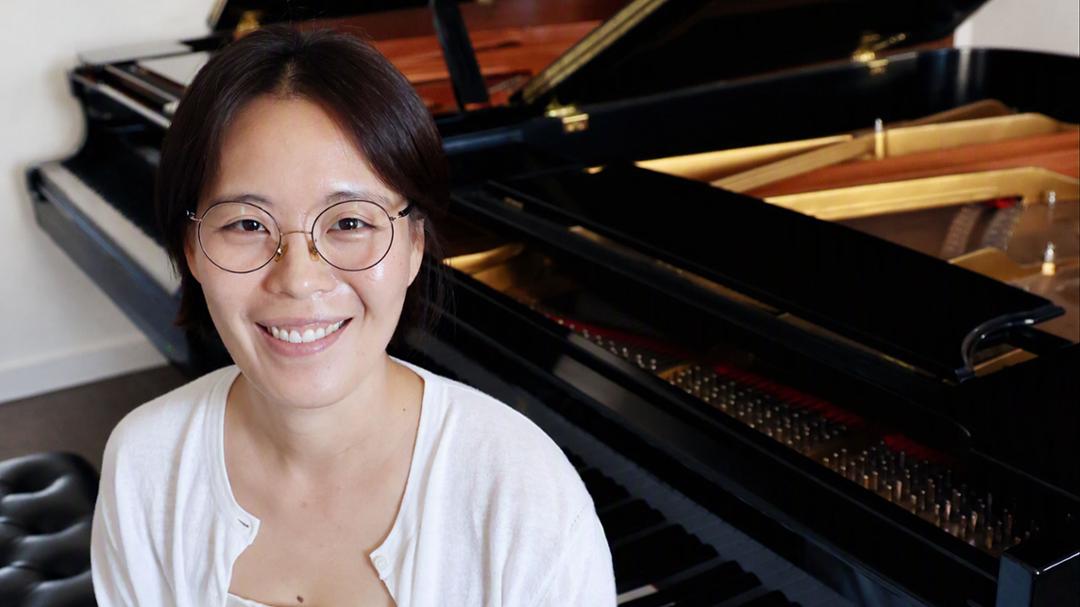

Soyoung Bae is researching how children with autism spectrum disorder best hear and respond to music.
The best research often comes from those affected by the answers.
Soyoung Bae is exploring how children with autism spectrum disorder (ASD) can access music education tailor-made for them.
Her inspiration? Her son, Jihoo.
Soyoung gave birth to Jihoo in Seoul, South Korea, where she studied piano.
Soyoung was raised in Seoul, and her parents quickly introduced her to classical music. It was the only thing that drowned out the cacophony of city noise that agitated her as an infant.
Jihoo also found certain sounds too loud or intense, so Soyoung didn’t think much of it at first. But as he started preschool, Jihoo wasn’t meeting certain developmental milestones.
“I wondered why some things that seemed easy for other children were so difficult for him,” Soyoung recalls.
After a series of tests, Jihoo was diagnosed with mild ASD.
This put a lot into perspective for Soyoung. Although Jihoo didn’t begin speaking until age four, he spent multiple hours focused on a singular task. He enjoyed lining up his toys and arranging colors to match the order of the rainbow. While he thrived in these ways, new environments proved challenging; even a simple family meal at a restaurant was a battle.


“He had so much he wanted to express, and he found his own ways to share through drawing,” Soyoung says.
When Soyoung began her Doctor of Musical Arts at Texas Tech University in 2024, she set off to understand how music could be more accessible to learners with ASD.
“As a music teacher and a mother, I wanted to use my professional skills and personal experience to support other autistic learners and their families,” Soyoung says. “I began wondering, ‘How could music create meaningful opportunities for children to participate, express themselves and connect with others?’”
A Change of Plans
Soyoung had always longed to be a concert pianist. She began playing at 7, enthralled by the sound resonating from the wood and the feel of the keys under her fingertips. As a child, she dreamed of traveling the world to perform.
As she grew, her interest in teaching piqued.
“Some of my experiences with teachers were difficult,” she recalls. “It wasn’t until college that I found teachers who understood me.”
This left her curious about why some students succeed with certain teachers. She investigated technique and teaching philosophy, but ultimately realized the best instructors took the time to build relationships.
At 21, Soyoung shifted her focus from performing to teaching. A few years later, she began her master’s degree at Ewha Womans University in Seoul and became a new mother.
During that time, Soyoung was chosen to perform at a masterclass her university hosted. The visiting artist was Se-Hee Jin, assistant professor of piano at Texas Tech. Jin’s deliberate approach to teaching, paired with practical advice, left an impression on Soyoung.
As graduation approached, Soyoung’s professors encouraged her to pursue doctoral studies, and they strongly recommended Texas Tech. They referred her to Carla Cash, a professor of piano pedagogy, who modeled the kind of piano education Soyoung wanted to provide to her own students.
A move across the world wouldn’t affect Soyoung alone, though. She had Jihoo to think about.
“Based on our experience in South Korea, I felt moving to the U.S. might give Jihoo access to more of the support he needed,” Soyoung said.
Coming to Texas Tech
“Texas Tech has allowed me to connect many parts of my life,” Soyoung says. “As a mother, pianist, teacher and researcher, I’ve never felt limited to just one.”
Jihoo had already been diagnosed before they moved to Lubbock, but Soyoung hadn’t yet realized she could use her experiences as a mom to inform her research.
Soyoung’s scholarly perspective was limited to the traditional teaching methods she’d inherited along the way. But when she discovered she could fuse her experiences as a mother with her expertise as a musician, her dissertation took shape.
With support from the School of Music, part of the J.T. & Margaret Talkington College of Visual & Performing Arts, and along with the Burkhart Center for Autism & Research, Soyoung now offers piano classes for children ages 8-14 who, like Jihoo, have autism. The classes give students a chance to experience an instrument and help them express themselves.
“Research has identified strengths in pitch discrimination in some autistic individuals, and perfect pitch has also been documented,” Soyoung says hopefully. “One of my students has remarkable musical ability. He has memorized his music theory book, and after class, he explains music theory to me.”
But what stays with Soyoung is the look in her student’s eyes when he plays.
“It’s difficult to put into words, but to me, it is simply beautiful,” she says.
This fall, Soyoung is working with a group of autistic learners through activities centered on contemporary piano music. She encourages them to listen and create their own version.
The concept came from Jihoo’s love of drawing. Jihoo doesn’t always have the words to convey an idea, but he is a prolific artist, and what he can’t verbalize often comes out on the page.

This made Soyoung think of contemporary composers such as György Kurtág, who compose their music not through traditional staff and notes, but through graphic scores that incorporate shapes and colors.
“I’ve designed activities around repeating patterns, different sounds, colors and clusters,” Soyoung explains excitedly. “Graphic scores offer multiple entry points into music. Learners can encode sounds visually by representing what they hear through lines, shapes and colors.”

The idea grew out of everyday experiences with Jihoo.
“Including a great deal of trial and error,” Soyoung adds, with the timbre of a laugh that only comes from an exhausted parent.
The biggest lesson Soyoung has learned is that there is no one right way to teach piano. Young musicians are often taught a single technique, which isn’t inherently bad, but it can deflate their imagination before they even begin learning.
This is especially true for autistic learners.
“I always begin with the individual, rather than assume there is one specific method for autistic learners,” she says.
This is clear to other educators around her.
“Soyoung cares about people, and she puts great effort into learning about them with an open mind,” Cash said. “She can observe her students without judgment and make the necessary modifications in the moment to ensure they get the experience they need. She is focused yet flexible, which is a wonderful combination for any teacher, in my opinion.”
Soyoung hopes her research will support music educators and help them feel confident in teaching different kinds of learners. As a mom, she wants Jihoo to have the same opportunities as other kids. As a pianist, Soyoung knows music is inherently inclusive when instructors keep an open mind.
Soyoung encourages local parents of autistic learners to consider enrolling in her study – not only to enrich their child, but because she’ll be the first to say she is inspired when she meets parents who understand her journey.
“I want parents to know that their children’s interests, choices and ways of expressing themselves matter,” Soyoung says. “As Jihoo’s mother, I am still learning too. We’re finding our way together, and I am so grateful for the people at Texas Tech who have supported us.”
