
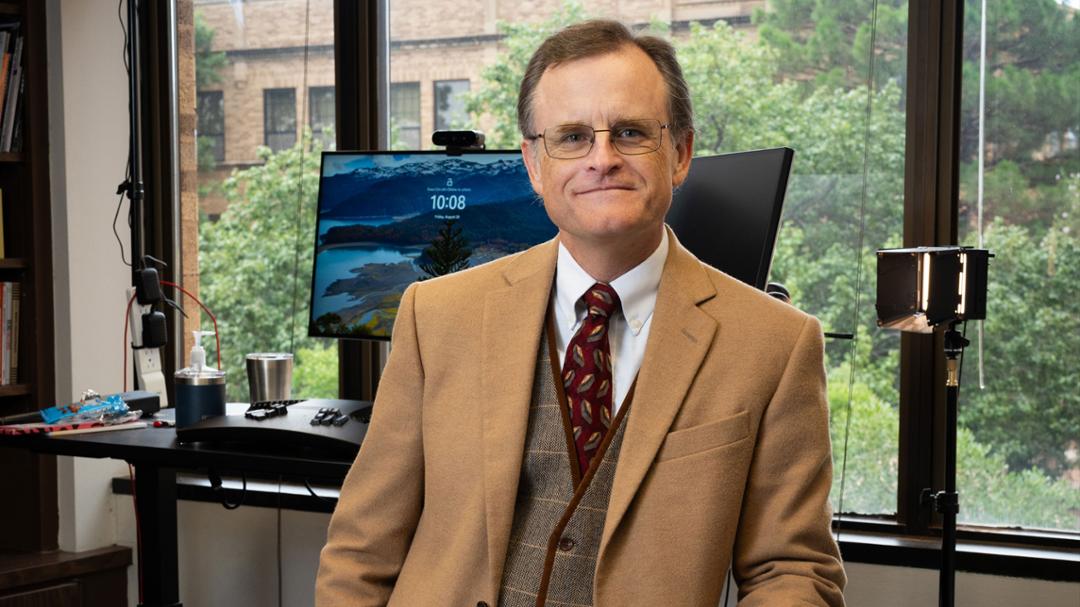

His important work on the motivation for generosity is making a difference in the philanthropic world.
Russell James’ research at Texas Tech University is different in some ways in that it is focused on a real-time application in the lives of working professionals.
In other words, people with boots on the ground, right here, right now.
James is a professor in the College of Health & Human Sciences and the CH Foundation Chair of Personal Financial Planning/Charitable Giving Program Director in the School of Financial Planning. Earlier this year, he was named a University Distinguished Professor, part of a series of new faculty recognitions instituted by Texas Tech.
The award celebrates tenured full professors/librarians/archivists with at least five consecutive years of service to Texas Tech for significant and ongoing accomplishments in teaching, scholarly and creative activities and/or engaged scholarship.
“It is very encouraging professionally that there are opportunities like this for faculty members to be recognized for their sustained effort over a number of years,” he said. “I am excited that Texas Tech created this brand-new award, and certainly glad to be part of it.”
Provost & Senior Vice President Ron Hendrick noted that James has both practical application and broad significance.
“Understanding the science of giving has important implications for the health and vitality of nonprofits and other organizations that depend on philanthropy to fulfill their missions – Texas Tech included,” he said.

James joined the Texas Tech faculty in 2010, bringing a varied background in estate planning, philanthropy and nonprofit organization law. He holds degrees in law and economics with his doctorate in consumer economics. His research interests at Texas Tech focus on charitable giving, charitable estate planning and behavioral and neuro-economics.
“Many of my students are online and are typically advisors and fundraisers,” he said. “I spend a lot of my time focusing on research that will have practical applicability for nonprofits and for financial advisors, and part of that is going out to professional conferences where the working practitioners are, presenting results and getting their feedback as far as what they want to know next.”
James has taken what might be seen as an inverted approach to his research and is zeroed in on the answer to a single question: how can generosity be encouraged in terms of major gifts of assets?
“That’s either major lifetime gifts or estate gifts, and then I am much more methodologically agnostic,” he said. “I do research using my economics background with very large data sets.”
James’ early research included work at the Texas Tech Neuroimaging Institute where people were asked to make charitable decisions or estate-planning decisions while wearing a device that scanned their brain activity and measured the impact of generosity on their brain.
“Research methodologies over the years have involved neuroimaging and the analysis of large data sets,” he said. “That’s a little bit different, and it speaks to the kind of freedom in research that tenure gives you. You can take time to learn these new methodologies and then ultimately produce peer-reviewed research.”
James’ contributions to his field have been acknowledged in a number of ways. He is a member of the National Association of Charitable Gift Planners Hall of Fame and an honorary fellow of the American College of Trust & Estate Council.
He is a longtime member of the Association of Fundraising Professionals Research Council, the Giving USA Advisory Council on Methodology and the Giving USA Advisory Council on Methodology.
“I love going to academic conferences with other researchers and faculty members, but having the freedom to focus on impact within the industry is also rewarding,” he said. “I like to work on projects that can translate for working professionals.”
James was pulled toward his research during law school, where he found the classes he excelled in were related to estates, properties and taxes. After earning his law degree, he went to work as director of planned giving for a Christian college, where he ultimately became the institution’s president.
After six years of balancing his work at the college with his law practice, he decided to pursue a Ph.D. and make the fulltime move to academia. He said Texas Tech and the Lubbock-based CH Foundation worked together to bring him to the South Plains, where he can do challenging and fulfilling work.
“When that job (as college president) ended, my career goal was to not be anyone’s boss,” he said. “I just wanted to teach and do research, and that’s what I have done ever since. I got an offer from Texas Tech that I couldn’t refuse because Texas Tech has the largest financial planning program in the country, and they told me to come and focus on charitable financial planning.
“That was 16 years ago, and it has really been a great niche to be here at the leading school in this field in the country. It has been a great opportunity.”