
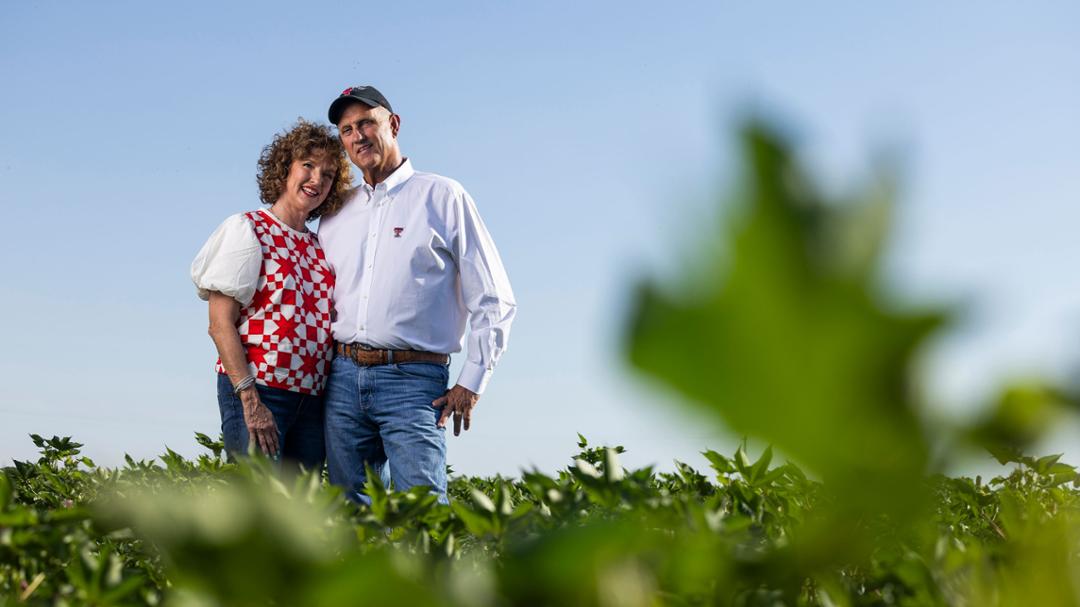

Barry and SuDe Street made the first gift toward Davis College’s new flagship building because they want the students, faculty and alumni who walk through it to see a college that matches the work already happening within it.
A front porch is the first thing you see, and it tells you something about a place before you ever go inside.
Look at the front porch of Barry and SuDe Street, and three things stand out: a life working in agriculture, a passion for Texas Tech University and, more than anything else, the joy that comes with both.
These three things permeate their entire life.
Barry and SuDe have proudly owned and operated Street Gin in Kress, Texas, since 1988. They also farm, rotating cotton and winter wheat, and raise cattle.
“We’re all about agriculture,” Barry said. “The agriculture within a 200-mile radius of Lubbock, Texas — there’s nowhere I say in the world that has that much diversified agriculture.”
Both are 1979 graduates of Texas Tech, Barry in agricultural economics and SuDe in elementary education. In public, the couple is almost always dressed in quintessential Texas Tech scarlet, Barry often with a Double T on one of his many caps or shirts. And when agriculture or Texas Tech comes up in conversation, they are never without matching beaming smiles as they share their love of the industry and their alma mater.

Barry was a first-generation student, but he grew up knowing college was in his future. His parents hadn’t attended themselves, but they made sure their children knew that was the path.
One of five children, Barry was raised on his family’s farm in Kress, developing an appreciation for long hours and hard work. By age 11, he was driving tractors and setting irrigation pipes with his older brother, Trent Street, who was 15 months older and was the first of the five siblings to enroll at Texas Tech.
The brothers knew if they wanted to attend college, their work needed to expand beyond the family operation, so they made a plan.
As preteens, they pooled money they had earned working summer jobs and bought eight young pigs from a neighbor. They raised the pigs, feeding them leftover corn from the fields, watermelons or whatever else they could find.
When the animals were mature enough, the boys sold six of them to the slaughterhouse in Plainview, keeping the two best gilts. They went back to the neighbor, borrowed a boar to breed to the gilts and did it again the next year. Each year’s earnings, along with money from odd jobs they worked when they weren’t in school, went into the bank.
“Everybody knew that money was for a college education,” Barry said. “Any money we made went into that bank account for the intention to go to school, and that’s how we put ourselves through college.”
While Barry was working on the farm, SuDe was in Fort Worth.
“I had never heard of 4-H or FFA,” she said, laughing.
Although SuDe had no direct involvement in agriculture growing up, her family had ties to both the industry and Texas Tech. Her father grew up in Cotton Center and graduated from Texas Tech in 1949 with a degree in petroleum engineering. He brought sheep to raise on campus to help pay for his education.
SuDe originally wanted to be a veterinarian, so when she came to Texas Tech, she enrolled in the Department of Animal & Food Sciences, where her coursework sent her into the meat lab on campus.
She met Barry through Block & Bridle, a student organization in the department. SuDe was a member, and the club had recruited Barry — who worked in the meat lab all four years he was in school — to play football on their intramural team.
They graduated in 1979, married and went home to Kress to farm. But the family’s ties to the university now go far beyond Barry and SuDe. Today, between the five siblings whose parents never attended college, their spouses, their children and their grandchildren, the family proudly holds more than 20 Texas Tech degrees.
They have stayed connected to the university with both their time and their money. Barry joined the Texas Tech Alumni Association National Board of Directors in 2009, served for 10 years and led the board as president in his final year. He has also served on the Texas Tech Foundation Board of Directors.
Through those boards, he and SuDe met a new, wider circle of Red Raiders and saw the breadth of opportunity available at Texas Tech.
“The people we met when I was on the (Alumni Association) board…” Barry started.
“They became our friends,” SuDe continued, “and through those Texas Tech connections, we became more educated about the university.”
“It was then I started to pay more attention to what was going on at the university,” Barry finished the thought. “Then when I got on the Foundation Board, I learned even more. All you can think is, ‘This is just amazing.’”
In addition to their time and leadership, the couple has also given back to Texas Tech financially. They have supported the Davis College of Agricultural Sciences & Natural Resources, Athletics, the College of Education, Presidential Scholarships, the Texas Tech Alumni Association and beyond.
Most recently, they stepped to the front of the line, making the first philanthropic gift for the new Davis College Flagship Building. The building will be a centralized, three-story facility spanning 148,000 square feet on 15th Street.

Philanthropic gifts from ON&ON: The Campaign for Texas Tech University, combined with grant funding, are propelling the project forward. Groundbreaking is anticipated in the 2026-27 academic year.
Grown Beyond the Buildings
As one of Texas Tech’s four founding colleges, Davis College has educated students since the university opened in 1925, and it operates today out of some of the oldest facilities on campus. Enrollment has risen about 3.5% annually since 2014, climbing from roughly 2,800 students in fall 2020 to nearly 3,500 in fall 2026. This mirrors growth across Texas Tech, which set a record this fall with 46,296 students. The college’s buildings have been renovated over the years, but they have not kept pace with the rest of campus — and Davis College has grown beyond them.
The Streets have watched what that costs.
A few years ago, a young man from their community worked summers on their farm while he was in high school. His family had moved to Texas from Nebraska, and Barry tried to recruit him to Texas Tech. The young man came to Lubbock, toured Davis College, then enrolled at an agricultural college in the Midwest instead, closer to where his family was from.
Barry knows the family’s roots influenced the decision. He also keeps hearing how the young man is doing and what his school offers in resources and facilities.
“We don’t want to lose those good students,” SuDe said.
For Barry, the fix has nothing to do with the quality of what happens inside Davis College. It has to do with what students see before they enroll.
“We are the best school even with the facilities that we have,” he said, “but your impression is what you see when you get there. It’s the front porch — what you see first. So, we need to update our front porch.”
The building on 15th Street is, in part, an answer to that. When Davis College leaders set the building’s purpose, they landed on two core values. They wanted it to hold the rich history of agriculture in the Texas High Plains and the longstanding presence Davis College has at Texas Tech. They also wanted it ready for what comes next — a space that gives the next generation of students and researchers the technologies that will serve the industry and keep it sustainable.
“The whole intent was to celebrate and educate,” said Clint Krehbiel, Davis College dean. “We really want this building to be a destination for people who are coming to Lubbock. So, if you’re alumni, a professor, a researcher or certainly if you’re looking for a place to come to school, we want this building to be inviting and to draw people in. As they’re drawn into the new building, we want them to feel agriculture in the Southern High Plains.”
It was important to leadership, faculty and staff that every agricultural industry in the region, as well as every department in the college, was represented in the space. The final schematics and renderings reflect that — whether in classroom and laboratory space or in the murals and designs found in common areas, each aspect of agriculture and its study at Texas Tech appears somewhere in the plans.
The design reaches outside the building as well. A circular outdoor space called the Green Infrastructure Landscape Lab (GILL) will sit beside it, its shape borrowed from the center pivots that mark the West Texas landscape, with the corners around it planted seasonally in native species and crops adapted to this region.
“We want people to get a sense of the value, the importance and mostly the excitement about the future of agriculture,” Krehbiel said.

Room For What’s Next
The building will replace the current Davis College Annex and the former Fisheries & Wildlife Research Building. It will be home to the Student Success Center, state-of-the-art classrooms, research and teaching laboratories, the Raider Red Meats Café, the Dean’s Suite, the Alumni & Development Center, central faculty and staff offices and collaborative and multipurpose spaces.
Dedicated spaces to enhance the student experience, along with updated teaching and research spaces, give the college room for the growth it has already absorbed. Faculty hiring has increased to maintain low student-to-teacher ratios, and faculty already here are running out of room.
Modern, collaborative spaces and equipment will help Davis College continue to recruit top faculty and students and keep its research responsive to the changing needs of agricultural systems.
“It’s really exciting to have the opportunity to think about the past, the now and the future of agriculture and natural resources,” Krehbiel said, “and to develop a structure that’s not just a building, but really a home for the people we serve.”
The transformative power of Texas Tech has always rested in how it cares for its students. A centrally located Student Success Center brings that to the forefront for Davis College. The center will gather undergraduate and graduate recruiting, student programs and resources in one place. A mezzanine common area in the heart of the building and dedicated study spaces on the first and second floors give students room to gather, meet, think, work and stay a while.
Darren Hudson, associate dean for strategic initiatives and assessment, who has helped lead the building’s design, saw what that looks like when the college toured other universities, where students filled every nook of the buildings, laptops open between classes.
“There’s absolutely nowhere for our students to sit,” Hudson said. “They come in the building, they go to class, they leave. This will allow them to stay in our building, collaborate, talk with each other.”

On the first floor, large lecture spaces sit alongside smaller rooms for seminars and discussions, matching the breadth of courses taught in the college. On the second floor, teaching and research labs share the same space so students work where discoveries are being made. The third floor turns almost entirely to research, with graduate offices mixed in. A staffed core analytical lab puts instrumentation in reach of every discipline.
Barry’s case for the building is simpler.
“The best ag school needs to be in Lubbock, Texas,” Barry said. “And I think when this is all said and done, it will be.”
The building will also put food science on display in the Food Science, Safety, and Workforce Development Complex, which a $28.9 million USDA grant will equip to take a product from the lab to the marketplace.
“It will be a collaborative space for industry and our scientists,” Hudson said. “It’s likely to have a pilot dairy in it, so we can produce ice cream to be sold in here, but also enology and other kinds of food technology or food product development.”
Next to it, the Raider Red Meats Café puts students into hands-on work in food prep, food safety and retailing, while giving the west side of campus another place to eat. Grab-and-go coolers, a full kitchen and smokers running in the morning will make it one of the building’s busiest rooms from day one.
Hudson has already pictured the walk to work past it, with Tate Corliss, director of Raider Red Meats, at the smokers.
“In the morning, as I’m walking down 15th Street and Tate’s got the smokers going in there, and that smoke is coming out the top of the building, and I’m smelling brisket cooking — I’m going to stop,” he said.

All of it will sit beside the college’s central functions — the dean’s office, development and marketing and communications — putting those staff members in the same building as the faculty and students they serve.
With the vision cast, plans drawn, donors investing and construction on the horizon, Krehbiel hopes the building becomes a space where students find their passion in the agricultural industry and faculty and researchers make groundbreaking discoveries. He hopes alumni and industry see themselves in the space, as well as the results of the grit and resilience at the core of the college.
These are things he wants to see now and for generations to come.
“We can drive impact in our time,” Krehbiel said. “But it’s really, as our campaign slogan goes, it’s really done on and on. I want anyone who walks in to continually get a sense of how important agriculture is to national and global security, and how valuable it is to be a part of that. If I’m a student and I’m looking for an opportunity where I can serve and have an influence on humanity, I want to be involved in agriculture.”
In The Budget
For Barry and SuDe, this was a future worth investing in — and a front porch worth building. So, they did what they have always done and made a plan around the gin and the farm.
“This gift is not a gift that has been set aside and said, ‘OK, someday we’re going to do something with you,’” Barry said. “This gift is in the budget for the gin operation, the farming operation.”
“We’re not multimillionaires. We’re just hardworking farmers,” SuDe picked up where he left off, “and we don’t have to give it all in one day.”

That is simply how they are giving. Why they are giving is the future Krehbiel described — the same one Barry and SuDe see for Davis College, and the reason they believe others should help build it.
“We all have the responsibility of recruiting for Texas Tech and raising money for Texas Tech,” SuDe said. “There are a lot of people that just don’t understand that they can give back to Texas Tech. They think it has to be the multimillionaires. We definitely need them, but we need the common person too.
“We work with agriculture, and we want agriculture to have a future. We’ve got to keep this up for the next generation, and that’s what we want. We have to educate. We have got to keep our industry strong, and we do that through education.”