
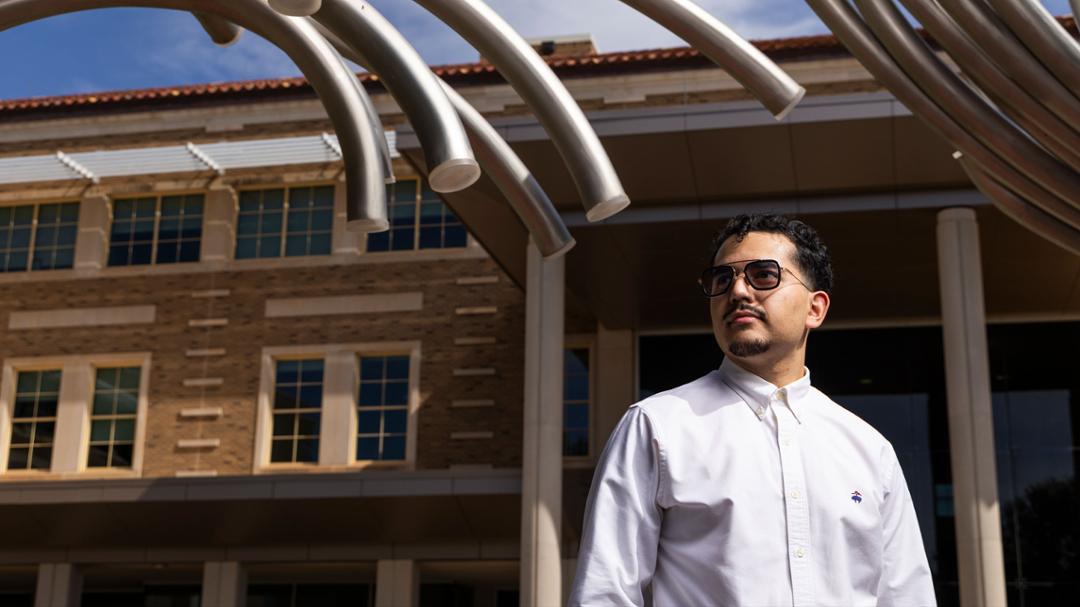

From 4 a.m. starts on his father’s crew to a Manhattan office, Sebastian Gutierrez got where he is by working harder than anyone around him and never waiting for an introduction.
Sebastian Gutierrez was getting ready for the opportunity of a lifetime.
He was in a tiny shoebox of an apartment in New York City. He spread his arms and stood in the center; he could nearly touch each wall, but his only qualification was a “place to sleep close to the office,” so it fit the bill.
He slicked his hair back, since his curls don’t always cooperate, and put on a navy suit and his biggest coat against the East Coast January temperatures. He carried a briefcase his mother had given him, because in the New York she had seen, everyone carried one. On his feet were python boots his father had brought him from his hometown in Mexico.
“They’re my prized dress shoes, because I get asked a lot of questions about them,” he said. “It’s the best representation of where I am from, so it’s like I keep a little piece of me and home wherever I am.”
Sebastian made his way outside and began the 20-minute walk to the first day of his 10-week internship in the Financial Markets and Real Estate (FMRE) group at PwC (PricewaterhouseCoopers), one of the Big Four accounting and auditing firms worldwide.
It was almost an out-of-body experience for the Amarillo native and Texas Tech University student as he traversed the packed city streets with people hustling to work instead of driving through the open West Texas landscape.
“I was extremely nervous on my first day,” he said with a chuckle. “I just started walking, looking around at the huge buildings. I was thinking it was a fever dream because what are the odds of the kid of an immigrant working (at PwC)?”
While Sebastian may have been in a new environment, this was not his first experience in the real estate world. In fact, he grew up working on the construction side.
Laying the Foundation
Nearly all of Sebastian’s family is either from or currently lives around Chihuahua, Mexico, where his father, Martin, worked construction alongside his own father and brothers. He was still a teenager the first time he came north to work, and he kept coming back. Sebastian says the decision to stay came down to a paycheck: his father finished a job, looked at what it paid and thought about the son he already had at home.
“It all started because whenever he was working, he started seeing the path,” Sebastian said. “My father was always a visionary; he had a vision despite not having the education and all that. He had goals and dreams and aspirations, but he quickly realized that if he stayed (in Mexico), he couldn’t guarantee opportunities for us and for us to be well off in a sense.”
Martin was dedicated to building the life he had dreamed of for his family, and this meant hard work and long hours. If Sebastian wanted to spend time with his father, that often meant going to work with him.
As soon as Sebastian could help, he became the third generation of Gutierrezes working on the construction site. It started with summer and spring break work when he was just 11. They would leave the house between 4 and 5 a.m., and depending on the day, they would get home between 6 and 8 p.m.
His first role at the site was working as the chalán — hauling and mixing mud for tape and texture.
“I used to have to stand on a bucket to be able to mix the mud because I couldn't reach,” Sebastian said, “and then I had to put it against my body because the torque of the machine — I couldn’t control it.”

As he got older and stronger, he took on other jobs, working on 3- to 4-foot stilts to apply the tape and texture to homes or box corners.
While the days were long and the work was intense, that is not what Sebastian remembers most from that time. Rather, he remembers the time with his father and the lessons he taught him.
“The things I learned from my dad that I didn’t really realize were important until later have to be the definition of working hard, of having responsibility and doing whatever you need to do to make sure that responsibility is fulfilled,” Sebastian said. “I never heard him complain, despite him working the hours that he did.
“I still remember hearing him whenever he got calls from his builders. He would always start off with ‘Another day in paradise.’ No matter whether it was a good day or a bad day, that just stuck with me.”
However, the lesson both of his parents pressed hardest was that Sebastian would get an education.
Neither Martin nor Sebastian’s mother had been able to finish high school; economic hardship decided that for them. What they could do was insist on something else for their children.
Sebastian’s mother expected excellence from him, and his father put it more plainly, usually on the job site.
“Work with your mind, mijo, not your hands,” he would tell Sebastian, showing him the scars from years of hard labor. “Because look at mine.”
Load-Bearing
Sebastian knew that education would have to come from school, and school did not come easily to him at first.
He lived in two worlds: Spanish and English, the Mexican household filled with culture, tradition and humility, and the American classroom, full of possibility but also challenge.
“As a child, I qualified for Head Start and free and reduced lunch,” he said. “And at home, Spanish was the only language spoken. I didn’t learn English until I was eight. At the same time, I often had to translate legal documents and everyday paperwork for my mother.”
By high school, he was working. He started at an Amarillo Chick-fil-A two months shy of his 15th birthday, then moved on to Home Depot, Lowe’s and finally Best Buy, where he stayed until he left for Lubbock. COVID closed Caprock High School at the end of his sophomore year, but as an essential worker, he kept his work hours. When classes resumed, he had banked enough credits to be out of the building by noon, so he worked Monday through Saturday and kept his Sundays free. The semester after that, he went fully online so he could work more.
Around the same time, Sebastian also had to take on a new role in his father’s construction business.
“By the time I was 15, my father’s fight with his health began to catch up with him,” he said. “I had to learn how to take over payroll systems, because families depended on us. I had to figure out how to do what we did, but better, without a guidebook.”
All of it was a heavy lift for a high school student, but the office work did something the job site hadn’t. Running payroll showed Sebastian how much of his father’s business he had never understood, and that a university was where he could learn it. What he already knew about the labor, plus what he was learning about the money, was enough for him to start flipping houses alongside his father.
Raising the Frame
He went, but not far.
“The main reason I went to community college was I followed in my brother’s footsteps,” Sebastian said. “Number one reason, financially, it made sense. I didn’t want to put the burden on my parents to figure out a way to make the freshman year in dorms prices and all of that. I didn’t want to burden them.”
He arrived at Amarillo College with roughly 40 dual credit hours and finished his associate’s degree in business administration with highest honors.
When it came time to transfer, his brother and sister-in-law, both alumni, pointed him toward Texas Tech and the Jerry S. Rawls College of Business, and in January 2024 he loaded a trailer in Amarillo and drove to Lubbock.
He got to campus knowing no one. His first class met in an auditorium, and he took the first open seat.
Sebastian treated college like a job.
“I was here because I wanted an education. I wanted to change my future family’s life as well,” he said. “So I didn’t go out at all that semester. I didn’t meet anyone. I just put my head down and would study until I couldn’t.”
Some nights, that meant three or four in the morning. He finished the semester with a 4.0 and a spot on the President’s List, and he already knew it would not be enough on its own.
“Even if I had my 4.0, that wouldn’t guarantee my success,” he said.
His brother had mentioned the Real Estate Organization, knowing Sebastian had spent high school flipping houses with their father. At the group’s first social that semester, Sebastian walked up and introduced himself to Jared Harrell, the professor who had built the commercial real estate program.

From here, his opportunities and work ethic converged.
Harrell introduced him to Jackson Heller, and Heller introduced him to Roque Alaniz, a recent graduate working at Woodbine Development in Dallas who had come up much the way Sebastian had. The two got along, and Alaniz put him in front of a broker at the firm.
Sebastian knew he needed an internship. What he didn’t have was leverage.
“I think it got to the point where he said maybe they didn’t have the funds for that summer, and I just told him I’d work for free,” he said. “Like, I will work for free. And he accepted me.”
Sebastian spent the first month of that summer studying abroad in London, flew home, and drove from Amarillo to Dallas the next day with everything he owned in the car. He rented a room in an Airbnb and worked the rest of the summer for nothing.
He returned to Woodbine the next summer, this time paid and on the development side, which was the work he had wanted all along. During those two summers, he had the opportunity to spend time with T. Dupree Scovell, a managing partner at Woodbine and a member of the family who supports the Scovell Business Leadership Program, in which Sebastian was involved.
“For him, the greatest fulfillment is using his time and resources to open doors for people like me,” Sebastian said, “people with a chip on their shoulders only needing an opportunity to show the world who they are.”
By then, Sebastian was vice president of the Real Estate Organization. In the fall of 2025, he became its president, running a group of more than 250 members and 13 officers.
Scaffolding
The introductions from Harrell and the opportunities that followed only mattered because Sebastian was still there to take them, and staying at Texas Tech came down to money. He had been thinking about that since he was a kid.
“That’s my biggest pride and joy, being able to have the opportunity to get those scholarships,” he said. “My whole life has always been, ‘I don’t want to be a burden to my parents. I want to help them instead of not being able to help them, and I never wanted them to have to allocate funds to pay for my schooling.’”
It started with one. He graduated from Caprock High School with a single scholarship and still doesn’t know who gave it to him.
“I don’t even know how I got it,” he said. “If I’m being honest, I think I just got lucky.”
That one, plus financial aid, got him into Amarillo College. The 4.0 there earned him a few more. When he transferred to Texas Tech, a transfer-student award covered his tuition that first semester.
After that, he went looking on his own, spending Sunday afternoons applying to everything he could find online. The grades helped. So did the people he met, who knew which scholarships existed and which he qualified for. Before long, the awards covered more than tuition and reached the day-to-day expenses his parents had been carrying.
What the money bought him, more than anything, was time. He took 17 and 18 credit hours a semester and studied the rest of the time. There were stretches of a couple of months when he didn’t drive home to Amarillo at all.
“If I look back and I remember all I was doing, and then add a full-time job to that, I don’t think I would have been able to keep my good GPA,” he said.
He finished bachelor’s degrees in finance and accounting without any debt. He also earned a certificate in commercial real estate from the Brownlee Center for Real Estate. He is now working on a master’s in accounting, which came with a scholarship he credits to Kirsten Cook and Janet Huston of the Lyons School of Accounting.

“I had the opportunity to be the first one in my family to earn a master’s degree; I had to do it,” he said.
He has thought about how it could have gone differently.
“Without those scholarships, I might have been like, okay, I can’t afford this,” he said. “Maybe I would have said no and not continued on this journey because of the financial aspect.”
Sebastian hopes his actions and accomplishments demonstrate his gratitude to the various scholarship donors who made his dream a reality.
“I’d have to start out with saying thank you, and really showing them not just with my words, but showing them the product of their donation,” he said. “That the scholarships went to a good cause. That I didn’t take it for granted. That I did what I had to do, essentially, and really show them so they can know that it was worth it.”
He wants the same for his parents.
“I want my parents to see that it was worth it to come to America.”

Finish Work
The master’s scholarship Cook and Huston helped him earn came through in January 2025, and with it, a decision. Through the program, he could choose an additional class or an internship, and Sebastian chose the internship.
Unfortunately, he missed Meet the Firms by a full semester — an event where Rawls College students connect with accounting firms for internship opportunities.
So he turned to the resource every college student knows best: Google.
“I just searched up ‘real estate big four,’” he said, “and I applied to everything I could find that involved the name real estate.”
He spent an entire evening submitting applications. The next morning, while he was in class, his phone rang.
The recruiter on the other end ran hiring for PwC’s Financial Markets and Real Estate group, a practice so specialized that Sebastian had spent months on LinkedIn trying to work out what it even did. The job he had applied for wasn’t the right fit, she told him, but another one was. Within the week, she had arranged an interview with a partner.
The partner, Eliza Kwong, was born to Chinese immigrants, studied finance and accounting and started working young. Their 30-minute interview ran to an hour as they discussed the similarities in their stories.
Partway through, she told him she thought he belonged in New York City.
“She said, ‘Sebastian, you need to come up here. I think you can make it up here,’” he remembered.
Despite Kwong’s vote of confidence, Sebastian was still hesitant to move across the country. He had always said he wouldn’t leave Texas because he wanted to be near his parents. He called his brother first.
“It was my brother’s dream to work in New York. It didn’t happen for him. As soon as I told him, he said, ‘I’m going to slap you if you don’t say yes,’” Sebastian said through a laugh.
Then he called his parents, who told him to go.
“Despite them wanting us to be close,” he said, “they came here to give us those opportunities.”
He said yes before noon and had the offer the same day.

The internship was scheduled for 10 weeks. PwC put him on commercial real estate debt valuations, work that comes down to deciding whether a loan is priced correctly against the building behind it. He was the only person on the associate level with a deep real estate background, so most of the valuations came to him on buildings across several continents. Before long, he was training associates on how to do them.
Ten weeks became five months. He was the only intern in his group to be extended, and it took two directors arguing his case to make it happen.
There were nights he was still at the office at 10. He thought about his father getting up to work at 4 or 5 a.m. for 45 years and doing it without complaint.
“I don’t have anything to complain about,” Sebastian said. “I’m in an office with AC. One of my mother’s quotes is, ‘When you pray for rain, you have to deal with the mud.’ And in that instance, I think the mud is a privilege, because a lot of people pray for rain and they don’t get it.”
The full-time offer came near the end of the five months, over a team dinner at a steakhouse. The two directors wanted to tell him in person.
He called home. His father had been a man of few words for most of Sebastian’s life but had grown more emotional since retiring.
“He told me he was really proud of me and that he knew I could do it,” Sebastian said, his own voice catching.
The Punch List
Sebastian did not treat the offer as an ending. Since high school, he has marked every milestone online with the same two lines: this is only the beginning, and the job’s not finished. He used them when he graduated from Amarillo College and again when he earned his bachelor’s degrees, and he plans to use them when he finishes his master’s degree.
When he announced this job on LinkedIn, he added that it was nothing a Red Raider from the Panhandle couldn’t handle, a grit he credits to West Texas and to his father in equal measure.
“My goal in my life is not just to make money. It’s not economic growth,” he said. “I think even more now it’s to help people.”
He explains it with two names.
“My father’s name is Martin. There are tons of Martins across the U.S., just like there are tons of Sebastians across the U.S.,” he said. “Some Sebastians get lucky, some don’t. I got extremely lucky, and it was a mixture of obviously hard work, but luck also played into my circumstances.
“I wish there were more Sebastians with my experience, that they have the brains and the will to study, but most of the time, especially in my community, we don’t have the funds. That’s the drawback.”
At the Distinguished Alumni & Awards Dinner for Rawls College, where he was the student speaker, Sebastian made the same argument from the podium.
“That is what makes Texas Tech so special,” he told the room. “This college doesn’t just educate students; it transforms families. It turns sacrifice into opportunity.”


That night he also met a Texas Tech graduate working in New York, who took him to dinner twice during the internship. The man had started a scholarship as soon as he graduated and had kept it going ever since.
“I really want to start a scholarship fund when I graduate,” Sebastian said. “That’s my goal. And even if it’s little, I just want to start with something.”
He wants to help students from the same background. Those who look like him. Those who never considered a “white-collar” job. Those who know construction because they and their families worked in it.
“If they saw me with my background being able to work in New York at these prestigious firms, then those kids are motivated,” he said. “They see that it’s possible. They see that his destiny isn’t just what’s around them. I grew up in El Barrio, I went to Head Start, I didn’t learn English till I was eight or nine years old. And if I can make it there, you can too.”
A mentor gave him a line a while back that he’s repeated ever since.
“Every father’s ceiling must become their child’s floor,” Sebastian said. “My father walked, so that I could jog, and I will jog, so the next generation can sprint.”
If you are interested in supporting scholarships for students like Sebastian, visit give.ttu.edu.