
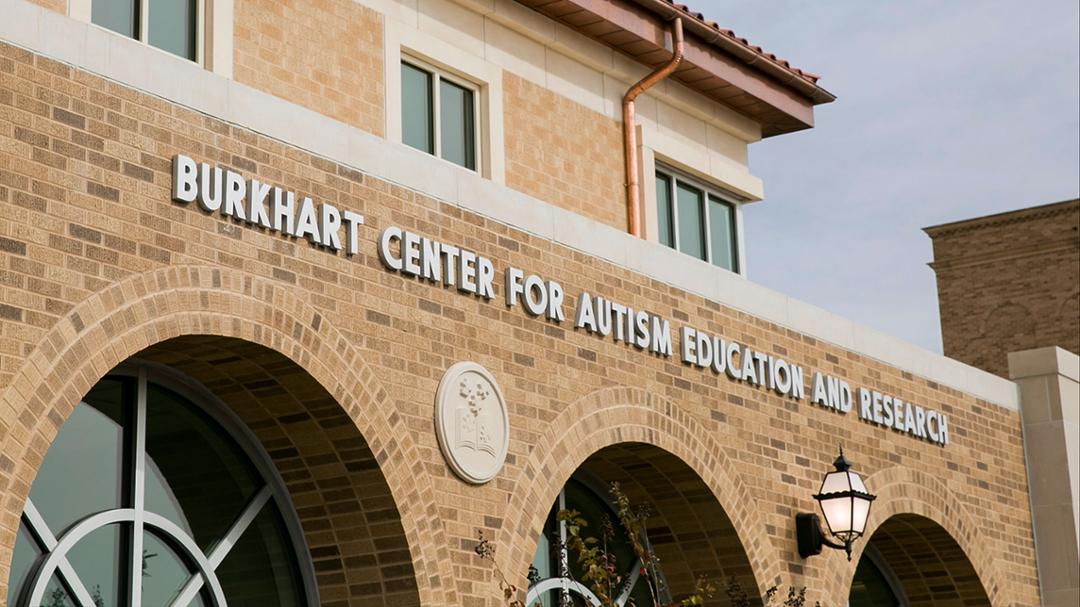

Funds awarded by Texas Higher Education Coordinating Board will help the center continue its parent outreach and education efforts.
Texas Tech University’s Burkhart Center for Autism Education & Research has received a $475,000 grant that will support its educational outreach efforts of partnering with parents to help their children be successful.
The funds, awarded by the Texas Higher Education Coordinating Board (THECB), were part of the $7.4 million Autism Grant Program disbursement approved by the Texas Legislature during its 2025 session. Texas Tech was one of six institutions to be awarded funds to support its parent-directed treatment program.
For the Burkhart Center, this grant will underwrite parent training initiatives with efforts focused on working to determine goals for children and collaboratively establish plans for achieving them.
“One thing we know about individuals with autism is that sometimes generalization of skills can be difficult,” said Jennifer Hamrick, the Jere Lynn Burkhart Regents Professor & Director of the Burkhart Center and an associate professor in the College of Education. “They might be able to learn a skill in one setting, but then generalizing it to another setting or another person can sometimes be difficult.”

The funds will allow center personnel to work with parents to fully understand the child’s individualized education program (IEP) and establish goals to work toward in the home and then possibly transferring those learned skills to other settings, such as school.
“It’s collaborative in determining what the goals look like or what they should be working on,” Hamrick said. “During that process, a parent could suggest their child might already know a skill or maybe it shouldn’t be the focus. We then discuss potential changes we can make to the goals to make them more appropriate for the child to work on.”
In many cases, the approach focuses on communication because individuals with autism can often find that to be a challenge, depending where they fall on the spectrum.
“You might have an individual with autism who has low or no speaking skills, and then you might have someone who just struggles with more of the social component and social skills as far as not being able to pick up on emotions,” she said. “In many situations, we have had families reach out to us for parent training, and we have worked with them to teach them how to help their child advocate for their needs and what they are wanting in the home setting.”
This grant, effective May 1, is one the center has successfully applied for in previous years under Hamrick’s leadership. As a result, thousands of parents have been impacted through the outreach and education efforts that span a variety of approaches to provide the broadest access possible.
She said the center works with education service centers as well as some of the larger school districts throughout West Texas to offer group trainings, which have been immensely popular. Likewise, they have the ability to offer specific sessions via telehealth, and people who live in Lubbock and the surrounding area can come in person to the center for training.
“If we’re talking about IEP goals, we will discuss what you should be looking for in those,” she said. “If we’re working on communication, we look at what some of the basics are for that. We can serve anyone in the state, and we have the technology, training and capability to provide telehealth. We have worked with families as far away as Houston and Texarkana.”
This year’s grant process was more competitive than ever, Hamrick said, meaning the Burkhart Center’s track record of significant and widespread impact continues to be recognized.
“I think it was huge that we were awarded this grant again,” she said. “This round was open to more universities and programs than in previous years, and I feel very fortunate that we were able to continue to get this funding to help families and to emerge as one of the grant recipients.”
The THECB award wasn’t the only funding the Burkhart Center recently received. It also landed a $1.25 million grant from the Office of Special Education Programs, a federal grant that will help a group of 10 special education teachers earn their graduate degree beginning in June. A second group will enter the program next year.
The grant will offset costs associated with required educational field work and underwrite training for them to become more adept at using artificial intelligence (AI) to reduce some of the everyday on-the-job demands.
“I was a classroom teacher for 18 years, and being a special educator, you have a ton of paperwork,” she said. “Many times, that pulls you away from why you got in the field in the first place, which is teaching.”
The hope, she said, is to embed AI technologies into the training so teachers become more proficient with necessary paperwork.
“We want them to consider AI like another peer as far as gathering resources and coming up with information to help program plan where they can use their time more efficiently,” she said.

While both grants are important as far as the center’s mission, the good news comes in the aftermath of the passing of one of its namesakes, Jere Lynn Burkhart, who was a dedicated autism advocate.
Hamrick said these grants are each in areas Burkhart felt strongly about.
“She was aware of the teacher training grant as I had shared that information with her,” she said. “We found out about the parent training grant on the day of her funeral, which was bittersweet, but these are two areas she was passionate about, and we’re trying to make sure we’re providing services and resources. None of that would be happening if it weren’t for her.”