
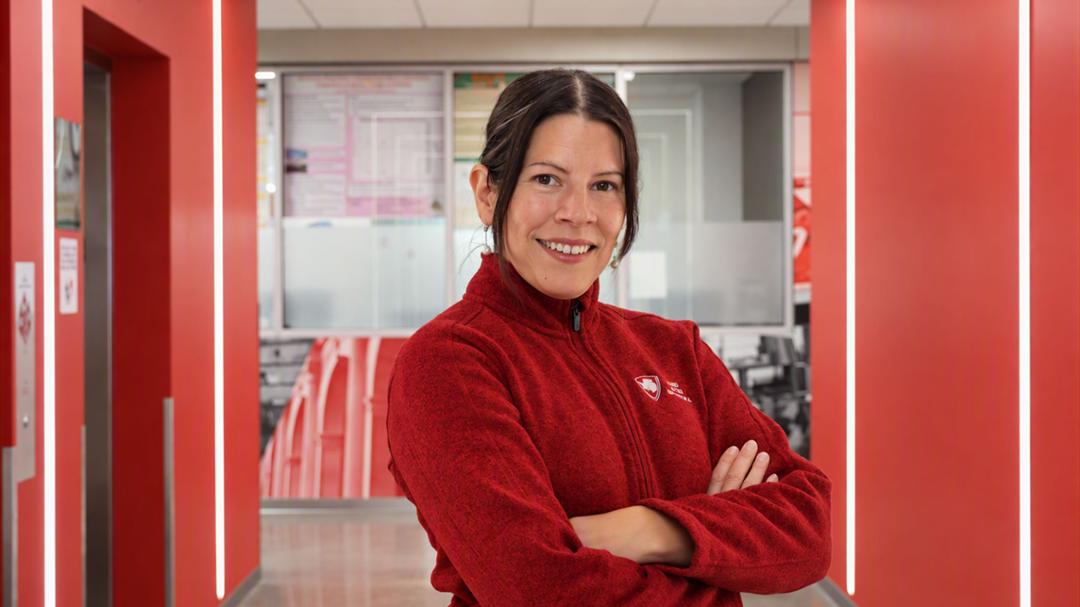

Natasja van Gestel on warming and plant and microbial growth in Antarctica.
Welcome to Rise & Research where cutting-edge discoveries are made as accessible as your morning coffee. This monthly feature offers a closer look at the transformative research happening on our campus. Pull up a chair as we talk with faculty who are pushing boundaries while creating opportunities for the next generation.
In this installment, Jayden Smith sits down with Natasja van Gestel to discuss her research into quantitative ecology and soil microbial processes.
What’s it like to have penguins in your backyard? Texas Tech University researcher Natasja van Gestel is one of few people on the planet who knows the answer.
She’s become increasingly acquainted with both the Adélie and Gentoo species over the past 15 years during her stays at Palmer Station in Antarctica, a U.S. research hub where she conducts trailblazing work exploring the continent’s land instead of the surrounding marine life.

One chance encounter occurred when she went for a hike through what Palmer Station denizens call the “backyard,” the continuously growing space behind the facility where more soil is exposed due to glacier retreat.
“I was sitting on those rocks, seeing a few penguins swimming in the water when one of them looked up at me, and then it actually came out of the water and sat next to me,” van Gestel recalled. “I didn't have a camera with me. I was just in the moment as it sat next to me, and it was wonderful.”


On Nov. 1, van Gestel left for the final six-month winter stint of a six-year project researching how warming affects plant and microbial growth on both Palmer and nearby Litchfield Island.
The associate professor of biological sciences and co-director of the Climate Center specializes in quantitative ecology and soil microbial processes. She conducts investigations in numerous, disparate environments to analyze which terrestrial ecosystems and microbial communities react positively to warming and how these changes affect the carbon cycle.

But before her trip began, I met with her to discuss her work, which involves using open-top chambers to superimpose heat on areas with little to significant vegetation and comparing plant and microbial life within experimentally warmed and control plots.
What is quantitative ecology?
Quantitative ecology is basically using more novel quantitative methods to address hypotheses about ecosystems or about aspects of an ecosystem. This could include a machine learning approach, structural equation modeling or other fancy analyses. Because ecology and how ecosystems function is complex, you cannot solely rely on traditional statistical methods, but you must think beyond that. So, quantitative ecology is a subdiscipline within ecology.
How does using various statistical methods help your research?
In the field, there are so many confounding variables, so in order to be able to tease apart the signal from all the noise that's out there, you need to use statistics.
Why are soil and moss microbiomes so important to the larger ecosystem?
When oxygen was first formed through photosynthesis by ancient microscopic life, by cyanobacteria in the ocean, a lot of that oxygen reacted to elements and minerals in rocks worldwide. Over time, the rate of oxygen production by microscopic life outpaced the rate of sequestration and reaction with rocks. This led to oxygen eventually accumulating in the atmosphere.


Photosynthesis back then was before we had trees, shrubs, mosses or plants. So, those tiny photosynthesizing cyanobacteria were and are important even though they are tiny, because there are so much of them, and so at the global scale they have a pretty big impact.
Soil has a vast array of microbes, and they are crucial for ecosystems to function. For instance, without microbes, plants would not be able to have the nutrients that are locked in organic materials. Without plants, herbivores would starve, followed by starvation of the predators – it would lead to ecosystem collapse.
In Antarctica, mosses are the dominant plant type. They are well-suited to the extreme climate of Antarctica, and can even desiccate or freeze solid entirely, but come back to life once conditions improve. Mosses can facilitate establishment of flowering plants, such as Antarctic hairgrass, and so mosses form one of the cornerstones of the Antarctic ecosystem..
How does your research with the open-top chambers work on experimental plots?
I place a small flux chamber on top of a stainless steel band in the middle of each plot, with a gasket that provides a very nice, tight seal. I then monitor what happens to the CO2 inside the airspace of the flux chamber. If CO2 levels decrease over the 60-second measurement, this means that plant photosynthesis is outpacing respiration. Plant photosynthesis scrubs CO2 from the air, whereas respiration releases it. First, we take the measurement in the light when both fluxes happen, and then we cover the flux chamber with dark cloth to get just the respiration part because there's no more photosynthesis happening. Once we cover it, we will always see the CO2 rise within the chamber because of respiration being the only flux. It’s really cool.

By taking measurements of these two opposing fluxes (photosynthesis and respiration) in both warmed and unwarmed plots, we can get a sense as to how much carbon is actually going into the system and how warming might alter the balance between the two fluxes. My main research question deals with whether ecosystems in Antarctica will become a larger carbon sink – in which more carbon is absorbed from the atmosphere than released – in a warmer world or if plants get more stressed and thus lead to lower carbon uptake.
What have you learned over the course of your project? What’s next for your research?
What we have seen so far is that, as expected, carbon uptake is getting stronger as you get further and further away from the glacier because we have more and more plants growing. But initially, I had hypothesized that warming is going to help mosses grow better, especially the ones on Litchfield Island, which has veritable peat banks comprised of two dominant moss species. I had hypothesized that the mosses on that island would benefit from warmer temperatures. However, my hypothesis was not met.
Apparently, warming is actually reducing how much carbon they're taking up relative to how much they're respiring, and I am not quite sure yet why that is. Could warming lead to drier conditions and hence affect mosses negatively? We looked at soil moisture, but it’s relatively similar between the warmed and control plots. Perhaps it has to do with changes in the relative humidity of the air. Perhaps warmer air within our warmed plots is dropping the relative humidity, and the mosses are sensitive to that. We will monitor the microclimate closer this upcoming field season.
How is researching Antarctica different than other places?
The Antarctic ecosystem is way more tractable compared to other terrestrial ecosystems elsewhere, because we don't have so many confounding variables as in other places and we are dealing with way fewer species. We don't have earthworms. We don't have anything really big that is burrowing around in the soil, so respiration is mostly going to come from the microbes and the plants. It's way easier for me to work in this ecosystem because it is quite species-poor, so carbon uptake and release can be attributed to the individual plants and microbial groups. The simplified ecosystem also makes it possible to scale up from individual microbial groups and plant species to the ecosystem scale.


What’s it like for graduate students who participate in these visits with you?
All of them want to go back. It never gets old. They all have loved the whole experience. Also, I have close interactions with them, helping them with critical thinking skills, whether it's experimental design or thinking about hypotheses. On the other hand, they have skills and knowledge that I myself can learn from! There's more one-on-one interactions compared to being on campus where they'll have their office elsewhere. The closer interactions, along with the pristineness of remote Antarctica, certainly provides for a powerful experience.
How do you see your work at the Climate Center at Texas Tech spreading awareness within the Lubbock community?
What I really appreciate about the Climate Center is not just trying to bring the researchers together, but also the outreach. I'm a big proponent of outreach. That’s why we have have events, such as Science By The Glass, where the Climate Center has invited speakers who give talks to the public in a family-friendly setting where people can learn about the science being conducted. Outreach is really important to me, so I've presented a few times, as well. I like to broadcast the results of my research, which is why I have an Instagram and my regular blog as well. To me, the Climate Center truly is this fusion of science and outreach, and that is what really makes it strong.

About Natasja van Gestel
Degrees: B.S. Van Hall Larenstein University of Applied Sciences, 1996; M.S. Wageningen University & Research, 1998; Ph.D., Texas Tech University, 2012.