
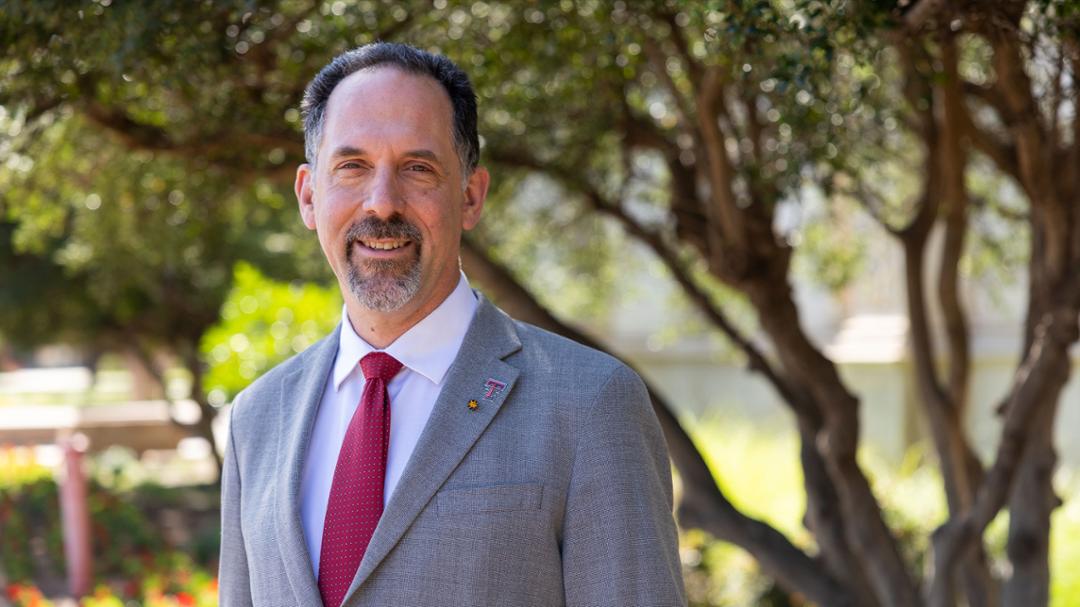

The new vice president for Research & Innovation sees impressive breadth of work already taking place.
Since arriving on the Texas Tech University campus almost two months ago, there has been no wasted motion, no wasted time, and most importantly, no wasted opportunity for James Reecy.
The new vice president for Research & Innovation has been caught in a whirlwind of activity, but that hasn’t dimmed his vision or dampened his passion for how he expects Texas Tech’s already impressive research enterprise to expand in scope, size, impact and prestige.
By his way of thinking, the time couldn’t be better to further raise Texas Tech’s research profile.
“As I have transitioned into this position, I have taken an assess, align and accelerate approach,” said Reecy, who began his duties July 1. “Right now, having been here about 60 days, I am just trying to learn as much as possible about all of the wonderful things that are going on.”
Those first 60 days? A blur, to be sure, but memorable for all the right reasons, nonetheless.
“It’s been awesome,” he says. “I’ve been introduced to so many people, and it’s been an absolute joy. Yes, the day starts early and ends late, but everything in between has been enjoyable.”

Reecy comes to Texas Tech after almost three decades at Iowa State University, where he served in a variety of roles, culminating in being named associate vice president for research while also a professor in the Department of Animal Science.
He earned his undergraduate degree in animal science from South Dakota State University and holds a master’s from the University of Missouri and a doctorate from Purdue University in the same field. He is an internationally recognized expert in beef cattle genetics, molecular biology and livestock bioinformatics.
In other words, he is the right person with the right set of qualifications to provide oversight and direction of Texas Tech’s expansive research enterprise.
“Dr. Reecy understands research from the perspective of a faculty member and as an administrator responsible for creating an environment in which researchers can succeed,” President Lawrence Schovanec said. “Our research enterprise has grown significantly, and we are in a period of tremendous opportunity. Dr. Reecy has the experience, perspective and leadership to build on that momentum and take Texas Tech’s research enterprise to the next level.”
Similarly, Reecy sees this new role as the logical progression in his career trajectory, giving him the opportunity to collaborate with researchers while supporting them with more of the tools they need to be successful.
“Years ago, when I was a researcher, one of the concerns I had was, ‘Who is in a position like this helping me do the things I want to do,’” he said. “I didn’t see other people wanting to take that on, but I thought, ‘You know what? I can solve that and help other people do that.’”
Reecy believes faculty members can always use more time, and what he expects to do is create processes that will help free them up to focus more on their research and the problems they are trying to solve.
As he continues to settle in, Reecy has been impressed by more than a few things while familiarizing himself with the campus: the people and the sheer breadth of the university’s research.
“It’s different than some aspects of research in which I have had experience in the past,” he said. “And that, to me, is great because I love to learn new things. The other thing that has impressed me is just how open people are in terms of wanting to collaborate and talk about the great things they are doing to have, ultimately, a greater impact.
“Whether you are talking about researchers trying to change sorghum to improve crop production for the future or developing semiconductors to handle the computational needs of the future, that breadth of expertise has greatly impressed me.”
Wherever he looks across campus, Reecy sees incredible work taking place such as in the Department of Kinesiology and Sport Management’s research into exercise capabilities and in the College of Media & Communication, where they are examining the psychology of communication.
Reecy explained that he learned a lot about Texas Tech’s expansive research portfolio prior to taking the job as he was doing his own due diligence and getting acquainted with the expectations of the position and its possibilities. However, that knowledge has been dwarfed by what he learned since his first weeks in Lubbock.
“I have been taking all of that in and identifying the highest priority areas,” he said. “Once we know that, we can start conversations to remove barriers and to make it easier for people to achieve the work they’re trying to do. We want to find out what are the things holding them back?”
Uncovering and eliminating obstacles will help Texas Tech create and refine processes. He sees this as a way to serve faculty and encourage them to access Research & Innovation with ideas that emphasize collaboration.
In the immediate future, he plans to hold listening sessions with faculty researchers and other campus stakeholders to envision and craft the next chapter of the university’s research enterprise together.
He has also been busy off campus, working to build or expand strategic alliances that can help spotlight research and move findings toward practical application.
“Where can we invite people in to work with us here on campus and open conversations with them?” he asked. “Doing that gives us an opportunity to get to a better place. I could see a discovery and think it has this particular application, but a community partner sees a different, more valuable application.”
Over much of the next three to five years, Reecy wants to see a direct link between on-campus research and a better-trained Texas workforce.
“We take research findings one day from the lab and are a week later providing that to students so they have the latest and greatest information that they can apply later on in their careers as they go forward,” he said. “And that same information is also resulting in new patents and licenses or potentially even new startup companies that our faculty and students are spinning out of this institution, further enhancing Texas Tech as a major economic driver.”
Reecy wants to be proactive in telling the campus community about what’s taking place here. He worries they may not know about this incredible activity and wants to figure out ways to connect them to it.
“I would love to see a day where every undergraduate has a research experience while here at Texas Tech,” he said. “That would help them understand what the future possibilities would be as well as show them how the research we’re doing will translate to and impact society.”
Specifically, Reecy is excited about the possibilities for the university’s growing research efforts in the national security space.
“We have our own campus working in that area right now,” he said, referring to the Reese National Security Complex (RNSC). “Vice President for National Security Stephen Bayne has expanded its footprint significantly in recent years. I look forward to collaborating with his team to strengthen partnerships and find solutions to the many challenges facing our nation when it comes to national security. We have unique resources there at Reese. And we are already working with partners very effectively in that space.”
Although he has only been in West Texas a short while, Reecy has firmly grabbed hold of Texas Tech’s motto, seeing “From Here, It’s Possible™” as a promise with a direct connection to scholarly research.
“I want to establish an ecosystem here at Texas Tech that allows people to go, ‘Yes, it is possible from here. I can do whatever it is that I want to do to help solve a new problem by discovering new information and translating that into a product that will benefit society.
“And if I can do that, removing barriers and unleashing the creative expertise and innovation on this campus, I will have succeeded in my own career in terms of going forward.”