
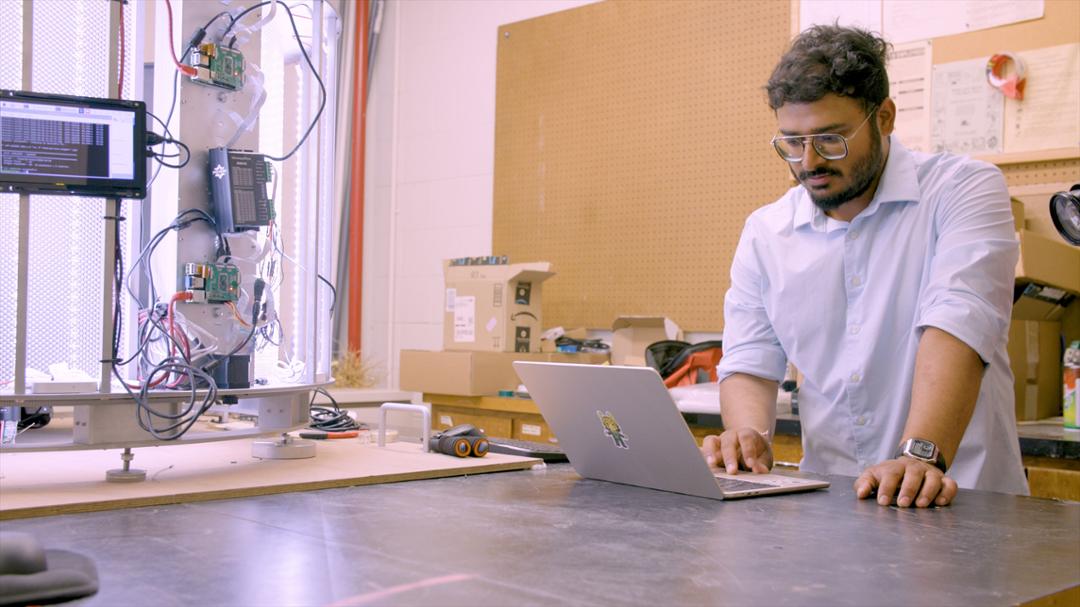

These Davis College graduate students study a variety of sorghum concerns, including chilling tolerance, digestive impact on cattle and stalk strength.
As Texas Tech University prepares to host the Global Sorghum Conference later this month, it continues to position itself as a leader in sorghum research.
A big part of this effort has been the work of the next generation of sorghum researchers: graduate students.
Three such students can be found in the Davis College of Agricultural Sciences & Natural Resources: Nicholas McNab, a first-year master’s student in the Department of Plant & Soil Science; Ahmari D. Henry, a second-year master’s student in the Department of Animal & Food Sciences; and Mayank Bangari, a doctoral student in Plant & Soil Science.
Their work runs the gamut of topics from forage sorghum’s chilling tolerance to grain sorghum’s digestive impact on cattle or factors that determine its stalk strength.
And while they have all arrived at sorghum research through different means, one thing is clear: the future of sorghum research is in capable and eager hands.
Chilling Factor
McNab may be starting the second semester of his master’s program, but he’s been a part of sorghum research at Texas Tech since completing a professional internship under the guidance of Impa Somayanda, associate professor of agricultural water management, and Krishna Jagadish, Thornton Distinguished Chair of Plant & Soil Science, and.
During the internship, McNab says he spent long days in the sun collecting sorghum samples and data. While others could have found the work tiring, McNab was invigorated.
“I liked it because my undergrad was in environmental and development engineering,” he said about his bachelor’s degree from Zamorano University in Honduras. “My previous research was oriented to remote analysis and sensing, and now it’s more in-field stuff. A lot of things I didn’t get to see during my undergrad I’m now able to revisit with my current agronomy-oriented research.”

After completing the internship, he was encouraged to continue his work with the research team as a master’s student in the Texas Coalition for Sustainable Integrated Systems Research Program (TeCSIS), supported by a Texas Tech strategic initiative award with funding from the State of Texas TUF.
McNab’s research interests are centered on forage crops including sorghum. He is interested in incorporating more sustainable practices into his research.
“Back home, a majority of the population lives below the international poverty line, and it’s hard to see people suffering every day, trying to get food on their tables,” he said. “Being part of this research, which can eventually translate into producers who can make more sustainable choices, is important. It’s not only about what we’re growing, but where we’re growing.”
McNab is conducting a chilling tolerance trial to see how early in the year sorghum can be planted. This, he believes, could let producers take advantage of the extra moisture in the soil following winter.
Traditionally, in West Texas, sorghum is planted in May and June. For the study, McNab has three planting dates: April 1, April 15 and May 1. Corn was used as a control crop to compare against sorghum.
While the trial is still in its early stages, McNab said forage sorghum appears to be outperforming corn.
McNab has worked with sorghum for just over a year, yet he can’t help but find himself awed by the ancient crop. Walking the fields, he takes a beat to mentally transport himself to the crop’s origins, which can be traced back to 8000 B.C.
“Sorghum is sort of symbolic of how ancient things can still work today,” he said. “But if you want to be a part of the bridge to the future, it’s important to transition traditional crops to more resilient ones. Being able to see how plants like sorghum develop in extreme conditions is a big factor.”
Feeding Time
Henry transferred to Texas Tech as an undergraduate in 2022, hoping to fulfill her childhood dream of becoming a veterinarian. She wasted no time finding research opportunities.
Henry participated in the National Bio & Agro-Defense Facility Laboratorian Training Program, which provides mentorship opportunities and practical experience to students interested in animal research. Henry was matched with Jhones Sarturi, associate professor of Animal & Food Sciences, and began researching beef cattle metabolism.
It didn’t take long for Henry to fall in love with nutrition research. She received a 2025 Undergraduate Research Grant from Davis College and was named Davis College’s Outstanding Undergraduate Researcher for 2024-25. She then started her master’s program, continuing to work in Sarturi’s lab.
“Nutrition is a very important component of animal health,” she said. “If you can understand how, when and what to feed, as well as how the animals metabolize it throughout their bodies, you can kind of prevent some ailments that animals experience caused by improper feeding techniques.”

Henry is examining the digestibility performance of cattle who are fed sorghum as an alternative to more commonly used feed grains like corn.
Henry says two challenging aspects of sorghum are that it naturally produces prussic acid and can be difficult to digest.
For this study, Henry is looking at four different sorghum hybrids, specifically prussic acid-free (PAF) sorghum. She has given PAF sorghum to cattle and will then analyze a variety of aspects including pH value, intake amount and particle size.
Henry distills her excitement around grain sorghum as a feed alternative to two main points.
The first is for crop producers. Sorghum, she says, has similar growth capabilities as other feed grain crops but does so with limited amounts of water. She believes this is a significant benefit for famers in a semi-arid region like Lubbock or the Panhandle where rainfall has decreased and temperatures rise.
The second point comes down to Texas animal producers being less reliant on crops grown outside the state. Though Texas produces a large amount of corn for feed, leaning into a drought-resilient crop like sorghum could help the state be more self-sufficient, especially when corn yields are lower than expected. In 2025, Texas was the second largest sorghum producer in the U.S.
“If we’re able to grow more sorghum here and it can be used in feed, this could be more affordable for our farmers,” Henry said.
Going forward, Henry hopes to combine her childhood goal of becoming a veterinarian with her developing passion for nutritional research. She wants to be a mixed-practice veterinarian that specializes in and researches animal nutrition, a combination she believes became possible because of her time at Texas Tech.
“Texas Tech is very interested in getting students involved,” she said. “I believe when you come here, you are set up to succeed wherever you plan to go.”
Lodging Accommodations
In his final year of the doctoral program supported by the United Sorghum Checkoff Program under the guidance of Jagadish, Bangari can’t help but feel a little nostalgic as he talks about his love of microscopy.
“My father used to show me microscopic slides of mustard flowers because they were easy to cut,” he remembered. “He was a pharmacist in a government hospital, so during holidays or time off from school I used to go there. It was just a simple light microscope, but my interest in botany starts from there.”
In some ways, Bangari is now repaying his dad’s favor, sending microscopic images of stomata or leaves at much higher magnifications.
“He seems happy, looking at those images,” Bangari said, a smile sweeping across his face. “Although he’s technically in human biology and has no real point of reference, he really wanted to know more about plants. It made me feel like he was happy and proud.”
Bangari is researching lodging in grain sorghum and is part of the TeCSIS team. Lodging occurs when a plant falls or flattens toward the ground either at the roots or the stalk.
This is a prominent concern for grain sorghum because the grain cannot be salvaged even if picked up. Bangari says this could cause yield losses of 20% to 80%.

Bangari is trying to identify key components of what makes a sorghum stalk strong and says there wasn’t a genetic marker for stalk strength until recently.
One challenging aspect of this research is assessing a lodging score for grain sorghum. Typically, Bangari would have to go out to the field and see if sorghum has lodged or not and then track that data.
To expedite the process a bit, he brings plants back to the lab and uses an electromagnetic tool called the Device for Assessing the Resistance to Lodging In Grains (DARLING). Created by a mechanical engineer at the University of Idaho, the DARLING apparatus helps mimic the natural failure pattern of sorghum.
Now, Bangari can test sorghum stalk strength in a more strategic manner.
Bangari also tests the strength of sorghum by examining the internodes along the stalk.
“It’s become a lot of work because we have around 2,000 to 3,000 stalks in our lab,” he said. “There are 14 or 15 internodes, and you’re just puncturing each one to see which is strong.”
The eventual hope is to have genetic markers signifying strong stalks and introducing them to breeders to develop resilient sorghum plants that can withstand blistering winds along the “Sorghum Belt,” which includes Texas, Oklahoma, Colorado, Nebraska, South Dakota and Kansas.
Bangari sounds like a kid in a toy store told they can only pick one item when he reflects on why he finds sorghum so interesting. He rattles off some of his favorite attributes – such as sorghum’s stay green nature, long stems and waxiness – spending just enough time to explain what makes those attributes unique before quickly moving on to his next favorite. All the while, his cadence speeds up, his body movements intensify and his words race to keep up with his thoughts.
“All these things fascinate me and make me excited to learn more about sorghum,” he says, taking a moment to catch his breath. “As I’m doing my own research, I’m like ‘Let’s study this thing. Oh, let’s study this other thing.’ There are many attributes I’ve seen and analyzed under the microscope which aren’t part of my research but pique my curiosity. It makes me excited, and I start going deeper and deeper, analyzing more and more.”
In his final year of the doctoral program, Bangari believes his future in crop sciences exemplifies “From Here, It’s Possible”™.
“If I want to go into the core crop plant physiology, I can,” he said. “I can focus on microscopy if I want to. I never was in an interdisciplinary environment before coming here. After three years, I feel like I got a really dynamic experience.”
Learn more about research opportunities available at Texas Tech’s Graduate School.