
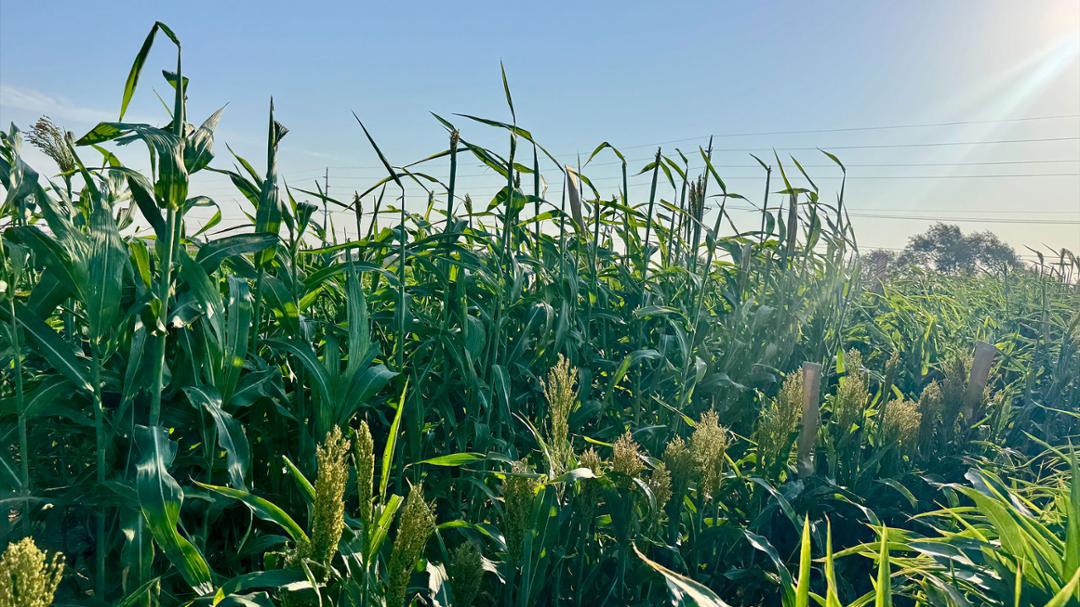

Yinping Jiao and David Becker are part of a group of researchers and experts striving to transform basic sorghum research into industry application.
In the corner of Yinping Jiao’s office in Experimental Sciences Building II sits a vase filled with stalks of sorghum ranging in shades of brown, some in compact, short clusters, others longer and unfurled.
They’ve lost their color since they were harvested a year ago as orange, burgundy, bronze, cream and black varieties. But Jiao, a Texas Tech University assistant professor of crop population genomics in the Department of Plant & Soil Science, still marvels at the plant’s diversity.
“Look at this,” she beamed. “How could they look so different?”
Sorghum and corn aren’t easily distinguishable in their germinal stages. Where they diverge, however, especially with sorghum’s heat and drought tolerance, is crucial to the future of agriculture on the High Plains and beyond.

Jiao’s research on the crop is a part of the Institute of Genomics for Crop Abiotic Stress Tolerance (IGCAST) in the Davis College of Agricultural Sciences & Natural Resources.
With West Texas farmers’ need to maintain soil health and productivity through crop rotation, sorghum has emerged as a promising solution, especially as it requires roughly 20-35% less water than corn uses to grow. Jiao is working to enhance sorghum grain’s digestibility and taste, advancing a crop that has historically received far less research attention than corn.
She is building off one of her major discoveries during her time at Texas Tech. While investigating mutations of the genes in sorghum proteins, she identified one that could improve the grain protein’s digestibility by 50%.
“That’s a big step to solving that limitation,” Jiao said. “With that increased protein digestibility, the nutrition in sorghum has the potential to be similar to corn.”
In the two years since accomplishing this feat, she’s faced additional challenges applying the basic research to industry production.
Jiao and her IGCAST and Plant & Soil Science colleagues have developed capabilities for advanced plant breeding applications, gene editing and genomics. David Becker, executive director for agricultural research strategy in Research & Innovation, is seeking to bring plans for a translational crop breeding center to life.
Attempts to transfer foundational research to the field are coming just as the industry elsewhere is improving sorghum berry processing technologies that likewise lagged behind what exists for corn kernels.
“That also creates a lot of opportunities for us to create optimized genetics for sorghum that will support the application of the new kernel processing equipment,” Becker said.
Though Becker has only spent two years working at Texas Tech, he’s seen a level of investment in agriculture, both at the Davis College and the university overall, that is uncommon nationally.
Becker also noted that Texas Tech sits right smack in a semi-arid area with a declining water supply and has demonstrated a drive to assist local producers by increasing the water-efficient crop’s nutritional value. These factors place the university in a prime position to host a conference that brings international thinkers and expands its reach.
In the spirit of the Global Sorghum Conference, Becker is hopeful his efforts will encourage collaboration across federal institutions and universities that maximizes the dollars put toward research and generates positive outcomes.
Some of that work has already manifested in purchasing a sorghum silage harvester and a thresher to support research at the New Deal Research Farm and beyond.
The foundational support Texas Tech provides, as well as opportunities for collaboration with the Lubbock-based United Sorghum Checkoff Program and the local branch of the U.S. Department of Agriculture’s Agricultural Research Service, make the area one of the best environments to focus on improving sorghum.
“This is the right place to turn sorghum discoveries into real-world impact,” she added.