
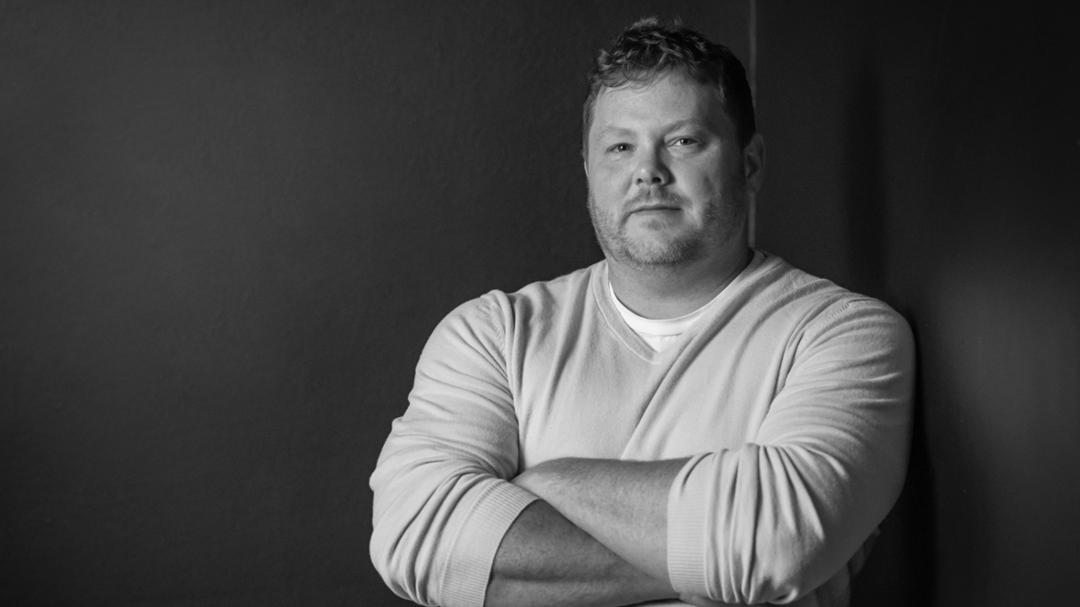

After reaching the peaks of the architecture world, Daniel Pruske hopes to carry through invaluable lessons he learned as a Red Raider to the next generation.
Studio culture in architecture is responsible for countless practitioners’ improvement in their careers’ early stages, as a laboratory in which to tinker, to fail, to bond and to develop through healthy discussion and competition.
Beyond the classroom, studios are pressure cookers for growth, and without them, many architects wouldn’t be where they are today. Daniel Pruske, a newly minted professor of practice in Texas Tech University’s Huckabee College of Architecture, is such a case.
After graduating from Texas Tech in 2003 and going on to an impressive career of working with the industry’s best, Daniel returned in 2025, seeking to repay the mentorship that inestimably contributed to his journey and help rebuild the studio culture the COVID-19 pandemic deeply altered.
Nearly 30 years ago, teenage Daniel was shaking off his family’s move from Florida to Texas that had impacted his final years of high school. His future was ambiguous, as few in his family had gone to college and his grades weren’t top tier, but his uncle was emphatic about pushing him to the next level of education.
What Daniel did have going for him was hand drafting skills and dreams of walking onto a football team, and Texas Tech would come to provide opportunities for both.
Daniel had a chance meeting with Michael Jones, then associate dean, who was on campus instead of leading his usual summer program in Italy. After presenting his portfolio, Jones gave Daniel full-throated encouragement that he should make Lubbock his home for the next few years.
“This is a person who loved architecture, loved to inspire, and so had I met someone else, maybe I wouldn’t have been so excited to come,” Daniel says. “But meeting him was really a joy, and it gave me the kind of, ‘Well, let’s give it a shot’ vibe.”
His first glimpse of what he could accomplish at Texas Tech came from the 1998 undergraduate catalog his first year. Gracing the cover was Bernard Harris, an astronaut and alumnus of the Texas Tech University Health Sciences Center’s School of Medicine, who became the first African American to perform a spacewalk in 1995 on a NASA mission.
Daniel attended Jones’ Design, Environment and Society course as his first class, taking in Jones’ excitable, enthusiastic teaching that remained with him long after. He also tried out for the Red Raider football team, bowing out after finding he didn’t specialize in battling 350-pound linemen.
It wasn’t until his second year, when the number of classmates around Daniel shrunk by two thirds and studio courses began, that he started getting into architecture in earnest.
The ones who were in it for the long haul made each other better. Daniel benefited from his studio being right next to a graduate studio, as he admired and analyzed the models the upper-level students built.
He learned through long nights, innumerable hours and plenty of Twizzlers and Dr Pepper how to produce designs that seemed to come easily to others.
“It was seeing all that stuff that just pulls you to a whole different level,” Daniel recalls. “If you have any sense of quality, studio culture really helps with all the things you don’t learn from professors.”
His third-year studio, taught by a Swiss lecturer named Urs Peter “Upe” Flueckiger, was transformative for myriad reasons.
After participating in a statewide competition for the Texas Society of Architects, Daniel and his peers traveled to present their project at the organization’s convention in Dallas.
Thom Mayne, a top architect and principal of the Los Angeles-based Morphosis Architects, was the event’s keynote speaker. Though Daniel didn’t know who Mayne was when he began his speech, his career dreams would soon be set in stone.
“I walked into that lecture and I had no freaking clue what was going on at first,” Daniel remembers. “But I saw his work and I was just like, ‘That’s what I want to do.’”
Mayne’s emphasis of complexity in architecture, combined with the irregularity and unpredictability of both his work and the Jackson Pollock pieces Daniel saw across the hall, dug into Daniel’s mind and didn’t let go.
Daniel was captivated by grandiose ideas he struggled to bring to paper, which led to some poor habits in terms of his schoolwork. It would take a couple more years for him to graduate, though during that time he impacted his instructor, Flueckiger, with the quality of his work and his time as a teaching assistant.
Flueckiger and then assistant professor Hendrika Buelinckx also advised Daniel through his thesis, and Daniel contributed two models to the storied Flueckiger house built in Lubbock in 2004.
When Daniel crossed the stage, his mind was set on working at either Morphosis or Atlanta firm plexus r+d.
His second job got him a bit closer to that goal, as Daniel went to Atlanta to do design work for Farrington Design Group, a company with ties to plexus founders Eric Lewitt and Jordan Williams. Through 18 months, Daniel mastered his traditional assignments during the day and eventually managed to convince Lewitt and Williams to let him do fulfilling, creative work for competitions and lecture animations at night.
An itch for something more gratifying continued to gnaw at Daniel. He asked for more from his supervisors at plexus, who obliged and brought him on for a three-month trial contract.
He still remembers his first day after the hire when the planning for the building they were working on began.
“I took my sketchbook and I went into a corner, because that was how I worked,” Daniel says. “Eric was like, ‘No, I want to talk,’ and he started pulling me out of my shell.”
Discussions were now out in the open, and work continued to flow whether the group was out at lunch or back in the office late at night. Daniel was absorbing more about design and professional culture, and those habitual issues regarding his approach to work that had plagued his later years in college began to wash away.
Soon enough, the three of them were moving in sync. The trio’s synergy grew as new employees joined over the years, but in the midst of plexus’ groove, the Great Recession halted everything.
The economic downturn spurred by losses on mortgage-related financial assets and a decline in construction turned Atlanta into a proverbial architecture graveyard, Daniel remembers. Firms with 100 people quickly downsized to less than 20. Bitterly, Lewitt and Williams were forced to let Daniel go in 2009.
Without much else on the horizon, Daniel called his former teacher Flueckiger, now an associate professor at Texas Tech, as the pair’s connection had grown into friendship over the years. Flueckiger referred Daniel to his colleagues within the College of Architecture’s administration who were looking to fill teaching positions at that time, and within a few weeks, Daniel landed a visiting assistant professorship.
Though Daniel had some teaching experience to rely on, it was his mentors, including Flueckiger and now emeritus faculty Bennett Neiman, who supported him in guiding students through semesters’ worth of studios on his own.
Neiman taught him how to pace a semester, define goals and properly use rigor in teaching. Flueckiger showed Daniel he had the freedom to develop his own projects.
His first semester was characterized by both successes and failures, but soon enough, Daniel received an invitation to lead a graduate comprehensive studio project. It would be longer and more intense than undergraduate courses, but the latitude afforded to him to develop the studio, which he went on to rotate teaching with other studios over the four years he was at Texas Tech, was critical.
“I was able to take that freedom and say, ‘OK, I’m going to do the things I’m interested in with this project, and I’m going to pour all my energy into this group of students,’” Daniel says. “It became a kind of strength of being able to take what I had learned from Atlanta and bringing it into the studio.”
Discussions emerged in 2013 regarding Daniel’s potential path to a tenure-track position, but a desire to pursue further education lingered on his mind. His options were down to the University of California, Los Angeles (UCLA) and the University of Michigan, when a call came while Daniel was in his downtown Lubbock apartment with his family.
He stepped outside to answer his phone, which displayed a number with a 310 area code. That meant Los Angeles County.
“Hey Daniel, it’s Thom,” said the voice on the other line. Daniel immediately recognized it as his architectural exemplar.
“You’re in.”
Mayne, also a UCLA professor at the time, would offer Daniel both a full tuition scholarship and an opportunity to work for him at Morphosis. Shortly after a couple days of graduate classes, Daniel pivoted to what would become 12 years of living a dream.
He worked next to some of the greatest minds he’d ever met, an all-star cast plucked from around the world.
“It’s like the NASA of architecture in there,” Daniel remembers noted practitioner Neil Denari saying of the firm.
The office was similar to the studio culture Daniel experienced at Texas Tech but on a grander scale, with colleagues constantly pushing each other to greatness.
“I was surrounded by the intensity of passionate people and just the raw capability, and then there was the talent that would come through the door,” he says. “I get an intern that I’m supposed to guide, and I’m looking at this person, like, ‘This person’s gonna potentially wipe the floor with me in 10 years.’”
The cherry on top was working in close proximity to his idol, whose heavy involvement with projects ensured the employees’ design processes largely reflected Mayne’s work.
As Daniel’s time at Morphosis progressed, he took pride in going the extra mile for projects and devising solutions that earned Mayne’s trust and approval.
A tipping point emerged during the pandemic, though, when Mayne decided to fall back into a more limited role. Daniel and his colleagues were unsure of their new roles as a new era began.
His first assignment in this period, the Crow Museum of Asian Art at the University of Texas at Dallas, caused Daniel distress as he felt pressure to produce a design that still felt like it had Mayne’s stamp on it.
Though he was called to a different project halfway through the design process, Daniel maintained that he held some responsibility for the final product. Anticipation was high when he was invited to the museum’s unveiling in October 2024, which also marked the first time his parents would see a project of his.
What remains with him is the happiness that radiated from all the onlookers.
“The museum director was just grinning ear to ear, showing people around the ribbon-cutting ceremony,” Daniel says. “The campus people are happy, my dad’s looking around with his eyes wide open, my mom is smiling, and the people I work with are like,
‘Wow, Daniel, you actually look happy right now.’”
He had always been intense, had always had a keen approach to his work. Since leaving the project years earlier, Daniel had also been restricted from checking in, especially in person, by other duties.
But by being there to witness not only the museum but also the satisfied reactions, and later receiving a congratulatory text from Mayne, Daniel had proof Morphosis could continue and thrive as more than being powered by any one individual.
Still, as the firm changed, so did Daniel’s needs. He felt a pull to return to Texas to be closer to his son in San Angelo, realizing his career and Morphosis’ trajectory were likely diverging and recognizing that an opportunity to teach at Texas Tech still existed.
After weeks of agonizing over leaving his dream behind, Daniel committed to being the 2025 H. Deane Pierce Endowed Visiting Assistant Professor of Architecture, a position Flueckiger, now dean of the college, had previously offered.
Returning to Lubbock and an architecture program far removed from what it was 12 years ago disquieted Daniel with cognitive dissonance. He pushed through teaching graduates in an integrative design studio while also relearning how to teach certain concepts.
In the fall, however, Daniel hit his stride. Endeavoring to integrate his abstract approach to architecture into the topical studio course, he challenged his students to a unique method of producing models while experimenting with organizational hierarchy, materials and order.
His students’ engagement greatly contributed to the course’s success.
“A couple of them were scared at first, but by the time we got to the midterm, one of the most satisfying things anybody said was, ‘I felt creative again,’” Daniel says. “That was great. We need that energy.”
He sought to pass on the lessons he took from Morphosis: integrating concepts from beginning to end, maintaining the rigor necessary to complete high-level work and balancing sacrifices to preserve project integrity.
Daniel had enough success to where Flueckiger asked him to stay on as a professor of practice and the architecture faculty approved; now, it’s a matter of him consistently bringing that value to students and incorporating his methodologies into the college’s broader culture.
“One of our values is collaboration,” Flueckiger says. “Everyone with their specific skillset brings something to the college, but the high design level in Daniel’s particular case is why I think he’s a perfect fit for the professor of practice role.”
There’s a schoolwide effort to restore the in-person studio culture the pandemic interrupted. Students can now work remotely and use 3-D printers for models, which limits the opportunities for them to look over each other’s shoulders and learn.
The models Daniel led in fall 2025 were too large to do at home, representing a successful start, but he anticipates significant trial and error in that aspect. And as the architecture industry broadens and allows for increased specialization, he aims to hone students’ soft skills as they prepare for their futures.
Everyone’s journeys will operate along different timelines, of which Daniel’s story is a testament, but what will always be en vogue is a basic knowledge of the design process, a questioning nature, and breadth and depth of research to allow for informed decision-making.
His approach is an evolution of the insights his own mentors at Texas Tech gave him, whether it was Jones’ intensity or Flueckiger’s compassion.
Daniel hopes to continue a tradition of lateral communication, in which instructors are eager to learn and use empathy to help students grow.
“If we were to have open conversations versus morsels of conversation, how would that change people and how would they evolve?” he asks. “I feel like Dr. Jones didn’t hide anything. I don’t feel like Upe hid anything.”
Texas Tech provides most everything anyone could need to start pursuing their dreams, he says, adding that the rest is about putting in the effort and time and asking the right questions.
“It’s kind of like the land we live on,” Daniel continues. “It’s broad, expansive; it’s open. There’s opportunity all around us to do things, it’s just whether or not we want to do it.”