
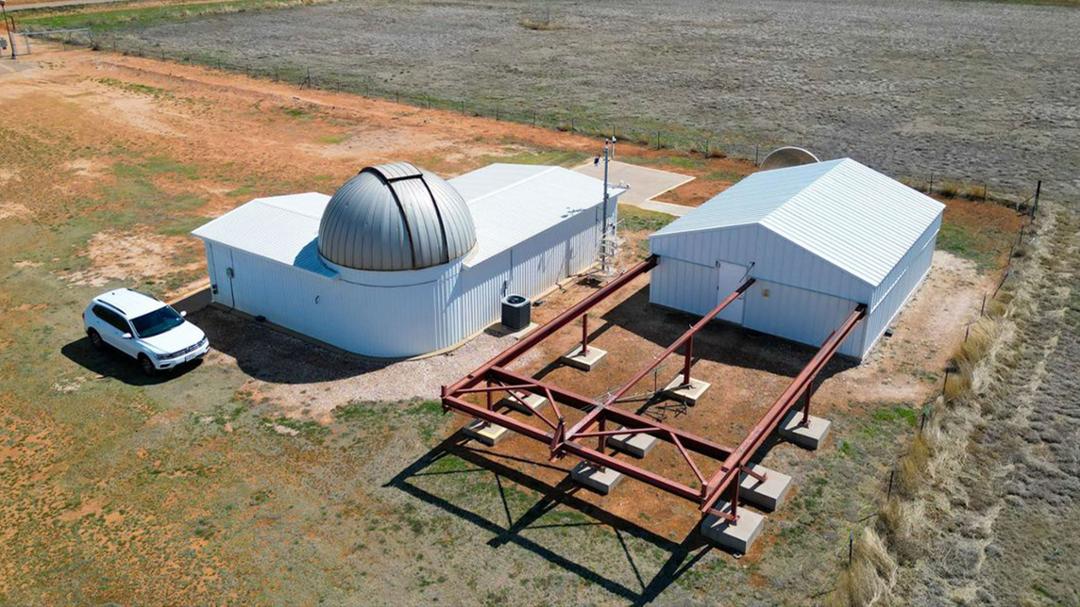

Elias Aydi and the Department of Physics & Astronomy are working to provide remote access to observatory.
Photos courtesy: Elias Aydi
As far as Elias Aydi is concerned, the beautiful, spacious skies of West Texas belong to everybody, and he is doing what he can to improve the Texas Tech University community’s access to awe-inspiring views made possible only by looking upward.
Beginning this fall, the Department of Physics & Astronomy in the College of Arts & Sciences is making available remote access to the Preston Gott Skyview Observatory telescope located northwest of campus near Shallowater.
“We have been working to transform the observatory into a fully remote facility,” said Aydi, an assistant professor in Physics & Astronomy. “We have installed two remotely operated domes and equipped them with several instruments that will allow us to carry out two major projects.
“The first project is what astronomers call a transient survey. Two cameras equipped with telephoto lenses will continuously map the sky, searching for transient phenomena such as stellar explosions and other sources that change in brightness over time. The project involves several students, giving Texas Tech students the opportunity to be at the forefront of discovery.”
The survey, named the New Milky Way Survey at Texas Tech, has already produced remarkable results. Most recently, it discovered a nova explosion in this galaxy Aug. 6, which was promptly announced to the international astronomical community.
“These discoveries are establishing Texas Tech as a major player in time-domain astronomy,” Aydi said.
The project focuses on opening the observatory to the broader campus community. As part of this effort, the remote domes will also house two “smart telescopes” that will be available to anyone on campus.
Smart telescopes are a rapidly growing trend in astrophotography, combining a telescope and built-in camera in a compact system that is simple enough for almost anyone to use.

“Despite how easy they are to operate, these telescopes are remarkably powerful,” Aydi said. “After about an hour of observing, for example, you can produce an image of an entire galaxy in incredible detail.”
“As we worked on this, we had in mind access for everyone on campus,” Aydi said. “The motto of the Physics & Astronomy Department is the sky is for everyone, and we are trying to make this a reality for everyone on campus, giving them the opportunity to enjoy our night sky, which is really, really nice.”
The department will have a schedule of available hours for people to use the telescopes, which they will be able to access on their personal device via a login code. They can receive assistance from department students, postdocs or faculty members, who can help them guide the telescope and make recommendations of celestial sights to view.

“We are thrilled to see the Preston Gott Skyview Observatory expanding its impact beyond research and creating new opportunities for the broader Texas Tech community to engage with astronomy,” said Sung-Won Lee, department chair. “This new remote facility represents an exciting opportunity for students, faculty and staff to explore the night sky, practice astrophotography and experience the beauty of West Texas’ dark skies using state-of-the-art smart telescopes.”
The project has been in a testing phase for the past month. The plan is to have the schedule available in September when clear, fall nights are the norm. To start with, time slots will run from sundown to midnight with additional time eventually possible.
“If we see there is a lot of interest in this, we might open it all the way from sunset to sunrise,” Aydi said. “Right now, testing the instruments, everything is working fine. We are also testing the login platform to make sure it is working properly.”
This is seen as one more way the department can engage with the broader campus community and share a passion for astronomy.
“I sincerely appreciate Dr. Aydi’s vision, leadership, dedication and tremendous effort in making this project a reality,” Lee said. “I also thank everyone who contributed to bringing this exciting initiative to life.”