
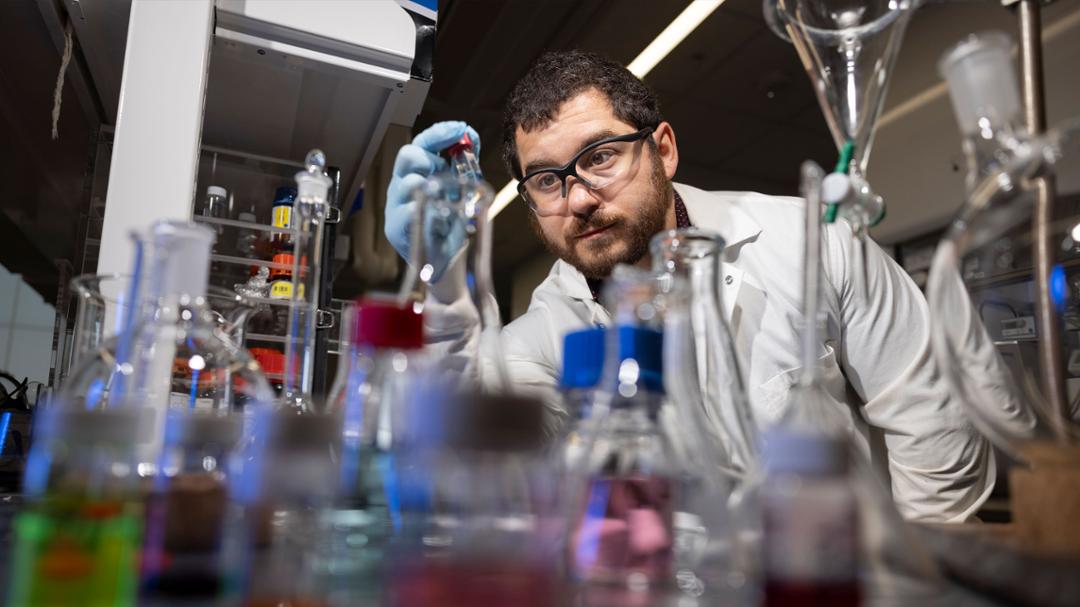

The assistant professor will deliver a presentation at the Military Health System Research Symposium on next-generation technology his laboratory has developed.
Joshua Tropp, an assistant professor in the Department of Chemistry & Biochemistry in the College of Arts & Sciences at Texas Tech University, will deliver a presentation on the possible applications of next-generation healthcare technology during the Military Health System Research Symposium (MHSRS).
The August event, sponsored by the U.S. Department of War, focuses specifically on the unique medical needs of the military.
Tropp’s presentation is titled “Ultra-Bright Near Infrared Conjugated Polymer Nanoparticles for Low-Dose, High-Contrast Imaging and Resource-Limited Environments.” It is part of a broader session on frontline, portable life support and imaging devices.
Tropp is developing technology that could bring advanced medical imaging capabilities closer to soldiers and medical personnel on the front lines.
“When we think about an MRI or a CT, these are technologies you typically find in hospitals,” he said. “On the battlefield, those resources often aren’t available. We’re developing lightweight, portable imaging technologies that could bring advanced imaging capabilities closer to where injured military personnel are first treated.”

The idea is to bridge the gap between an initial battlefield injury and definitive surgical care. The challenge has been providing injured combat troops and those who treat them with the tools and technology they need.
One issue is that traditional imaging equipment is often too large and impractical to deploy near the point of injury. A second challenge is that many conventional imaging contrast agents can present safety and logistical limitations in these environments.
Tropp says a fluorescent dye could be used as a contrast agent, allowing structures beneath the surface of tissue to be visualized with an infrared camera.
“Think of something like a glow stick, but it glows in a region you can’t see,” he said. “The human eye can’t detect infrared light, but it can penetrate skin and tissue. That means structures labeled with these dyes can be seen with a specialized camera, even though they’re invisible to the naked eye.”
Through the use of a fluorescent dye and an infrared camera, surgeons could perform florescence-guided procedures in battlefield environments. Tropp says the technique could have additional applications in remote, low-resource areas such as rural West Texas.
“I originally envisioned this technology for low-resource healthcare settings like rural West Texas,” he said. “Then it occurred to me that the battlefield presents many of the same challenges. That realization opened the door to military applications.”
The technique is known as fluorescent image-guided surgery. Other possible applications include the identification of vascular images following trauma, the detection of tissue ischemia, foreign body localization and perfusion monitoring.

Tropp, a material and polymer scientist by training, has developed a new series of organic nanoparticles that glow in the infrared region and can be detected with a specialized camera. His presentation will focus on their potential applications in medical imaging. The nanoparticles are the subject of a patent application filed through Texas Tech and are in the early stages of commercialization.
As a result of this work and related research, Tropp recently was selected to receive the U.S. Air Force Young Investigator Program Award. His laboratory’s research has also attracted support from multiple federal agencies, resulting in five active projects in the areas of energy and defense awarded this year.
“It’s extremely meaningful to me professionally,” he said of the recognition and funding. “I am thankful to Research & Innovation, who have provided funds to help me attend the conference. Without their support, this wouldn’t have been possible. I am very thankful to Texas Tech and the Research & Innovation office supporting me so aggressively since I’ve started here.”
Presenting at the conference is a significant opportunity, bringing together Department of War program managers interested in advancing healthcare technologies for military medicine.
“It’s not the same as presenting at an academic conference,” he said. “I’m presenting to people whose ideas and priorities can shape the future direction of my research. Opportunities to interact directly with these program managers are rare, so being able to discuss my work with them is incredibly valuable.
“Opportunity is everything. I have ideas about where I want to take this research, but it’s just as important to understand the challenges they’re trying to solve. Those conversations can open new directions and opportunities that I might never have considered on my own.”