

Soroush Avval was recently named the 2026 Charles S. Peirce Interdisciplinary Graduate Fellow for his research on distributed artificial intelligence models.
It seems conversations and views surrounding artificial intelligence (AI) today are either framed in unbridled enthusiasm or apocalypse-fueled skepticism. These competing narratives often leave people uncertain about where reality lies, fueling both excitement and apprehension.
Soroush Avval, a computer science doctoral student at Texas Tech University’s Graduate School and Edward E. Whitacre Jr. College of Engineering, hopes his research can address those concerns while shifting conversations toward a middle ground.
“I get a sense of gloom and grief talking to people about AI and AI systems,” he said. “Ultimately, I think AI is going to just be another tool that we can use in our daily lives.”
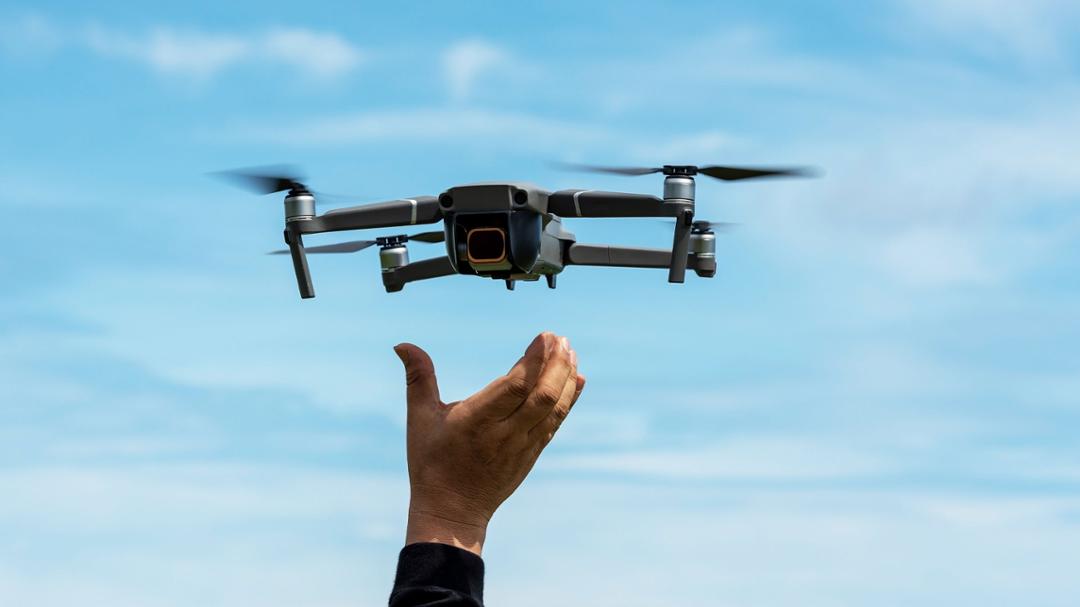
Avval wants to build a distributed, or decentralized, AI paradigm, or model, that utilizes drones to handle localized computer processing requests.
He believes much of the anxiety people feel is rooted in the current centralized models through which AI is developed. When a user accesses an AI tool, massive amounts of data are collected, transferred and processed to a central server, data center or public cloud.
According to Avval, three of the biggest issues with centralized systems are privacy concerns, communication bottlenecks and the energy required to power large-scale computing infrastructure.

In contrast to a centralized model, distributed models spread the data collection process across several nodes or devices. When a person wants to access an AI tool, they would connect to a dedicated device as opposed to a centralized entity via a network. This should reduce energy consumption, improve data privacy and reduce the time it takes to process data.
Avval believes a distributed model could enable affordable mental health AI tools for people in remote areas where internet access is unreliable, too costly or too slow. Specifically, he’s thinking about rural communities and disaster relief or military operations.
Balancing personalizing the user experience while maintaining a high level of security is a well-known challenge when it comes to distributed AI systems, and it’s one Avval is addressing head on.
“What is especially intriguing is that no matter how much I try, I need to provide a trade-off between privacy and performance,” he said. “If I increase the sense of privacy, performance will degrade. If I increase the performance, privacy will degrade. It’s a challenge that excites me because I know there is an answer. I just haven’t found it, yet.”
Avval hopes drones can be part of that answer.
“They’re cheap,” he jokingly and matter-of-factly says. “With AI, the main constraint is the energy consumption. It’s the most expensive part, so that’s why I’m utilizing drones. I need to make this as cheap as possible.”
Essentially, a drone would arrive and serve as the data-processing entity anytime a person uses an AI tool on their device.
Avval’s research recently garnered recognition as he was named the 2026 Charles S. Peirce Interdisciplinary Graduate Fellow. The fellowship is awarded through the Institute for Studies in Pragmaticism and recognizes and supports young researchers conducting interdisciplinary studies.
Peirce was a 19th-century American scientist, mathematician, logician and philosopher. He is credited for founding American pragmaticism and practiced what he considered “egoless research,” where a researcher detaches from their biases and preconceived notions to allow reality to reveal itself.
Avval sees this fellowship as an acknowledgement not only for his research topic but for himself as a researcher.
“At first, I was just trying to produce papers, papers and more papers; I was trying my hardest to become something like a publication factory,” he said. “Once I was introduced to the egoless research produced by Pierce, I saw that if I spent my time on a very meaningful problem, everything else downstream would follow.”
Avval also credits his advisor, Assistant Professor Jingjing Yao, with playing a major role in developing his research topic and prowess. Her expertise includes decentralized AI learning models and the internet of things, a network of physical devices that connect to the internet to collect and share data.
Avval describes Yao as being very pragmatic and helping ground his research in sensibility. It’s how he went from a broad goal, like how to make AI better, to developing a distributed AI model that can balance privacy concerns with user personalization through the use of drones.
However, what Avval values the most is Yao’s ability to provide what he affectionally described as “gracefully authentic” feedback.
“I always tell her, ‘It’s a lot better that you criticize my work rather than the publication reviewers,’” he said. “When she criticizes me, I can address the issues right away, but it can take up to a year to address a concern from a publication reviewer.”
As Avval continues to envision and research a world in which AI users send data to localized drones instead of massive, centralized cloud systems, he is grateful to have found a research home at Texas Tech.
“Everyone here values a sensible idea and wants to see if it can morph into something special,” he said. “That was new to me. I had no idea such a thing was possible. This fostering environment has been great.”