
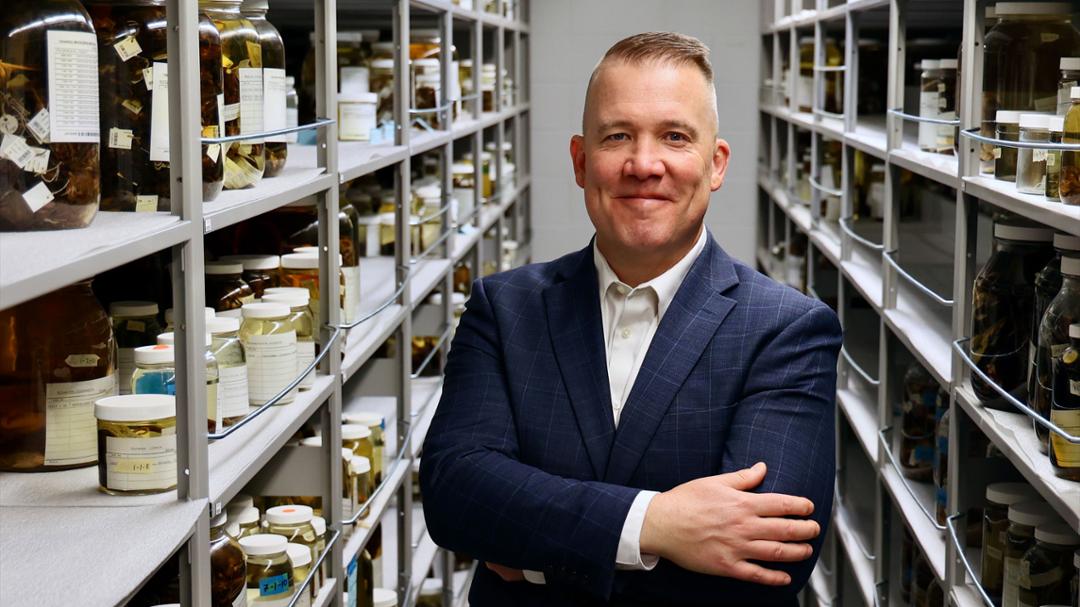

Caleb Phillips on genetics, wound healing and community collaboration.
Welcome to Rise & Research where cutting-edge discoveries are made as accessible as your morning coffee. This monthly feature offers a closer look at the transformative research happening on our campus. Pull up a chair as we talk with faculty who are pushing boundaries while creating opportunities for the next generation.
In this installment, Jacob Gordon sits down with Caleb Phillips to discuss his research into genetic individuality and chronic wounds.
The morning sun peeks behind the shades of Caleb Phillips’ office, illuminating several objects on his windowsill. Most notably, a hummingbird skull and the skeleton of a bat embryo are on display, inviting questions from curious office guests.

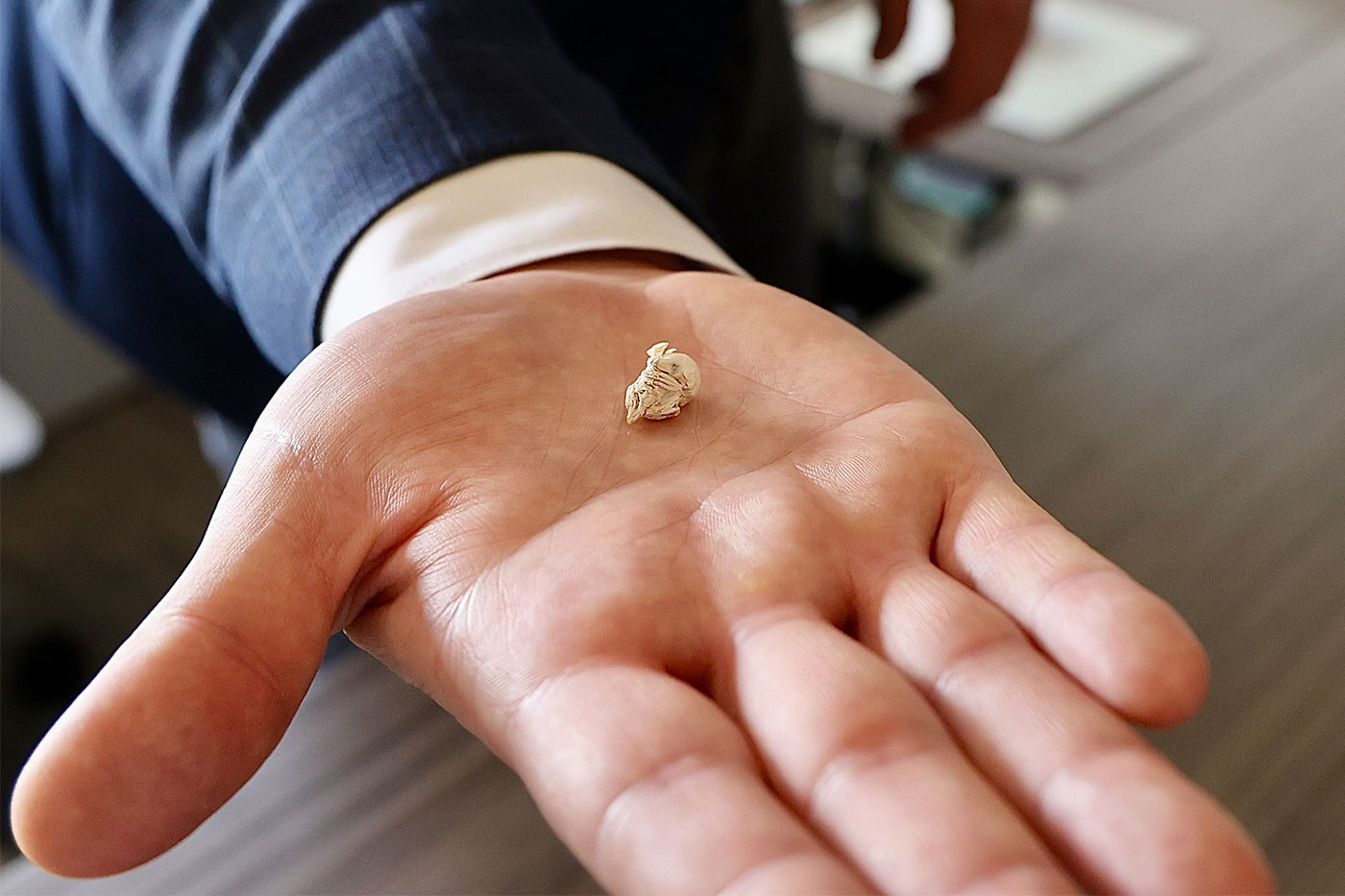
Phillips isn’t shy about showing off the embryo in his palm, its size and color reminiscent of a piece of popcorn.
“You see the elongated digits?” Phillips asks with the same enthusiasm of someone showing off a vinyl record signed by all four members of The Beatles. “There are a couple of labs I know of that study the developmental evolution of bats.”
Along with being an associate professor in the Department of Biological Sciences in the College of Arts & Sciences, Phillips is the curator of the Robert J. Baker Genetic Resources Collection and interim assistant director at the Natural Science Research Laboratory at the Museum at Texas Tech University. He sometimes finds himself on the second floor of the museum strolling through the wet- and dry-preserved mammal collections.
However, the topic of today’s conversation is Phillips’ research into genetic individuality and the healing of chronic wounds.
“In our work, we’ve shown that the microbes in wounds are the most important thing when predicting how long it takes for someone to heal,” he said.
What makes Phillips’ research especially impactful is his collaboration with the Southwest Regional Wound Care Center. He sees this as an opportunity for academia and the professional medical sector to work together and exchange knowledge to better the lives of a community.
Q: Can you talk about your research interest in genetics?
A: In the most general sense, I study how people’s genetic uniqueness influences their predisposition to getting certain types of infections. The research is in the area of multiomics, which integrates multiple molecular layers. We’re looking at how genomics, that is the study of genomes, and metagenomics, the study of the meta communities like the microbiomes that live in and on us, connect to each other.

In one body of work, we built a model that shows that microbes strongly predict how long it takes for people to heal. Then in our adjacent work, we show that your genetics predict which microbes are in your wound. So now, we’re proposing to build a large causal model in which we identify the parts of the genome that work through microbes to influence healing or the components of the genome that don’t have anything to do with the microbes but have something else to do with the healing trajectory. We think healing is a complicated process that involves a lot of genetic uniqueness.
Q: What makes you most excited at the prospect of a clinical application for your work?
A: The overarching goal is for people’s genetic individuality to guide treatment. One potential idea is the ability to personalize prophylactic antibiotics. For instance, one type of chronic wound is a surgical non-healing wound. If you’re going in for surgery, you could take a cheek swab and do quick testing. Maybe it shows you have a high genetic susceptibility to a Pseudomonas aeruginosa infection that could impair wound healing. You could be put on a course of prophylactic antibiotics before you go in.


Q: How did you become interested in studying genetics and wound care?
A: In my junior year at Tarleton State University, I took a heredity genetics class and was asked if I was interested in doing undergraduate research. The lab was focused on population genetics of a variety of different rodent species. Part of doing that work meant going camping to collect the rats. I was setting traps, catching rats and sitting around the campfire; then going back to the lab and extracting and sequencing the DNA from those animals; and doing genetic testing and working out patterns of diversity across the landscape. I was hooked because the genetics lab work was so hands-on.

When I came to Texas Tech as a postdoc, I worked under Robert Baker, who developed the Natural Science Research Laboratory at the museum. He was studying a group of really cool bats that have a lot of morphological variability, and I did a metagenomic study on bats. We did the sequencing at a company owned at the time by Randy Wolcott, M.D., a local wound care physician. A few years later the company recruited me as an employee.

Randy was a genuine mentor to me, and I learned a lot about wound biology from him. He pushed the idea of biofilm-based wound care: that addressing the microbes in wounds is paramount. Basically, during weekly wound care the slough and dead tissue are removed. This slough includes a lot of bacteria, and DNA sequencing is performed on that slough to identify the community of microbes in the wound. Then the physician can treat the wound using custom topical antimicrobials.
Q: How have you seen your professional collaborations impact the research?
A: I wouldn’t be able to do this without the Wolcott family. Joe Wolcott is my collaborator at the Southwest Regional Wound Care Center. Whenever he’s treating a patient, he’ll send off a sample of the wound to a company here in Lubbock called MicroGenDX to do DNA sequencing to determine what microbes are present. He also asks patients for consent to be in our studies about how people’s genetics influences their wound microbes and healing. Through our collaboration, we are understanding this relationship and hope that it will guide improved patient care in the future. I feel that the reason we’re able to show strongly that the microbes and genetics are so important is because he’s doing everything correctly – from record keeping to the very best treatment practices. They have very low amputation rates and very high healing rates. We’re not providing genetic information to guide his decision making today, but there’s the possibility that could be the case in the future.
Q: Can you talk about your role as the curator of the Genetic Resources Collection at the Natural Science Research Laboratory (NSRL)?
A: The NSRL is part of the Museum at Texas Tech, and there’s over half a million tissue samples in its Genetic Resources Collection. It’s a liquid nitrogen infrastructure, so samples are expected to be preserved for centuries. Through our collaboration with Joe Wolcott, we’ve built what we refer to as the Wolcott Wound Care Research Collection, and we have 1,500 vials of tissue in that collection from our local population, people who have consented to be in our studies. Because of that collaboration where Joe is willing to collect on our behalf, they modified their electronic medical record system to accommodate our research studies.
Q: What role do students play in your lab?
A: We have a really good student body here at Texas Tech. I have three Ph.D. students – Jake Ancira, Khalid Omeir and Nina Kent – and two of them came from the undergraduate population in this department. The graduate students are assigned to mentor the undergraduate students in my lab. I recognize the need to provide these research opportunities because they were so important to me. At the same time, the lab really has gotten a lot out of it because I have these phenomenal students. I joke that everyone should have their lab staffed with people smarter than you.
“I joke that everyone should have their lab staffed with people smarter than you.”
Q: Why do you choose to conduct your research at Texas Tech?
A: I’m very fortunate to be in the Department of Biological Sciences and to also have an appointment at the museum and get to be a part of a natural history collection. Those opportunities are few and far between. Then you take the Genetic Resources Collection, state-of-the-art facility and full-time staff that curates and maintains the collection and compound that with the collaboration I have with the community – it’s just the perfect scenario for someone like me.
About Caleb Phillips
B.S. Tarleton State University, 2003; M.S. Tarleton State University, 2006; Ph.D. Purdue University, 2009