
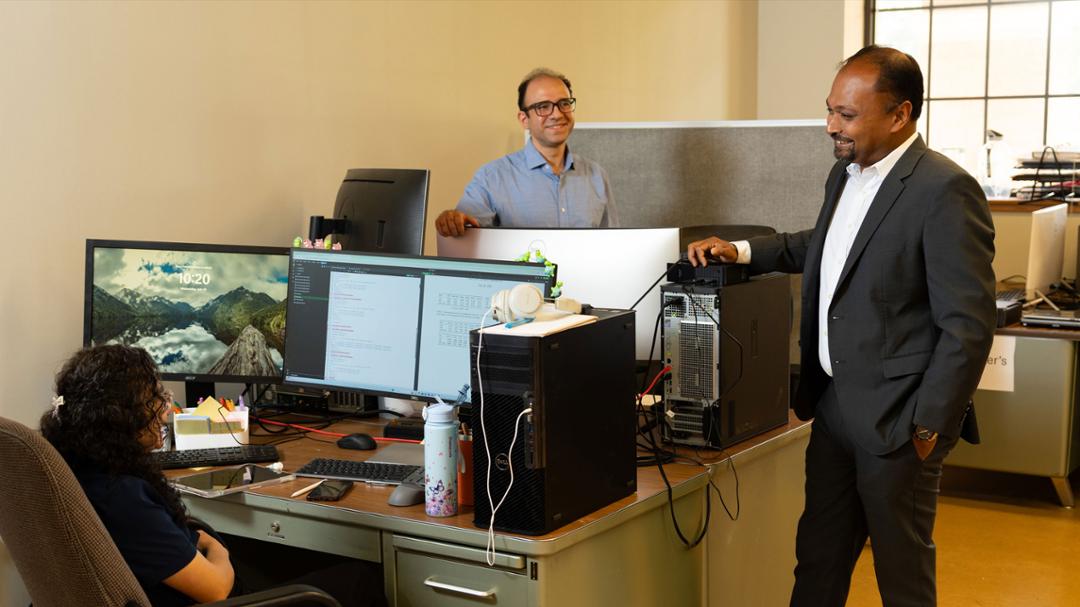

This Electrical & Computer Engineering professor tackles problems through a multidisciplinary approach.
Exploring scientific frontiers is where Ranadip Pal does some of his best work, whether that has been in electrical engineering, mathematics or genomics. He enjoys tackling complicated problems, and the bigger the challenge, the more energized and focused he becomes.
Pal joined the Department of Electrical & Computer Engineering faculty of the Edward E. Whitacre Jr. College of Engineering in 2007, and he has devoted much of his recent research work at Texas Tech University to computational biology and how it intersects with his original discipline.
“A lot of the work I do looks at how biology is involved,” said Pal, professor in the college, faculty fellow in the Critical Infrastructure Security Institute (CISI) and founding member of the Human Molecular Aging Center (HMAC).

“Initially when I arrived at Texas Tech, I was focused more on genomic signal processing or how genes provide signals. If you think about (DNA chemical bases) A, T, G and C, it’s almost like a code with four letters similar to binary in electrical engineering where we use zeros and ones. That was very interesting to me.”
Much of his primary research today centers on designing algorithms to solve thorny biological challenges like cancer and Alzheimer’s.
“It is amazingly satisfying work,” he said. “But sometimes the work requires thinking long term rather than right away. I can’t say that what we did was applied in a clinic. It takes a long time, but we have a lot of potential, and that makes me feel really good about the work that we are doing.”
Pal’s work in this area was one of several reasons he was selected for the President’s Distinguished Scholar Award earlier this year. The award is part of a suite of new recognitions instituted by Texas Tech with this one designed to recognize mid-career faculty while supporting continued scholarly research.
“Ranadip’s work has progressed over the course of his career, the way we hope that all research does,” said Provost & Senior Vice President Ron Hendrick. “Adapting one’s life work to meet societal need is how Texas Tech University, and Ranadip, bring solutions to big problems.”
Pal, whose other research interests include machine learning, stochastic modeling and cybersecurity, said it was rewarding to be recognized by Texas Tech, especially considering the excellent research work being done by so many other faculty members across campus.
“I definitely feel honored to be selected,” he said. “To see your work recognized among so many brilliant people is a good thing. Also from an outside perspective, it shows how Texas Tech cares about research, and that there are efforts to motivate us to work on our research and continue to the next step.”
It was a colleague at another school who helped steer Pal to Texas Tech, telling him the university had a lot of benefits to offer and that he should think about applying. While completing his doctorate, he interviewed and received a job offer.
“The offer was good, and I could tell they wanted to grow their research,” he recalled. “In 2007, there was a significant push toward becoming an R1 institution, and we got there in 2016 and we’re continuing to expand. It’s been very nice to see the research enterprise grow as well as the number of students. We have grown in all aspects.”
Research isn’t the only thing Pal enjoys about his job. He also takes great pride in serving as a mentor to students and helping them chase their goals and realize their dreams.
“I have always considered that an extremely important part,” he said. “Our Ph.D. students will go on to represent us outside (campus). They are our representatives, so I try to do the work that will make them successful. We are growing the next generation of engineers here.”
There was a time in life when Pal said he felt pulled toward math, but he said engineering provided more opportunities. Still, he kept his options open, looking at telecommunications and other areas. In graduate school, he encountered genomics, and he was eager to look for ways to expand his knowledge by blending disciplines.
“You heard a lot about genomics in the early 2000s,” he said. “They were working to process the human genome, and so much data was coming out from that work that we were going to have the opportunity to look deep inside the human body and see what’s happening.”
Pal thought his background fit nicely, and he landed a research assistantship with one of the labs working on the project. He continued to see connections between that work, his engineering foundation and other areas of interest. Over time, Pal began working in machine learning and artificial intelligence (AI).