
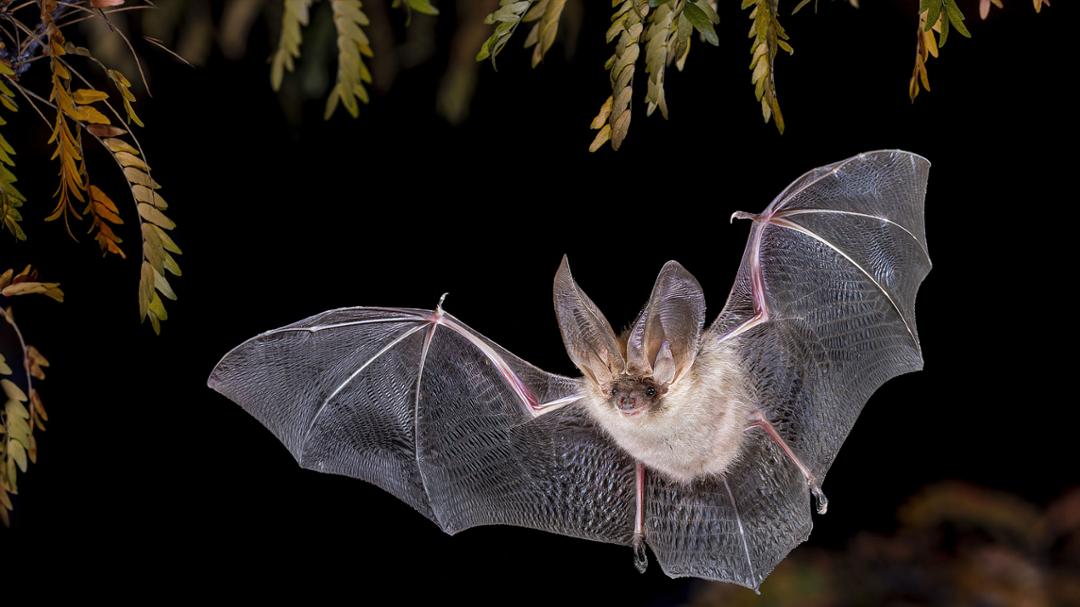

The work by professor David Ray and doctoral student Francisco Castellanos has provided a new family tree for bats with an origin now believed to be in Europe.
Forget everything you thought you knew about the origins of bats. Research involving a Texas Tech University professor and doctoral student just changed all that.
A paper published today by the academic journal Nature resulting from the largest bat genome and fossil study ever conducted revealed that bats did not originate from Asia, Africa or North America as had previously been presumed.
Instead, evidence shows that bats most likely arose in Europe about 65 million years ago, redrawing the bat family tree and providing answers to questions for which scientists have spent decades asking.


“It’s been a long-standing question as to where did bats originate,” said David Ray, a professor and associate chair in the Department of Biological Sciences, within the College of Arts & Sciences, who along with doctoral student Francisco Castellanos were part of the study.
Castellanos said it was a comprehensive analysis of fossil morphological data along with high-quality genomes that helped prove that bats originated in Europe.
“It’s all from the fossils,” Castellanos said.
According to Castellanos, a team of paleontologists had been collecting data from scarce fossil records over the last decade regarding the form and structure of bats, including a species whose ancient anatomy indicated it had already developed echolocation.
“Our approach also incorporated the data of living species, which along with the sequence data from the high-quality genome assemblies, enables a more accurate estimation of divergence dates and overcome challenges from previous studies,” Castellanos said.
In doing so, not only did researchers discover bats likely originated in Europe, but that their system of echolocation predates the diversification of modern bats. This discovery seems to settle that echolocation did not evolve twice in bat evolutionary history, suggesting that the two defining characteristics of bats – echolocation and powered flight, which is the ability to use an onboard power source to generate continuous thrust – were established close to bats’ origins.
The discovery was part of an international project called Bat1K, which targets sequencing and assembling of genomes of every living bat species, of which there are more than 1,500. Last year, as part of the study, Ray’s laboratory helped identify the components of a genome in a specific species of bats that have shown more genetic adaptations in their immune systems than other animals. That study revealed that a gene common in some bats can reduce the production of the SARS-CoV-2 virus by up to 90%, which could help lead to new medical approaches to combating viral diseases.
Ray’s laboratory was brought into the project thanks to his work leading the effort to sequence genomes of crocodiles. Castellanos is a doctoral student working in Ray’s laboratory, and his job was to perform whole genome alignments.
Castellanos said this was a highly computationally intensive task due to the high volume of data and deep evolutionary times that have generated an overwhelming chromosomal diversity and genomic restructuration, further complicating the analysis. But he said that process was fundamental to reconstructing a robust evolutionary bat family tree, determining across 103 bat and 11 other mammalian species genomes the conserved and divergent regions that provide the signal to infer evolutionary relationships.
These discoveries, along with Ray’s previous work showing how immune genes evolved in bats, opens the door to finding even more answers about the adaptations of flying mammals.
“There are various working groups within Bat-1K that are focused on immune-related questions or the evolution of echolocation,” Ray said. “Now, the goal is to have all of us in our individual groups use the data that's been published to investigate those questions, and then come up with some more publications for some time next year that will say, ‘OK, now that we have all these cool genome assemblies, here's what you can do with them,’ and we can discover all these different things about the way that these genomes have evolved.”