
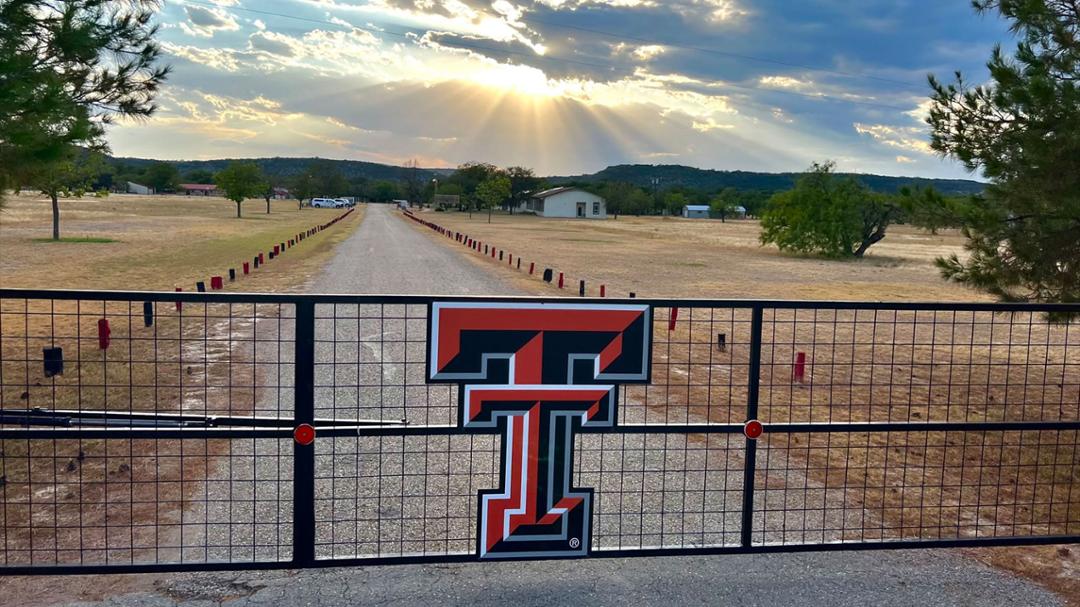

Texas Tech University Center at Junction hires new leadership with a strategic eye on outreach and engagement.
Marissa Cochran can’t recall the correct answers to the first science test she took. She can, however, recall the spiny feel of the horned lizards she’d catch in the fields outside her house as a child. She can sort through the dozens of sketches she drew at Palo Duro Canyon – each drawing capturing a nuanced treasure of the land.

She credits these experiences, not a textbook, with her love of nature and science. So, it comes as no surprise that Cochran was recently named the executive director of the Texas Tech University Center at Junction.
Cochran isn’t the only new face at the site – Texas Tech University alumnus Kody Robinson was hired onto the team as director of the Outdoor Learning Lab – which is as wild as it sounds.

From following animal tracks to setting up scent stations to observing tadpoles in the river, Robinson empowers students who visit to get their hands dirty. He considers this the best way to learn.
“Students might remember information, but they always remember experiences,” Robinson said. “That’s what we’re trying to provide here.”
With increased demands on public schools to produce competitive state-testing scores, Cochran explains that many administrators and teachers hesitate to take time out of the classroom, away from core curriculum. It’s for this reason Cochran and Robinson have implemented curriculum called “The Nature of Teaching” – a joint curriculum between Texas Tech and Purdue University – to increase student knowledge, appreciation and love of the outdoors through science, technology, engineering and mathematics (STEM) education. The curriculum has been adapted to align with Texas Essential Knowledge and Skills (TEKS) standards.

The goal is to come alongside educators in their community – and beyond – bringing to life concepts taught in the classroom. This reinforces the core curriculum students are tested on, but the hope is it also develops a passion in students for solving real-world challenges facing Texas.
To a fifth-grade child, the recent flooding in the Texas Hill Country is incomprehensible and frightening. But once they step onto the banks of the South Llano River with Robinson showing them how to take water samples, it becomes a problem they can wrap their minds around.
Robinson then brings out a water table that teaches children about erosion and flood plains.
“My hope is that these students will go on to be better stewards of our planet,” Robinson said. “But you have to experience something to care about it.”
The new leadership comes as part of a restructuring that places the Center at Junction as an educational unit under Outreach & Engagement. This strategy aims to ensure Texas Tech’s research and teaching is integrated with communities across the region.
“The nature-based STEM experiences students receive at the Outdoor Learning Lab are unique, meaningful and impactful,” said Vice Provost for Outreach & Engagement Rod Williams. “Empirical evidence shows the programming offered through this lab increases student knowledge, appreciation and excitement for STEM and nature. This is what Texas Tech Outreach & Engagement is all about – providing evidence-based programming to our communities that yields a positive impact on society.”
Many of the educational units at Texas Tech – the Center at Junction being only one – have the resources to supplement the work teachers do every day and perhaps bring lessons to life in a way they can’t on their own.
Both Cochran and Robinson worked in schools before joining the staff at Texas Tech. They understand first-hand how many priorities classroom teachers juggle.
“We have professional development for teachers and students alike,” Cochran said. “We’re familiar with the rigor of project-based learning and we want to encourage the inquisitive scientific thought process.”

Cochran believes place-based learning reinforces students’ ability to think critically – a skill that is often sacrificed to pass a test.
“Many students are losing the ability to think critically,” Cochran observed. “But place-based learning gives students a setting, a bigger picture of sorts, that helps with that critical thinking process.”
Cochran and Robinson beam with the anticipation for what the future holds for the center. But most importantly, they can’t wait to see how students will fall in love with the land and what that might turn into in the future.
“This is everything I could want in a job,” Robinson said, gesturing to the wilderness around him.
The prickly pear cacti, the mesquite trees and the curious deer, all of it outside the window, waiting to be noticed.
To learn more about the Center at Junction or contact its staff, visit the website.