
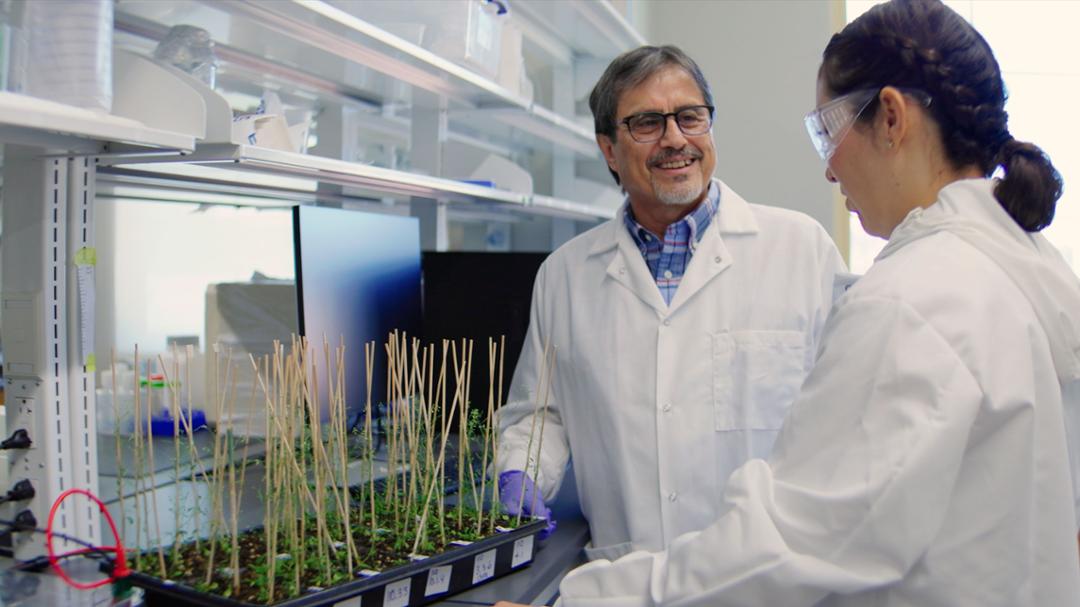

Haydee Laza, Luis Herrera-Estrella and Gunvant Patil and other faculty’s successes in crop improvement will be highlighted at the Global Sorghum Conference.
Among the breadth of talented and knowledgeable attendees convening at the Global Sorghum Conference, hosted by Texas Tech University from Sept. 14-18, are Red Raider researchers pioneering the sorghum industry’s next steps.
Working in the Davis College of Agricultural Sciences & Natural Resources’ Department of Plant & Soil Science and the Institute of Genomics for Crop Abiotic Stress Tolerance (IGCAST), Haydee Laza, Luis Herrera-Estrella and Gunvant Patil are tinkering with the details that will move crop improvement forward.


Laza, an assistant professor in plant physiology, investigates plant communication and the ecosystems managed for food production of semi-arid landscapes such as the High Plains. Her work draws on her extensive experiences that included a postdoctoral stint at the U.S. Department of Agriculture Agricultural Research Service’s Cropping Systems Research Laboratory in Lubbock.
Herrera-Estrella heads the IGCAST and is the President’s Distinguished Professor of Plant Genomics. As IGCAST director, he has concentrated the program’s efforts toward understanding how plants persist through adverse circumstances and developing various gene editing technologies to improve crops’ adaptability, nutritional value and other traits.
The central question Herrera-Estrella seeks to answer concerns how plants react to external impacts such as drought.
“I want to know how the plant perceives if there are enough nutrients in the soil, if there is not water in the soil and how these mechanisms of perceiving an environmental signal trigger a response of the plant that makes it tolerate adverse conditions,” he said.
With a growing world population that needs food to survive amid diminishing natural resources, Herrera-Estrella stresses the responsibility of researchers, producers and industry experts to produce more, better food using less land and less provisions.
Continuing to invest in agriculture is fundamental, he added.
Patil is an associate professor in molecular crop improvement, whose lab has two objectives. He uses several biotechnology techniques to discover new traits required to withstand both abiotic (e.g., heat or lack of water) and biotic (pathogenic) stressors and develops genetic engineering technologies to enhance crops such as cotton or sorghum.
There are no commercially available genetically engineered sorghum varietals on the current market.
Patil is particularly excited about a recent achievement that completed a five-year process. His lab discovered two genes that can reprogram sorghum cells to regenerate roughly three times faster than the normal rate.
Sorghum is typically difficult to conduct gene introduction and engineering with due to its myriad varieties and high production of phenols, or defense response chemicals that resist the agrobacterium used to deliver genes from other sorghum species or plants.
“We have used those genes to transform sorghum in at least two cycles, and the data looks very promising,” he said. “We have submitted the patent application, so once we get the patent, these new genes will be available for academic and industry licensing and collaboration.”
The work in these technologies addresses the numerous major bottlenecks Patil describes in translational genomics, which aims to apply genetic research discoveries to corresponding fields.
In addition to challenges in transformational and regenerative efficiency, genotype dependence and maintaining sterile lab conditions, the amount of time needed to transform a genotype can also be a hindrance to progress.
With his lab’s advancement, Patil foresees the reduction of time for genetic engineering necessitating fewer dedicated resources and skills in turn.
Streamlining this process will help researchers and the food industry verify the vast number of genes and data that has already been identified as potentially important to crop improvement but has remained simply hypothesis to date as water decreases and heat increases.
“Those traits need to be rapidly tested to improve the (sorghum) crop, and the tools that we are developing will be helpful with that testing,” Patil said. “Therefore, since our technology is going to be available very soon, the researcher will be able to use that as a medium to at least learn, understand, and develop the new varieties.”