
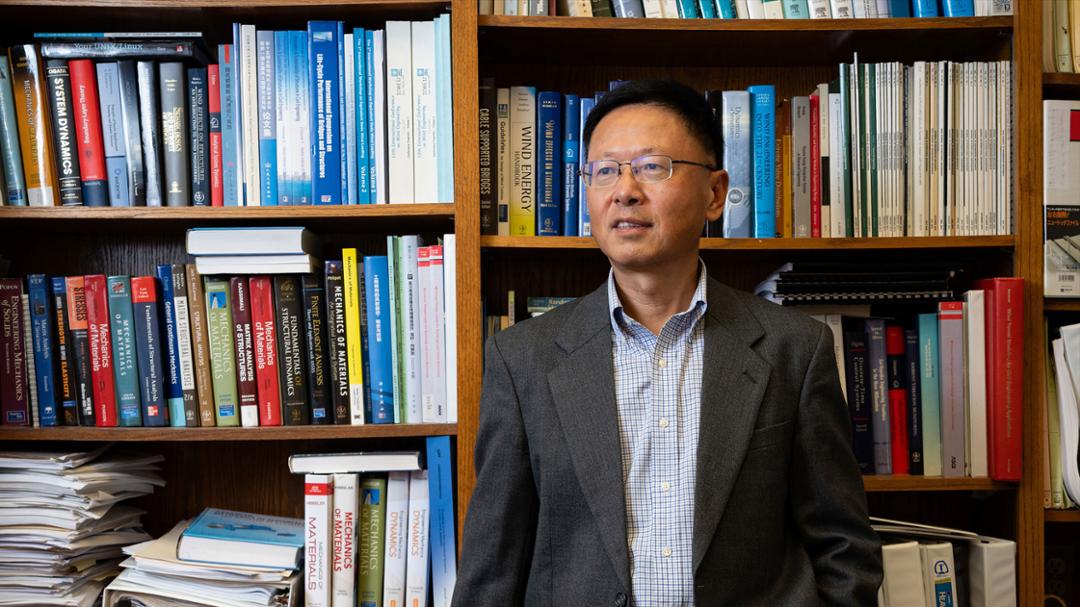

This civil and structural engineer has become one of the most respected experts in wind engineering and structural aerodynamics.
Throughout his career, Xinzhong Chen has been recognized around the world for his trailblazing research in wind engineering and structural aerodynamics, but just as meaningful to him was an honor he received earlier this year from Texas Tech University.
Chen, who joined the Texas Tech faculty in 2004, was named recipient of the Texas University Fund Distinguished Research Professor award, one of a suite of new faculty recognitions unveiled this year. This award supports senior faculty engaged in strategic research initiatives aligned with institutional and statewide goals.

“I’m very pleased and at the same time very humbled to receive this prestigious award,” said Chen, President’s Excellence in Research Professor in the Department of Civil, Environmental & Construction Engineering in the Edward E. Whitacre Jr. College of Engineering.
“I see it not only as recognition of my achievements to date, but also, I think, in a different way it is inspiration as far as building on what has been achieved and continuing to make a significant contribution to our university’s great mission to become a member of the Association of American Universities (AAU).”
Chen’s work on campus has helped him build an international reputation as an expert in his primary research areas of bridge and building aerodynamics and wind engineering. As a result, he received the Davenport Medal and the Scanlan Medal in 2024 for his contributions to the field of aerodynamics of bridges and buildings.
“Texas Tech and our place in the world provide an ideal laboratory for Xinzhong’s work in weather resilience,” said Ron Hendrick, provost & senior vice president. “The recognition he has earned from his peers reflects the significance of his research and its real-world impact. His work, alongside that of his collaborators, is helping communities better prepare for severe weather and, ultimately, save lives.”
Chen said the honor is especially meaningful on a campus where world-class researchers are conducting significant work regularly.
“It is important that this award recognizes senior faculty and their value they bring to the university,” he said. “In that sense also, I am very proud to be part of the university.”
The thrust of Chen’s work seeks to understand the impacts of wind on buildings, bridges, transmission lines and wind turbines. The goal is to deeply dig into and characterize the effects on those types of infrastructure and then design safer, more economical and sustainable versions of the structures to the benefit of society.
“For civil and structural engineers, two of the greatest hazards are seismic and wind,” he said. “We have a lot of research focusing on both of these, and I started working on wind-related research following my Ph.D. dissertation in the early 1990s.”

Originally, Chen focused on the wind’s impact on long span bridges, looking to make them safer and stronger. Later in his career, he broadened his approach to include bridges in general as well as low- and high-rise buildings and other infrastructure that might be susceptible to wind damage.
Chen has also been recognized with the Jack E. Cermak Medal in 2017 for advancing wind engineering, giving him a sweep of the three most prestigious awards in his field. He is only the fourth person in the world and second from the U.S. to receive all three honors.
He has written over 160 peer-reviewed articles, delivered keynote lectures around the world and frequently been on the leading edge of unlocking new knowledge in his field. He is listed in the world’s top 2% of most cited scientists for their scientific careers, per a study by Stanford University in 2025.
For Chen, he said it has been satisfying to see his research translate into real-world application, especially in West Texas and other areas susceptible to high winds.
“That is really the most rewarding part of the research,” he said. “You see your research published and then cited by colleagues worldwide, and your research allows for a better understanding of complex problems and improved infrastructure. Also, I have attended conferences and had colleagues tell me they were inspired by my research, and that is a very rewarding moment professionally.”
Still, as much as he has accomplished, Chen said there remains much to be done.
“I could not have imagined continuing this work for so long and achieving so much,” he said. “A lot of things need to be done, but I am very satisfied so far, and I thank Texas Tech for providing the opportunity for me to do this kind of research.”