
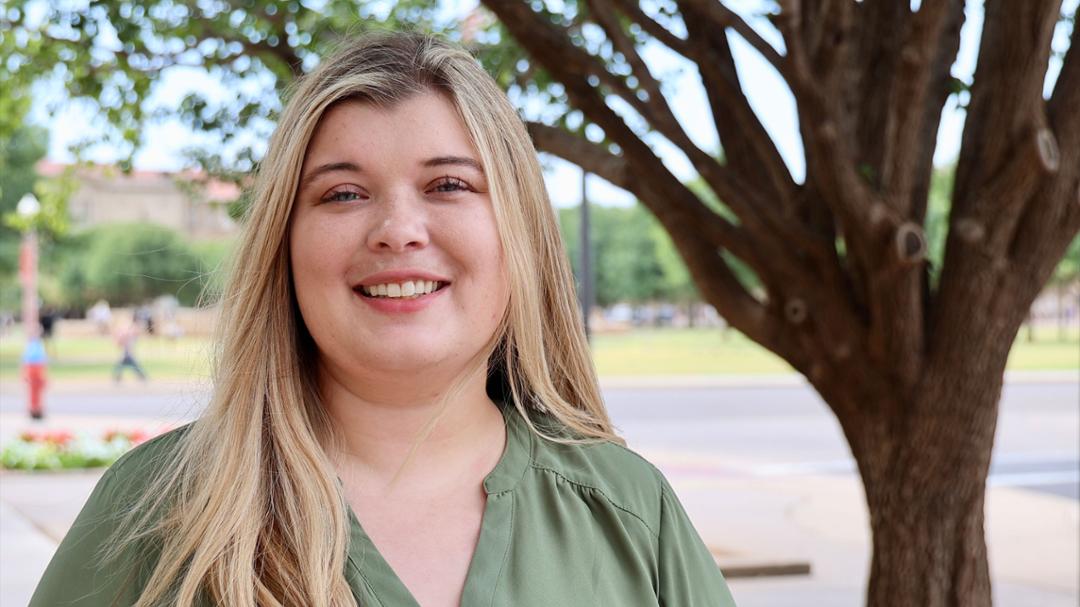

Texas Tech instructor Ali Hooks overcame hardships of her own as a student and now uses that momentum to help others.
It’s a hot, late afternoon, in September. Many students may be tempted to doze off, but as soon as Ali Hooks, a Texas Success Initiative (TSI) math instructor at Texas Tech University, walks into her classroom, the students are lively.
“So, who’s going to our football game on Saturday?” she asks.
The students raise their hands quickly, and immediately begin asking questions like, “Where’s the student section gate? How do I get my tickets? What should I bring to the game?”
Ali answers everyone’s questions and shares her favorite moments from attending the games during her time as an undergraduate and graduate student at Texas Tech. Her students smile as they prepare for class, passing down the exercise sheet for today’s session.

Ali has devoted herself to assisting first-generation students. Her genuine passion to help originates from her own experiences of overcoming major adversities when she was in their position.
“You’re following a road that wasn’t paved for you,” Ali said.
After she graduated with a master’s in sociology in 2025, she decided to work at Texas Tech’s TSI office. The state-mandated program is designed to ensure students entering Texas public colleges and universities have the necessary academic skills to succeed in entry-level college coursework.
The program creates customized academic support plans for coursework in key areas to ensure students will be successful.
“I joined the TSI program because I know what it feels like to come here and go, ‘Oh my goodness, what did I do?’” she said. “I like being that friendly face and showing students what they can do with their major and the resources that the university has.”
One of the most impacted groups when transitioning into higher education is first-generation students.
“A common hardship that first-gens face is not knowing the hidden rules of college, like office hours, financial aid, degree plans and academic advising,” Ali said. “That can feel confusing when you’re the first one in the family to ever go to college.”
She also says the majority are under great pressure. Many of these students also need to balance jobs with schoolwork, leaving them overwhelmed by new demands.
“They feel like they have to succeed, not only for them, but they have to succeed for their families too,” Ali said.
Coming to Texas Tech
Ali grew up in a small town in Louisiana, with a population of about 2,000. She said Louisiana has historically ranked low in education levels, even recalling times where she had to help her grandmother read her mail.
In 2018, Ali started her Texas Tech journey. Luckily, her outgoing personality opened many doors for her.

“The first thing I did was Red Raider Camp,” she said. “That’s right before you even do orientation, and I met my best friends and bridesmaids at Red Raider Camp.”
For the first couple of months everything was going fine. She adapted to college life, made new friends, participated in student organizations and was doing well in classes.
Before arriving on campus, though, Ali occasionally felt nauseated and fatigued. She had visited three separate doctors but felt as if they all downplayed her concerns. They claimed the symptoms were likely due to the stress of starting college.
Now two months into the semester, she still felt nauseous, had headaches and couldn't urinate regardless of how much water she drank. She was scheduled for an ultrasound to confirm a possible stomach ulcer.
Unfortunately, Ali missed her appointment.
More Than Stress
At 4 a.m. Oct. 5, Ali woke up struggling for breath.
Amid the panic, she drove herself to the emergency room at Covenant Medical Center.
The medical staff initially thought she had a broken rib, but they ordered additional bloodwork to rule out other options. Rather than doing so, the results confirmed it.
Ali was diagnosed with end-stage renal disease. Her kidneys could no longer filter her blood properly, which resulted in over 90% of her lungs being filled with liquid, and she even underwent heart catheterization. The doctors told her she needed immediate dialysis or a kidney transplant to stay alive.
After a grueling week of living in intensive care at the hospital, going through dialysis treatments, the medical team once again had to deliver bad news. There was still an excessive amount of fluid built up in Ali’s heart. She would need to immediately undergo major heart surgery.
Ali just said, “Go for it.”
Only a week after her successful heart surgery, Ali returned to campus; there was no way she was giving up what she came for. She continued her classes but now had to endure the dialysis process for five hours a day, three to four days per week.
The dialysis only bought Ali more time because without a kidney transplant, her body was slowly shutting down. The more time passed, the worse her condition became, even resulting in a stroke.

Luckily, in fall 2019, Ali received the news that would change her life. A family friend was a perfect match for a kidney transplant, but Ali had an unexpected request – she wanted to wait until after the semester ended so she could finish her classes. On Dec. 23, after a year of resilience, patience and bravery, she finally had the kidney transplant.
Ali could live a normal life again.
Relentless Perseverance
After her graduation in May 2023, Ali decided to stay at Texas Tech, pursuing a master’s degree. Her medical history was still very much part of her experience, causing her to occasionally miss class or events to attend appointments. Ali believes this experience shaped the way she works with students today. She understands that students facing circumstances outside of the classroom bring that into their classwork.
In July 2025, Ali’s journey continued at Texas Tech when she became a full-time instructor for TSI. Her motive is clear: Ali has a pure desire to help students.

“My story taught me how important it is for students to have people check in on them, to have access to different forms of accommodation, to have Student Disability Services (SDS), to have Academic Testing Services, having different angles like that,” Ali reflected.
Katheryne Camacho, a second-year animal science major, took Ali’s TSI math course. What Katheryne didn’t know was that registering for this course would change her view on college.
“Ali impacted my college experience in a unique way because I never thought going into college, I would find a professor that I related to so much,” Katheryne said. “She would always try to help us stay engaged; she would tell us stories and make us laugh, and it was fun.”
Looking back on her own experiences, Ali believes that she needed exactly what other first-gens need.
“I needed someone with the guidance and patience to say, ‘You can do this, and here’s how,’” she said.
One thing she likes about teaching TSI is that class sizes are smaller, which allows her to build a stronger connection with her students.
“They can actually engage in the material I’m teaching,” said Ali. “It’s not just about passing another course. It’s about helping those students build confidence, and helping them realize they belong at Texas Tech.”

Belonging
During the middle of last semester, Ali noticed some of her students were still struggling with the content, which inspired her to offer additional tutoring.
“After that, something clicked in my brain, like, ‘I do need extra help,’” said Katheryne. “I emailed Ali, and we scheduled one-on-one meetings where she would work with me on things I was confused about, even if it was two units ago. That helped a lot. It honestly made me feel relieved, and Ali always made us feel invited.”
Marley Edwards, a second-year digital narrative major, is grateful for her teacher’s hard work, which helped shape the way she views college.
“For the final before winter break, Ali emailed us that she would have her office open the day of the final, from the earliest she could have it open until right before the final began, and I took that opportunity,” Marley said. “I was so panicked I was going to fail.”
On that day, Ali and Marley went through every question from the exercises.
“I remember her stopping me in the middle of my panic to tell me she knew I would pass,” Marley said. “She told me she believed in me.”
For new students, having access to this customized mentoring can be crucial in their early semesters. It helps them build confidence, a sense of belonging and gives them a clear idea of what resources the university has. It also shows them how these resources, combined with the correct guidance, can pave the way for their future.
“I say, ‘Yes, I’m your professor, but if you need anything, if you’re looking for tutoring, or looking for the food pantry, or looking for Red to Black, I know all the organizations,’” Ali said. “You tell me what you need, and if I can’t find it, I promise you, I’ll find someone who can.”
One thing Ali noticed is that not all students come to college with a computer or a tablet. So, she goes out of her way to properly accommodate them, by printing out what will be covered or demonstrated digitally.
“I make sure I have printed copies, so no one feels left behind,” she says.
Being nonjudgmental plays a key role in educating students. Many first-generation students fear being judged or how they will be portrayed, especially when asking questions. While teaching, Ali claims she has three main goals: deliver clear instructions, build encouragement and give students space to ask any questions.
“I want them to understand that struggling doesn’t mean they’re failing. It just means we found out where they need support,” she said.
One way Ali achieves this is by holding occasional “assessment” quizzes, which helps her see where her class stands in relation to the content.

“There really wasn’t a moment where she’d leave a student behind while the rest kept going,” said Marley. “It made me feel seen as a student – and more relieved for sure. I felt more positive about going to her class compared to other classes. I’m not sure how else to describe it other than pure relief.”
Outside of the classroom, Ali is still a supporter of first-gen students. She partakes in the American Sociological Association, where she travels nationwide to conferences to speak up for students. Additionally, she is preparing to pursue a doctoral degree at Texas Tech. She understands just how much this milestone would mean as a first-gen student.
“If I’m going to be the first one to do it, I’m going to go all the way,” she said. “I want the bachelor’s, I want the master’s, I want the Ph.D.”
Her relentless perseverance is what got her through major challenges in life, and she has no plans to stop any time soon.
“In 10 years, I’d love to be a full-time professor who’s still teaching and advocating for first-gen students; I love helping students kickstart their journey,” said Ali. “Even though I’ll have another degree, I still want to be me.”
