
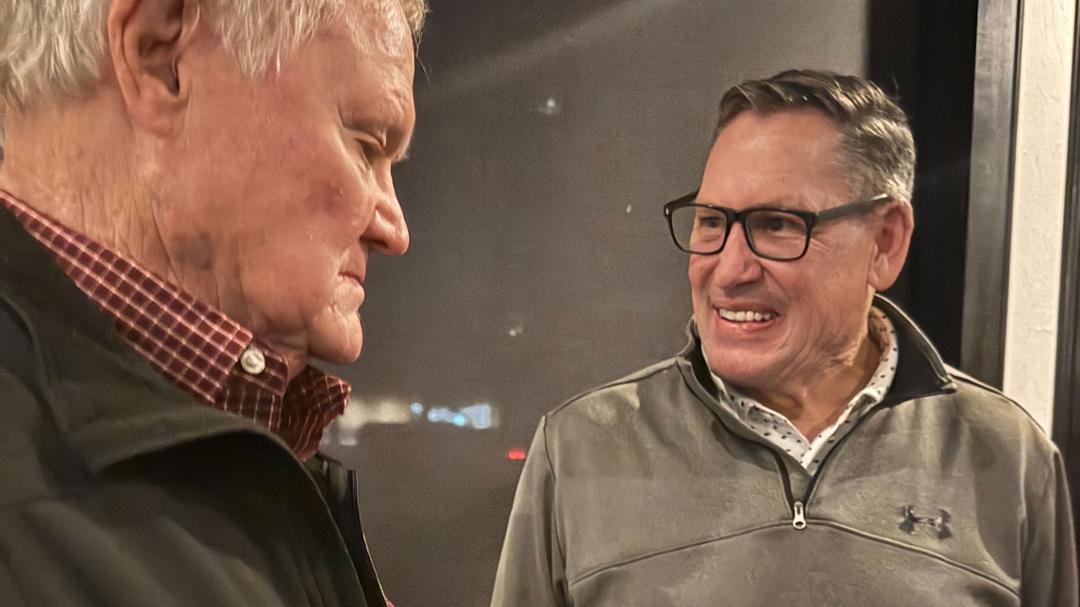

From the classroom to the basketball court, this former Red Raider athlete made a difference as a player and continues to make one as a coach.
Bubba Jennings gave Texas Tech University and Red Raider basketball fans five memorable years. In return, the university helped prepare him for a lifetime of successes, many of which came because of his love for the game.
It’s been a minute (or two) since Jennings was one of the most coveted recruits in Red Raider basketball annals, coming to Texas Tech from Clovis, New Mexico, after a storied high school career that included once scoring 75 points in a single game (a formidable feat in the days before the 3-point line).
Even more than 40 years since his last game here, he remains one of the purest shooters ever to don a Texas Tech uniform (think Jimmy Chitwood from the movie “Hoosiers.”)
Earlier this year, Jennings, a point guard and one of the program’s all-time greats, was inducted into the Texas Tech men’s basketball Ring of Honor. And, once again, for a while anyway, the Bubba Jennings stories were flying – just like those beautifully arcing shots he launched over determined defenders.

“Growing up, all I ever wanted to do was play basketball as long as I could and then coach basketball as long as I could,” he said. “And I’m still doing that.”
Indeed, these days Jennings is the head coach of the Arlington Baptist University men’s basketball and golf programs. The Patriots compete in the National Christian College Athletic Association, and Jennings, to no one’s surprise, is working to build a competitive program, where he just completed his fourth season at the helm.
Before all that, though, Jennings was part of a wave of talented eastern New Mexico players who competed at Texas Tech. Including Jennings, the Red Raiders signed six consecutive New Mexico players of the year. Other familiar names from that stretch include fabled Hobbs, New Mexico, standouts Kent Williams, Jeff Taylor, Vince Taylor and Tony Benford.
“I felt like I had a great educational experience at Texas Tech,” Jennings said. “There were a lot of New Mexico kids who came over to Texas Tech and Coach (Gerald) Myers He had some great assistants in Rob Evans, who was from Hobbs, and Brad Adkins.”
Adkins, who was just starting out as a college coach, built a relationship with Jennings, his family and his high school coach Jimmy Joe Robinson during what became a hectic recruiting process. Scores of other schools, like the University of Kansas, Southern Methodist University (SMU), the University of Texas at Austin and the University of New Mexico, were also looking to land Jennings.

“I remember Bubba went to Kansas for a visit, and this was a long time ago, they got him out on the court to play in a pickup game,” said Myers, who led the Red Raider program from 1971-91. “I don’t think they realized how good he was until then, and after that, they started recruiting him pretty hard.”
Ironically, Jennings remembers another pick-up basketball game that took place during his recruiting visit to Texas Tech. The Robert H. Ewalt Student Recreation Center had just opened, and it was a cold, snowy day. The basketball courts were packed, and per pickup basketball rules, winners stayed on the court and kept playing.
“If you didn’t win, you’d have to sit out for 30 or 45 minutes before you could get back on the court,” Jennings said.
Jennings and his teammates took the court against another team that had been having great success that day, but the team with the prized basketball recruit wound up winning the game. Then things got a little confrontational with one of the players from the opposing team challenging Jennings.
But the would-be conflict didn’t last long.
“As I turned around, all I saw was this guy being picked up basically by the neck and sort of being thrown across the court,” Jennings said. “After that, he and pointed at me and said, ‘Don’t mess with this guy.”’
Jennings’ protector that day? Another all-time Texas Tech athletic great, football player Gabriel Rivera. It may not have clinched the deal as far as Jennings becoming a Red Raider, but it was certainly a point in Texas Tech’s favor.
“I thought Texas Tech would be a good place for me to come after that kind of support,” Jennings said. “I always wanted to be a coach and a teacher, and I really enjoyed the professors. I had a great advisor. They were all special people, and I enjoyed going through the program and learning a lot about physical education and health and those things.”

In the end, Lubbock’s proximity to Clovis was a decisive factor. Jennings wanted his family to be able to watch him play, and the 100-mile drive down U.S. 84 wouldn’t be a heavy lift, no matter how many times they made it.

But the recruiting battle didn’t end for some time, and both Myers and Jennings credit Adkins for his tenacity as far as making sure Jennings knew the Red Raiders’ interest in him never waned.
“Gerald told me that there was one kid he really wanted me to focus on, and that he could be the single most important player they had ever recruited there,” Adkins recalled. “I figured it must be a 7-footer or some big-time player from New York or Los Angeles, somewhere way off.
“Turns out, though, it was like (former radio broadcaster) Paul Harvey used to say: I didn’t know the rest of the story.”
In fact, Jennings didn’t quite qualify as a 6-footer. He was listed at 5-11 on the official roster. But what he lacked in height, he made up for in heart, grit and determination.
Adkins went about making sure Jennings, his family and his coach knew the Red Raiders were extremely interested in seeing the standout sign with Texas Tech. Adkins estimates he watched Jennings play as a high school senior somewhere between 20 and 25 times.
“I was there every time he turned around,” Adkins said with a laugh. “As a result, Bubba and I became very close. For a while there, no one had him coming to Texas Tech.”
Adkins’ persistence eventually paid off. He recalled attending a Hobbs-Clovis game and watching Jennings score between 40 and 50 points. Afterward, while visiting with Robinson, Adkins said people around him were certain Jennings was going to attend just about any school … except Texas Tech.
Robinson looked Adkins in the eye, his face growing solemn with the sincerity of the words he was about to speak.
“Bubba loves you, and he thinks the world of Coach Myers as well as all the coaches there, but he’s not going to play at Texas Tech,” he said. “He has to play somewhere he can get up and down the court.”
Adkins was aghast. Robinson was convinced Texas Tech’s more deliberate style of basketball would work against the Red Raiders. The game was changing with more emphasis on pace and tempo and fewer constraints around ball control and shot selection.

As a result, the Texas Tech assistant coach also saw the wisdom in Myers’ decision to pursue Jennings and characterize him as such a vital recruit. He would be instrumental in helping the Red Raiders increase their offensive pace.
Shortly after that, Adkins asked Jennings straight up: Did he want to come to Texas Tech and play basketball?
Jennings didn’t say yes, but he didn’t say no. There was something about Texas Tech that he couldn’t shake. At last, in early May, which was way late in the recruiting wars, Jennings signed with Texas Tech.
It was official. He was a Red Raider.
It was a big deal. Adkins arranged for Jennings to fly by private plane from Clovis to Lubbock, and he had a Cadillac reserved to drive him from the airport to campus. He also had another surprise planned.
“We drove right by the football stadium, and there on the Double T scoreboard, we had giant, flashing letters. They would come on the screen, get bigger, go off and then repeat,” he recalled.
The letters on the screen spelled out B-U-B-B-A.
“I remember seeing that and thinking, ‘Oh, my gosh,” Adkins said. “Everybody was excited about him coming to Texas Tech, and you know what? Bubba was a great basketball player, but he is an even better person.”
At Texas Tech, Jennings was a physical education major, which later evolved into exercise and sports science and now would be a bachelor’s degree in kinesiology within the Department of Kinesiology & Sports Management in the College of Arts & Sciences.

While Jennings considered the possibility of a basketball career after college, he prepared in case that didn’t pan out. His father, Brooks Jennings, was a coach, and Bubba wanted to travel that path as well, once his playing days wrapped up.
Jennings discovered the transition from high school to college was a challenge, and he learned some tough lessons early.
“I didn’t do very well my first year there,” he remembered. “I had a two-point something grade-point average. After that, I realized I had to go to class every day, and moving forward I don’t think I missed very many classes. I just did what I was supposed to do and had my GPA up near a 4.0 by the end of my career.”
Jennings enjoyed teaching the game to others, and he possessed a natural aptitude for connecting with athletes, abilities that came through at Texas Tech as he was the team’s floor leader throughout his career.
As a student-athlete, Jennings spent five years living on campus in Weymouth Hall, which was a designated athlete dorm at the time. After earning a spot in the starting lineup in his first season, Jennings broke his right foot only a few games into the next season and redshirted.
Regardless of the ups and downs, Jennings looks back on his time as a Red Raider athlete as shaping him into the player and person he would become.
“We had the athletic dining hall, and all the athletes got along really well,” he recalled. “We ate together. We lived together, and it was a really enjoyable time with all the programs supporting each other. There were just a lot of really good people there at Texas Tech.”
The Jennings era turned out to provide a memorable stretch of Red Raider basketball. With their floor leader in place, Myers and his staff turned their attention to surrounding him with more talent. Progress was slow, and there were struggles the first couple of years, but ultimately, one of the school’s most talented teams was assembled.
Jennings also kept his attention focused on academics, making sure he handled classroom responsibilities.
“There is no question that Texas Tech prepared me,” he said. “First, just playing for Coach Myers and having classes where professors focused on your development. Those were beneficial for me.

“Coach Myers was great. I learned more about defense in my first year of basketball there than I did the rest of my career. Still today, my own defensive philosophy is based a lot around what Coach Myers taught. I have never, ever been around a more competitive person than him.”
Jennings started all 117 games of his career with the Red Raiders. By the 1984-85 season, his final year in the program, the team fashioned a 23-8 record and won both the Southwest Conference (SWC) regular-season and post-season tournament titles, landing the team’s first NCAA Tournament berth in nine years.
Jennings was a four-time all-SWC selection and was named the conference’s player of the year as a senior. That same year he was named the league’s Athlete of the Year and also received the Frances Pomeroy Naismith Award, given to the nation’s outstanding player under 6-feet tall.
His 1,760 career points scored ranks him ninth on the school’s all-time list, and his career 85% free-throw shooting ranks fourth. He is also still among the program’s all-time top 10 in assists and steals.
“I don’t think Bubba ever had a bad day shooting the ball,” Myers said. “He shot the ball and scored every day in drills at practice. He was so consistent and just the kind of player you could mark down 20 points for in the scorebook every game. When you have a player you can count on for 20 points, you can win quite a few games.”
Jennings was inducted into the Texas Tech Hall of Fame in 1995, and once the men’s basketball program launched its Ring of Honor, it was only a matter of time before his impact and legacy were acknowledged.
“It brought back so many memories, and I still get emotional when I think about it,” he said of the Ring of Honor induction that took place at halftime of a February game against Kansas. “It really hit me, being with all my teammates and Coach Myers and everyone. I don’t know if it’s sunk in yet. It feels good and humbling and rewarding.”

Jennings moved into coaching shortly after his playing days, first working as a graduate assistant for the Red Raiders and then becoming head coach at Artesia, New Mexico, where he won two state championships in basketball and one as golf coach during nine seasons.
From there, he became head coach at Coronado High School in Lubbock and then returned to the Texas Tech staff, first as video operations coordinator and then as an assistant coach on Bob Knight’s staff. He left Texas Tech in 2013 during a coaching staff transition.
For the first time in his life, he was away from basketball. Jennings said former Red Raider head coach Tubby Smith had inquired about him joining the staff, but Jennings thought a new season of a different type was just what he needed.
He went to work for a Lubbock bank and spent five years collecting professional experiences and broadening his resume.
“I loved working in the banking business,” he said. “And I was grateful for the job. As I was doing that, though, I was also giving private and group basketball lessons, and I missed being an actual coach with my own team.”
He returned to the high school ranks at Peaster, located northwest of Fort Worth, and after three years there, he accepted the job at Arlington Baptist, where he also coaches golf and lives close enough to spend regular time with his grandson.
And while Jennings had an impact on Texas Tech, the same is true for the school’s impact and imprint on him.
The memories remain.
“I still remember my first visit to Lubbock and Texas Tech,” he said. “Everyone was so friendly. They may not know you, but they say hello to you, and I really liked that. And once I got there and was living in the dorm and eating in the dining hall with other athletes, it just seemed like we were one big family.
“Things were really good for me at Texas Tech. I started as a freshman, and I had great teammates, and I just really couldn’t have asked for anything better.”