
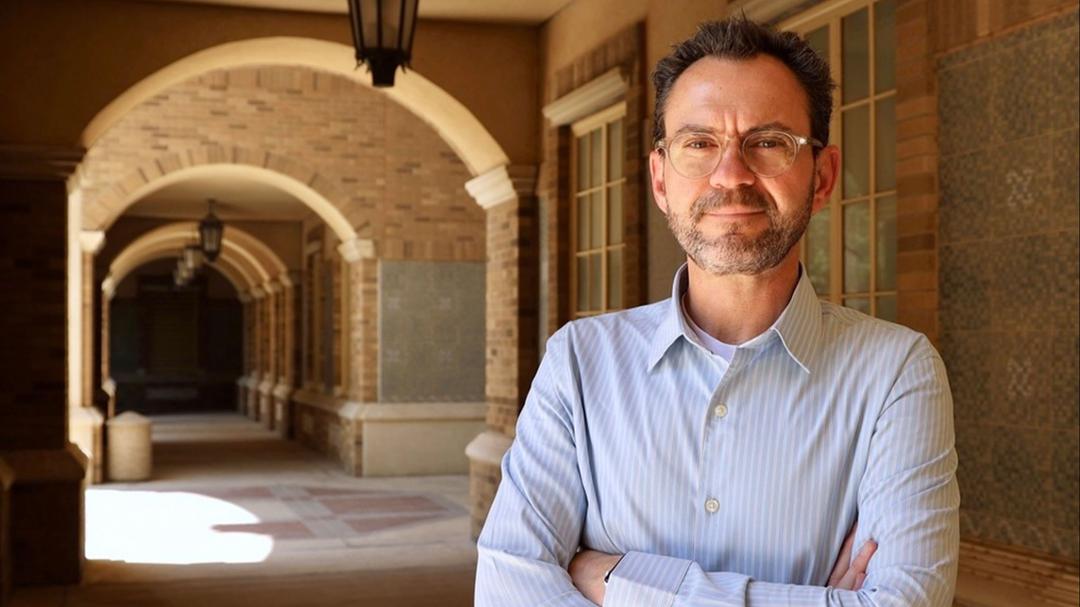

For Glenn Cummins, the recent honor merely punctuates a long road of growth and success in the College of Media & Communication.
Glenn Cummins has a 10-minute commute to Texas Tech University. It’s a straight drive down Indiana Avenue to his office, allowing him time to listen to highlights of the marketplace morning report on NPR. If it’s a short report, he’ll switch over to local radio – a remnant of his early career.
Cummins earned his bachelor’s degree in radio, television and film from the University of Southern Mississippi in 1997.
“I didn’t even know you could study media like radio or TV,” he recalls. “I was planning to become an accountant.”
His pocket transistor radio and the debut of “Star Wars: Episode IV” had captivated his attention as a child, but he assumed they’d become bygone hobbies. He never thought of his own media consumption as something that could be studied.
Twenty years later, Cummins’ tenure at Texas Tech University was recently accentuated with a competitive selection to the Scripps Howard Leadership Academy. The professor and associate dean in the College of Media & Communication has built a successful career by teaching and researching journalism and creative media industries.
“Everything I’ve gotten to experience in my career because of Texas Tech would have been a mere pipedream to me as a kid,” Cummins says.
The Bigger Picture
Cummins has evolved and grown along with Texas Tech. As he’s celebrated the university’s growth, it’s been impossible to separate his own. But his career didn’t start here.
After two degrees, Cummins took a job as a producer at a broadcast news ABC affiliate. This had been the goal since starting college. A barrage of writers, editors, anchors and producers filled the station’s newsroom.
“Everyone was zeroed in on making the 6 p.m. and 10 p.m. news,” Cummins remembers. “And I was too for a while.”
Two years in, Cummins was invited to a workshop in Houston.
“That was a transformation moment,” he says. “We were discussing audience research and when I went back to work, I couldn’t stop asking these big-picture questions that no one else wanted to talk about – not unless it somehow fit into the 10 o’clock news.”
Cummins had always been fascinated by the psychological process that informs what media someone chooses to listen to or watch. And in 2002, the dot-com boom and advent of social media was changing everything he thought he knew. Media was ceasing to be a one-way street. He decided to leave his broadcast news job and take a chance on a job in academia. He didn’t want to merely produce and consume media; he wanted to understand it.
After finishing his doctoral degree and cutting his teeth as an assistant professor for two years at another institution, Cummins began looking for a university with more ambitious research goals.
“I immediately recognized a kindred spirit between Texas Tech and myself,” he says.
Cummins had never been to Lubbock, but one of his friends had taken a faculty job at Texas Tech.
“Glenn is quick-witted and always looking to laugh, but he doesn’t shy away from serious conversations,” says Associate Dean for Research and Graduate Studies Coy Callison. “He is a standout educator because he is equally fantastic as both a teacher and a researcher.”
Knowing he was looking for more research opportunities, Callison encouraged Cummins, who he had met when they both were graduate students at the University of Alabama, to apply for an open position at Texas Tech. He had no doubt his friend would be the perfect fit.
“He’s always struck me as the smartest person in the room. That’s been a bit aggravating both then and now,” Callison says, laughing. “Even back in graduate school, he would say something in response to a question, and I would think, ‘I wish I had thought of that.’”
Possibilities & Potential
“I like that Texas Tech remains ambitious,” Cummins says.
In his time here, he has grown from an assistant professor into a tenured full professor, and in 2010, he took on his first administrative role as an assistant department chair. From there, he’s served in various capacities, most recently being appointed the associate dean for faculty and academic affairs within the college.
“I’ve been rounded out as a scholar, I don’t feel like a one-trick pony,” he says.
From teaching Introduction to Creative Media Industries – his favorite class – to advising graduate research projects and publishing hundreds of articles, papers and chapters, Cummins has never been bored.
He got busier when the college’s former dean recognized Cummins’ capacity for leadership and management.
This flattered Cummins but also alerted him to a potential gap in his professional development.
He began looking back at his training as an academic and noted there was a lack of formal training when it came to leading people.
“When you earn a doctorate degree, you’re trained very specifically in a niche area of study,” he explains. “Those individuals are experts in their field, but that doesn’t automatically mean they’re experts in leadership.”
He’s had access to opportunities at Texas Tech that aim to fill this need for faculty, such as the President’s Leadership Institute or the resources offered through the Office of Research & Innovation.
His shift into leadership positions has forced Cummins to recalibrate.
“When I began my career, it was all about the classes I led, the papers I published, the students I taught,” he says. “But now, my success is measured by the success of others.”
Last year, Dean Bey-Ling Sha suggested Cummins apply for the Scripps Howard Leadership Academy. The highly competitive program offers immersive training for leaders in journalism and mass communications higher education.
“I felt Dr. Cummins merited selection not only for his prior leadership experience at Texas Tech, but also for his leadership potential in continuing to serve faculty, staff and students,” she says.
Dean Sha worked closely with Cummins as he served as interim chair of journalism and creative media industries, and now, in his new position as associate dean.
“He is a wise and generous source of institutional knowledge,” Sha adds. “He is always seeking to develop as a leader, and he possesses genuine humility, which is what makes learning possible for any individual, when you’re OK with acknowledging that you still have stuff to learn.”
These were all sentiments Sha made known in the recommendation letter she sent to the Scripps Howard selection committee, which notified Cummins in April that he’d been accepted.
In June, Cummins and 13 others gathered at Syracuse University for a week. Each day easily went for 12 hours, sometimes longer, with participants trying to squeeze all they could out of the limited days together.
Cummins says the first day started with a panel of guest deans from across the country, including Sha, who shared their own leadership journeys and personal reflections about leadership.
“We also covered incredibly practical items like departmental budgeting and how best to engage with external stakeholders,” he recalls.
The days were carefully curated to explore topics that academic leaders need to have in their toolkit.
“It gave me the skeleton of a puzzle that I can now add the pieces to,” he says. “I learned a lot of the real day-to-day lived experiences of what it’s like to be a senior academic leader.”
During his time at the academy, as with many experiences he’s had through Texas Tech, Cummins tries to pause for a moment and reflect.

“For a little kid from rural Mississippi, the Scripps Howard Leadership Academy may as well have been Mars,” he says in disbelief.
He says the university’s slogan of “From Here, It’s Possible™” feels personal for him.
“It’s what motivates me when I’m working with students,” he says. “I want them to realize they can pursue whatever they want to pursue, because that’s been my story.”