


The newly established Danielle Alexandra and Richard L. Clemmer Institute for Social Entrepreneurship and Enterprise will help Red Raiders change the world far and wide.
Danielle Alexandra and Rick Clemmer know a thing or two about impact entrepreneurship. Between them, they have decades of experience creating and building startups and nonprofit organizations (NGOs) whose missions are to benefit humankind.
Now, Alexandra and Clemmer want to help Texas Tech University develop future generations of impact entrepreneurs through the Danielle Alexandra and Richard L. Clemmer Institute for Social Entrepreneurship and Enterprise.
The recently established institute propels students’ understanding of the meaningful role entrepreneurs can have in fostering global impact. Students will develop skills and knowledge by attending guest speaker presentations, completing the Graduate Certificate in Social Entrepreneurship through the Graduate School and participating in the Social Entrepreneurship Challenge hosted by the Innovation Hub at Research Park.
The five-course certificate empowers graduate students who feel personally compelled to change the world to become innovators who design ventures that address real-world problems through entrepreneurial thinking.
“The partnership between the Graduate School and the institute ensures that students have both the academic foundation and the entrepreneurial tools to create real impact,” said Tim Dallas, associate dean of the Graduate School and professor in the Department of Electrical and Computer Engineering. “Together, we’re building a pipeline for student-led ventures that advance social good in meaningful and scalable ways.”
While students will learn to run major businesses and NGOs that have a global impact by completing the graduate certificate, the challenge gives them a chance to jumpstart their ideas.
The challenge was held this past fall semester and named four students as winners. These students are working on projects that cover a range of global concerns including providing personalized extreme weather hazard notifications to supporting cognitive and communication abilities of people with motor and speech disabilities.
“There are a lot of students today that have an interest in how to make an impact,” Clemmer said. “What we really want to do is give them the tools, knowledge and experience to be able to have success.”

Becoming Impactful Entrepreneurs
Clemmer and Alexandra may have professional roots in different industries – Clemmer in technology and semiconductors and Alexandra as a highly successful screenwriter, television and film producer, and DaVeritas Media CEO – but the couple work closely in their pursuit of impact entrepreneurialism in for-profit and non-profit sectors.
“We understand how to create and build entrepreneurial businesses that succeed,” Alexandra said, “and we want entrepreneurs to apply that strategy to build their impact ventures.”
While Clemmer and Alexandra are venture capitalists, the are strong advocates for what Alexandra calls “venture philanthropy” and invest in startups they believe in across technology, public health, environment and global impact entrepreneurship.
“For us, that entrepreneurial spirit not only goes across industries, sectors and startups that we believe will become very successful, but NGOs that have scalability and sustainability to make a deep difference to global human crises,” Alexandra said. “We are about impact.”
This led them to Texas Tech and their new endeavor as co-chairs of the Danielle Alexandra and Richard L. Clemmer Institute for Social Entrepreneurship and Enterprise.
Clemmer saw the impact the university could have firsthand. He grew up in North Texas and said attending Texas Tech was a natural choice. After graduating in 1973, he stayed in Lubbock and worked at the Texas Instruments facility before relocating to Dallas.
He now leads a semiconductor venture fund, serves as chairman of multiple successful startups and is on the board of directors of several global companies. In addition, he is vice-chairman of For Inspiration and Recognition of Science and Technology (FIRST), a global youth robotics organization that inspires young people’s interest in science, technology, engineering and mathematics (STEM). Clemmer also sits on the Texas Higher Education Coordinating Board, a role he was appointed to by Gov. Greg Abbott.
Clemmer has maintained a connection with Texas Tech, serving as part of the Edward E. Whitacre Jr. College of Engineering Dean’s Council. As part of his time with the council, he helped establish the robotics minor in the college.
Alexandra, a Harvard graduate, chaired the Women’s Leadership Conference and Awards for Young Women in STEM for six years and currently serves on the boards of two successful technology startups. And while she may not have a Texas Tech degree, she said the university offered a clear opportunity to make a substantial impact.
“Having seen extraordinary programs on both coasts, yet little focus on the exceptional students in the middle of the country, we wanted to bring entrepreneurship at a high level into midstream America where some of the brightest young minds are,” she said.


It also helped that President Lawrence Schovanec was fully behind the idea of the institute.
“Rick’s passion for the university enabled our first donation, but the ongoing building of the institute is because of the engagement of the President with us as a couple, “Alexandra said. “Our experience with President Schovanec and the passion he has to build the university and this program has been amazing. He really is an igniter of action.”
For President Schovanec, Alexandra and Clemmer’s new endeavor was an easy one to support.
“Danielle Alexandra and Richard Clemmer share a belief in the potential of Texas Tech and its students,” said President Schovanec. “Their commitment to the institute and initiatives like the Social Entrepreneurship Challenge speaks to a shared focus on innovation, service and preparing students to lead with purpose. We are grateful for their partnership and their confidence in the university’s direction.”
As more students work with the institute and complete the graduate certificate, Alexandra and Clemmer hope students realize they do not have to choose between building a successful business or one that makes an impact. These two aspirations are mutually scalable and achievable, and the institute will give students the confidence, foundation and vision to succeed in both.
Clemmer and Alexandra stressed they want the institute to have a presence across the entire university even though the heart of the information stems from the business and engineering fields.
The Social Entrepreneurship Challenge was the perfect opportunity to bring in more partners from across the university, such as the Innovation Hub.
“The Innovation Hub is such a terrific part of the university,” Alexandra said. “It’s ground zero for ideas to turn into execution.”
Meeting the Challenge
The Social Entrepreneurship Challenge gives undergraduate and graduate students from across the university an opportunity to transform bold ideas into viable and scalable social ventures.
“The Social Entrepreneurship Challenge is powerful because it helps Texas Tech students turn empathy into action, using innovation, customer discovery and measurable impact to solve social problems that can impact our world,” said Taysha Williams, managing director of the Innovation Hub. “We love to see ideas that don’t just create value; they create change.”
Twenty-four students competed in the inaugural challenge. Alexandra and Clemmer were part of the judging committee who evaluated students based on their ability to execute an idea, the viability of the idea and the clarity of each student’s vision.
And while Alexandra and Clemmer say they were very pleased with the level of commitment and passion demonstrated by all participants, four students especially stood out to them with life-changing global impact projects and were named as the challenge’s inaugural winners.
Rohan Khatri, a sophomore double majoring in electrical engineering and physics, wants to develop an artificial intelligence (AI) powered wearable device that can provide real-time navigation and hazard detection.
Shruti Nagawekar, a computer science major who graduated in December 2025, is working to develop BlinkTalk, a lightweight camera-based system that translates eye blinks into speech. She wants to give people with motor or speech impairments a means of maintaining dignified verbal communication.
Yanyi Chen, a civil engineering graduate student, is part of a team working on NeuroKeys, which uses AI-powered robotic music therapy to support cognitive and motor rehabilitation.
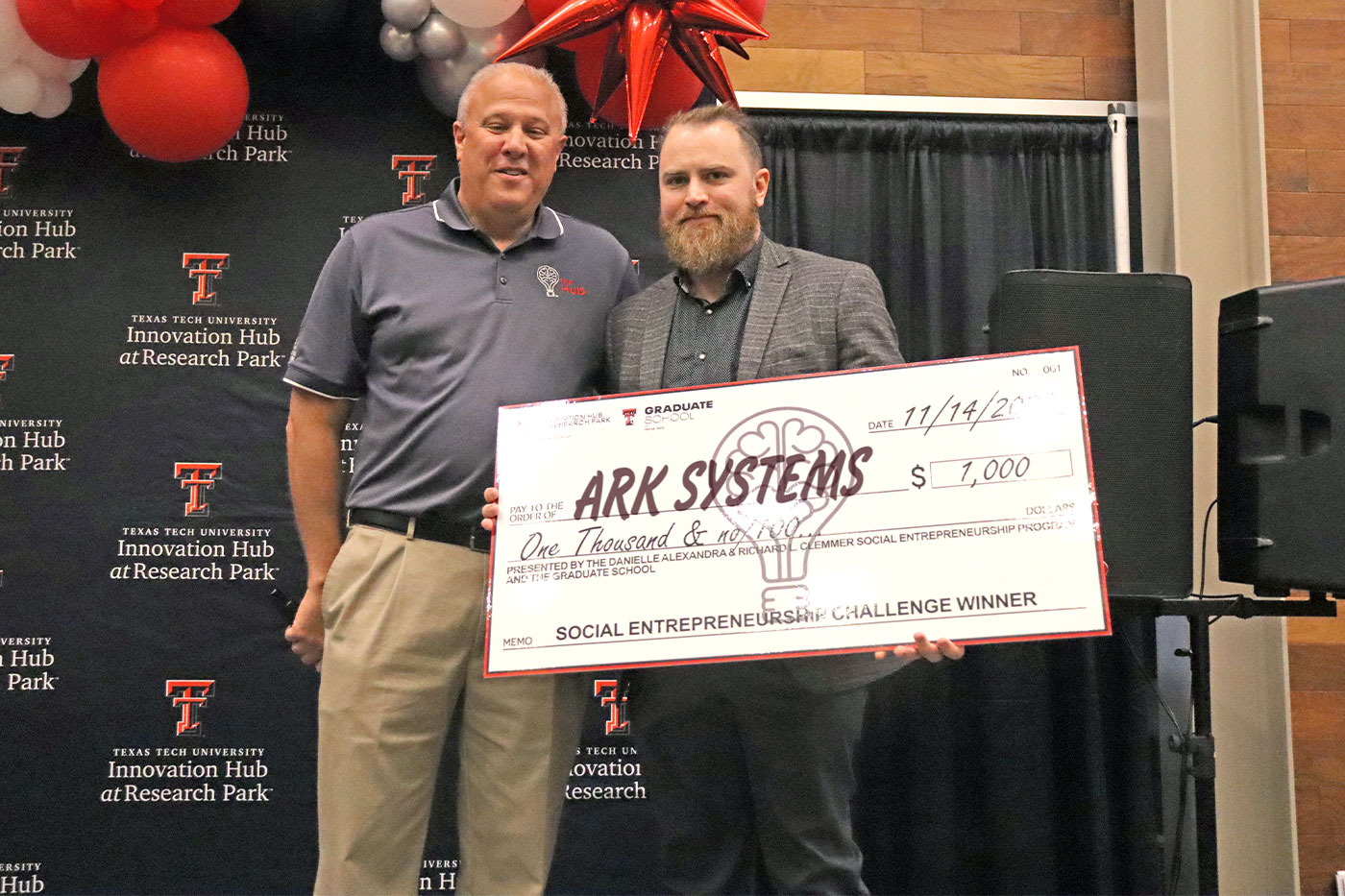
Hunter Cantrell, a graduate student earning a doctorate through the College of Media & Communication and a master’s of data science through the Jerry S. Rawls College of Business, hopes his venture, Ark Systems, can create decentralized, hyperlocal weather intelligence networks to provide real-time, street-level warnings.



Williams proudly noted that every student who participated in the challenge was at a different stage of developing their venture. Some students entered the challenge with little more than a realized idea, and others entered with an updated prototype or clear understanding of their next steps.
“Through the Innovation Hub, students don’t have to have it all figured out—if you have a problem that you care about, we can help you validate the need, shape a value proposition, build a prototype, connect with mentors and learn how to pitch and measure impact,” she said. “Our programs are designed to meet students where they are and help them move from idea to action.”
The challenge gave Chen an opportunity to better consider the next few development steps for her robotics team, the biggest being the commercialization of their idea to help real-world patients.
She said it can be easy to lose herself in the research and development of the technology, but it is another thing entirely to consider the usability of the robot as a product.
“We don’t have businesspeople on our team, but commercialization is a stage we want to achieve,” Chen said. “I think the most difficult part will be how to identify the customer.”
Cantrell, who is now planning on adding the Graduate Certificate in Social Entrepreneurship to his doctoral and master’s degrees, appreciated the whirlwind ride of the challenge.
“I really had to think about things beyond the idea phase and consider how we communicate this big idea and manifest these pieces in terms of progress,” he said. “It was challenging, but I found it really fun, too.”
Nagawekar has been working on BlinkTalk since the summer of 2024. She has seen her project develop quite a bit. Currently, her program can turn blinks into words instead of just letters, but she is not done iterating and making the tool even better.
“I want it to actually speak what the person has said and use AI to autocorrect,” she said. “I see the impact of BlinkTalk as giving people a voice and their dignity back.”
The first-prize awards will be divided into rounds centered on milestones and achievements to encourage continued development of their ideas. The winners received $1,000 this round and will submit a competitive execution deck in March for a chance at additional funding.
The four winners also received a one-year membership to the Innovation Hub and were assigned mentors to help with future deliverables and research.
Alexandra explained that this handing of the first-prize awards was an intentional decision to reflect the importance of impact and cultivate the entrepreneurial spirit within students. For her, having a great, impactful idea is only the prologue to a bigger story.
“We know from the decades of our experience that in order to be a successful entrepreneur, you not only need an absolute fire in your belly for what you’re doing, but you have to be willing to put the time and effort into making it happen,” she said. “Hopefully, we can keep the students moving, side-by-side all the way and climb the mountain together.”
All of this goes back to the mission of the Danielle Alexandra and Richard L. Clemmer Institute for Social Entrepreneurship and Enterprise. Impact – true global impact – is not just an of-the-moment idea, product or service.
“It’s about ensuring that there’s an understanding of how one student can create an avalanche of change,” Clemmer said. “It’s not just about Texas Tech or West Texas. It’s about how to make the world a better place and give all the students the knowledge and skills to be able to have that impact.”
Learn more about the Graduate Certificate in Social Entrepreneurship.