
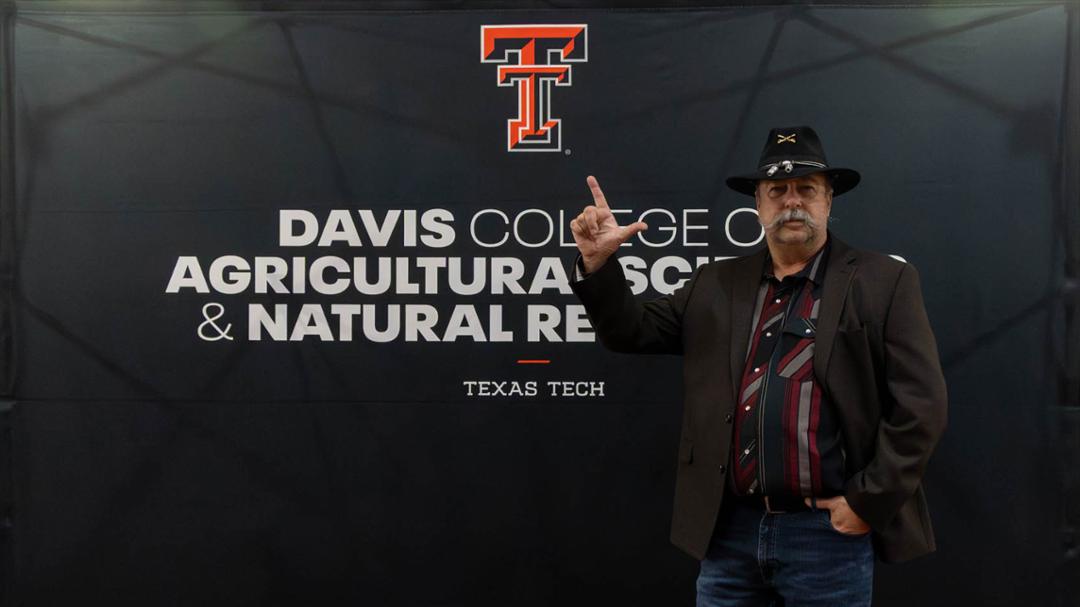

Army veteran Robert Mason found a second calling at Texas Tech, and now he’s created the Veterans Helping Veterans Scholarship to pay it forward.
It was no surprise to Robert Mason’s family when he joined the military.
In fact, it was practically a genetic trait.
Mason’s father and brother both served in the U.S. Coast Guard, and his nephew is at the U.S. Coast Guard Academy. His paternal great-grandfather served in the Missouri National Guard and fought against Pancho Villa in 1916-17.
His grandfather on his father’s side was on the USS Pennsylvania while it was drydocked in Pearl Harbor during Japan’s attack on Dec. 7, 1941. Meanwhile, his maternal grandfather abandoned a life as a “cornhusker” in Nebraska to enlist in the military during the Great Depression and served in World War II, the Korean War and the Vietnam War.
“We can date our military history all the way back to England, where my great, great, great, whatever grandfather fought against the King of England in the English Civil War,” Mason said. “Then we have members in our family that have served in every major conflict that (the U.S.) has had since it was a colony.”
Mason’s moment of rebelliousness was joining the U.S. Army rather than the Coast Guard, as his father had done.
At 18, he graduated from Ball High School in Galveston, Texas. Soon after, he arrived at Fort Rucker, Alabama, where he began preparing for his first day of flight school.
For nearly two decades afterward, Mason would find himself rising through the ranks and serving at various locations across the country and around the world.
He was stationed at Fort Hood and Fort Bliss in Texas and at Fort Campbell in Kentucky. He also served in the Ohio and Texas National Guards. Internationally, Mason was deployed to Iraq five times, once to Jordan and once to Turkey.
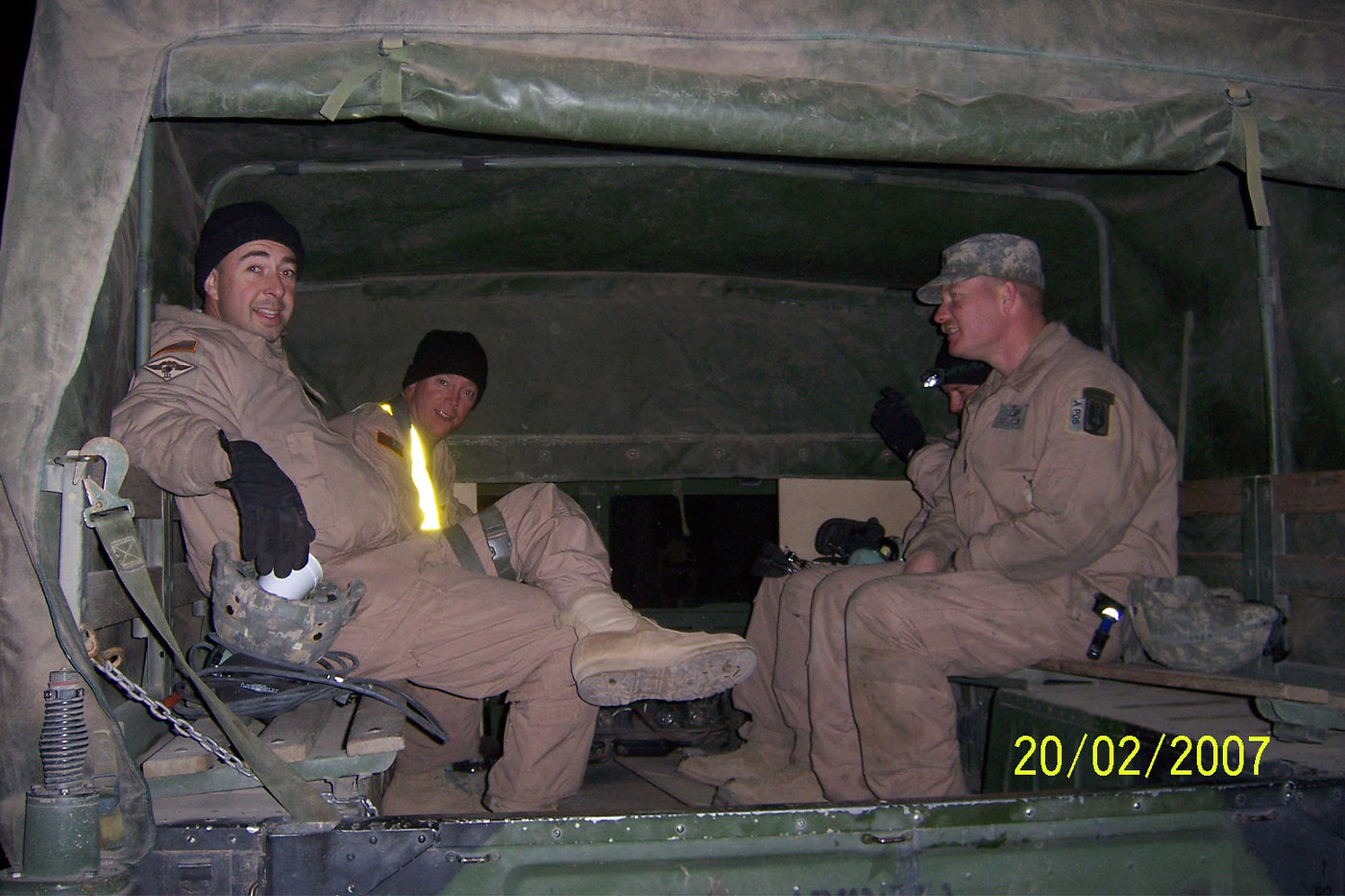

Traveling and moving frequently to new locations was nothing new to the self-described military brat who attended more than 10 different schools from kindergarten to his senior year.
“I served for 23 years total,” Mason said, pointing his finger with a quirk in his lip that lifted his big handlebar mustache on one side. “Well, unless you count growing up that way.”
He retired in 2010 as Army Chief Warrant Officer 3 Mason and began working as a defense contractor for the Army, performing aircraft maintenance and serving as a test pilot. However, shortly after, he began thinking about going back to school to broaden his career opportunities.
The decision was twofold. First, his daughter was turning 5, and he wanted her to understand the importance of education. Additionally, there was a round of layoffs, and he was confronted with the fact that his skill set was somewhat limited.
“I realized I couldn’t do anything besides fly,” he quipped.
Finding His Roots
The first decision he had to make was what he wanted to study.
He reminisced about his family’s roots, “corn husking” in Nebraska, and recalled how his father had such a green thumb, seeming able to grow any plant except cacti.
“He always killed those,” Mason said, chuckling.
While stationed at Fort Rucker, he had married the daughter of a farmer. When his father-in-law had injured his back, Mason began helping on the farm.
Early on, he understood how the tractors operated and why they were irrigating the fields. Still, for the life of him, he couldn’t figure out why they were using chicken manure composted with peanut hulls as fertilizer.
This was the first of his many questions about farming.
His family history and this experience sparked a curiosity for plant and soil science, and now was his chance to explore that interest and find answers to his questions.
Next, he had to choose where to pursue his degree.
Although he was living in Alabama at the time, he had spent a significant part of his childhood in Texas, as well as the time he was stationed there, so Texas colleges caught his attention from the start.
To sort through the best fit for him, he knew he needed a university with a trusted online program, and Texas Tech University’s Davis College of Agricultural Sciences & Natural Resources easily rose to the top.
“Texas Tech is one of the schools that was one of the first to grab onto (online learning) and realize that this was a boon for the students, especially those of us who are elsewhere,” Mason said. “They made a great program available.”
Faculty and Staff Helping Students
Mason enrolled in the Department of Plant & Soil Science and began working toward his Online Bachelor of Science in Plant & Soil Science with a minor in biology. This fully online, asynchronous program allows students to complete their degree while not disrupting their work and personal obligations.
This was ideal for Mason, who needed to continue his defense contract work while balancing his commitments as a single father.
Mason, who is still living in Alabama, said his education at Texas Tech opened his eyes to issues in the field he hadn’t considered before, such as water scarcity and drought in Texas and the Southwest, which are often overlooked in the Southeast.
Choosing to enroll in Texas Tech’s online program ignited Mason’s passion and opened new opportunities. After graduating from Texas Tech in 2016, he went on to earn a graduate certificate from Texas A&M University and a master’s degree from the University of Florida.
Although he still works for the Army as a defense contractor, Mason now provides plant and soil science consulting in Alabama, helping farmers and homeowners choose the best fertilizers, herbicides, pesticides and other supplements for their crops, lawns and more. His advice is based not only on the type of plant or soil but also on their surroundings.
In addition to his consulting work, Mason also works as a lecturer in the Department of Soil, Water, and Ecosystem Sciences at the University of Florida. His path to the classroom was unconventional, though not surprising to those who know his wit and candor.
While pursuing his master’s degree at the university, he was required to take an introduction to soils class that had him pulling out his hair by the end of the course.
“I went up to the professor and said, ‘Dude, we got to do something about your course, man,’” Mason said. “He responded, ‘OK, smartass, you do it.’ So, he hired me to do it.”
Mason has now been with the department for nearly four years, teaching graduate-level online distance education courses. He instructs Soils for Environmental Professionals and Environmental Soil and Water Monitoring Techniques and occasionally helps with Hydric Soils.
While Mason may now be the one behind the lectern, this new path started behind his laptop, connected to professors, advisors and staff at Texas Tech—people who he said made all the difference in his undergraduate experience.
“You have to remember that it’s all the same classes; it’s all the same requirements. We just don’t have all the help,” Mason said. “We have to do a lot of the learning on our own in addition to what we have in our own lives. But I had the benefit of having Dr. Cynthia McKinney as my advisor, and Diann Merriman, and all the other people who were great about helping with anything I needed.
“I can say that Texas Tech, when they talk about how student-friendly they are, they’re 100% correct on that. They have bent over backward. Staff have bent over backward. Professors that I have had at Texas Tech, even though it was online, I’ve met them a couple of times, and five years later, I come back, and they still remember me. That’s one of the endearing things about Texas Tech.”
Mason said this commitment to go above and beyond to ensure he had what he needed to be successful is what sets Texas Tech apart from other institutions he has attended. Whether it was a quick text to confirm he was enrolled in the right classes or an hour-long phone call to help him through a soil chemistry course, they were there for him.
“I’ve gone to probably 11 or 12 schools total over 23 years of being military, and I would say that Texas Tech is probably the best when it came to actually sitting down and talking,” Mason said confidently. “You have that feeling that even as a distance student, you’re part of the school.”
Veterans Helping Veterans
Mason is now embarking on a mission to ensure that more veterans have the same opportunity to earn a degree in Davis College, just as he did.
During his final year at Texas Tech, Mason had reached the 36-month limit for using the GI Bill benefits. In typical Texas Tech fashion, the faculty and staff in Davis College stepped up to the plate to help.
They worked with Mason to find scholarships that would waive his out-of-state tuition and help him complete his final year of undergraduate studies. At Texas Tech, an out-of-state student who receives cumulative, competitive academic scholarships of at least $1,000 per year qualifies for in-state tuition rates.
This gesture, along with the other times Texas Tech faculty and staff went beyond the call of duty, stuck with Mason. So, when he reached a point where he had the financial ability to give back, Texas Tech was top of mind.
With his own experiences in mind, he knew he wanted to create a scholarship in Davis College’s Department of Plant & Soil Science that would support veterans, especially those who no longer receive GI Bill or Texas Hazelwood Act funding.
The Texas Hazelwood Act is a State of Texas benefit that provides qualified veterans, spouses and dependent children with an education benefit of up to 150 hours of tuition exemption, including most fees, at public institutions of higher education in Texas. This does not include living expenses, books or supply fees.
“Contrary to popular belief, the GI Bill does not cover everything,” Mason said resignedly. “It doesn’t cover life. So, I thought, ‘It’s going to be a small scholarship, but I can help somebody with it.’ I started the Veterans Helping Veterans Scholarship with the hope that we could grow it over time and help more vets.”
Mason donated $10,000 in July 2022 to establish the Veterans Helping Veterans Scholarship. The scholarship was expanded beyond its original purpose so that if there are no veterans or verified dependents of a U.S. service member enrolled in the Department of Plant & Soil Science, then all students in Davis College who are veterans or verified dependents of U.S. service members are eligible.
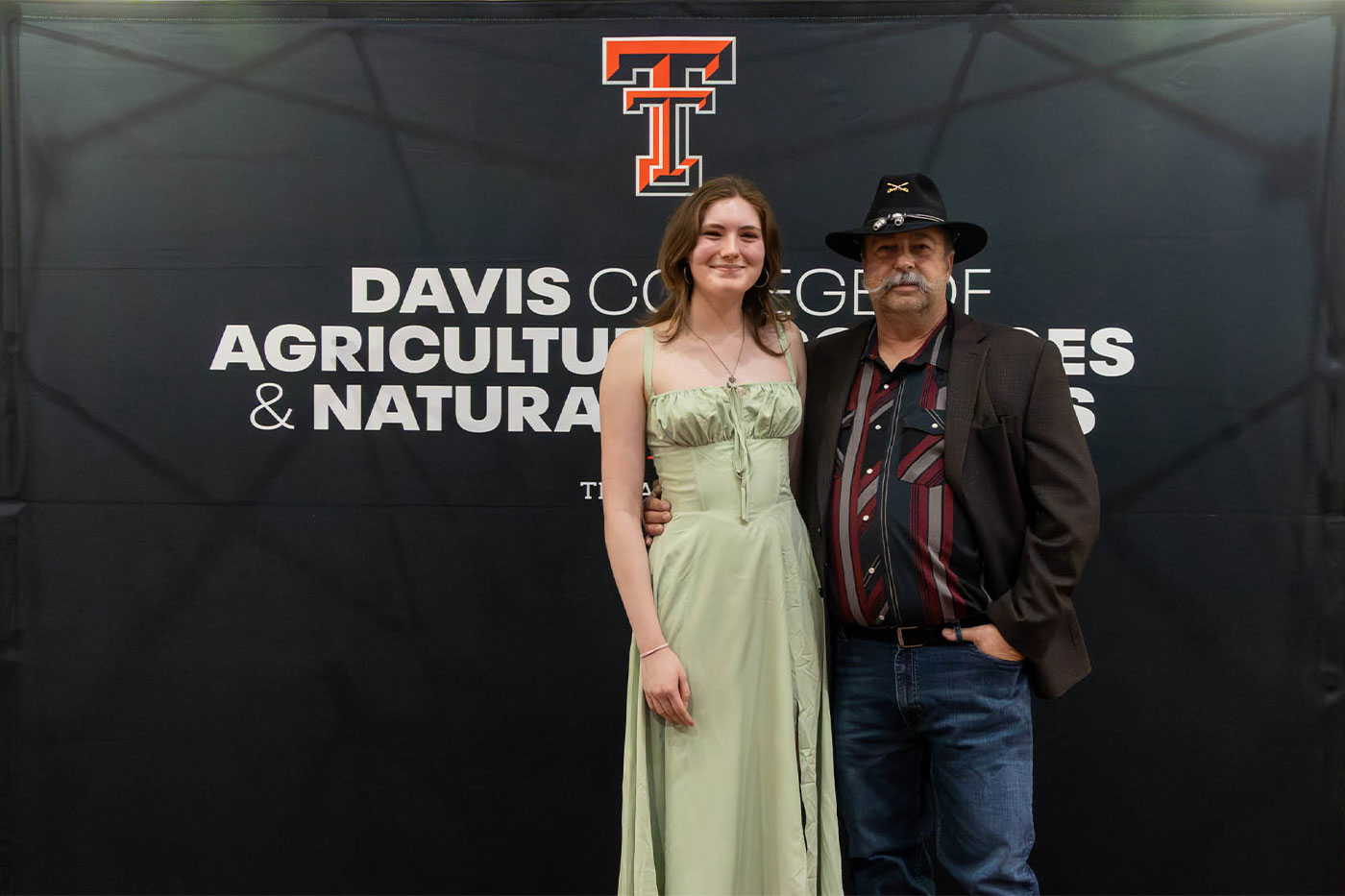
He has since added $15,000 to the fund, making it a $25,000 endowed scholarship and opening the opportunity for two scholarship recipients each year.
The fall 2025 semester marked the third round of recipients for the Veterans Helping Veterans Scholarship, one of whom is James Awtrey.
A Natural Fit
Awtrey was born and raised in Lubbock, and said that as a kid, he was fascinated by the Northrop T-38 Talons and Cessna T-37 Tweets he saw flying over the flatland cotton fields.
So, when the counselor at Frenship High School pulled him into his office with bad news—no grants, no scholarships, but military service could cover his education—the U.S. Air Force was a natural fit.
He graduated in May and began his service July 14, 1980.
“I love to tell people that I applied for Texas Tech in 1980 and got accepted in 2020,” Awtrey laughed.
Like Mason, Awtrey had a roundabout path to the plant and soil science industry.
Awtrey served 24 years in the Air Force, retiring as a master sergeant Feb. 1, 2004. He then spent the next 13 years working intermittently in the cell phone industry while in Fort Worth with his wife and two young children. However, his primary career focus remained on international government contracts in Iraq and Afghanistan.
This continued until September 2018, when he found out he had cancer and was forced to relocate to Lubbock for treatment.
Because of this diagnosis, he was no longer qualified to work as an international government contractor. However, it was because of this diagnosis that he would discover a new passion and livelihood.
During his first visit with his oncologist, amid the many papers and instructions he received, he came across one that was unexpected—a list of 20 plants. He was told to always keep at least 10 of the plants on the list in his sick room.
“I thought, ‘OK, well, that’s weird,’” Awtrey said with a scoff. “But then I got them, and I started caring for them. I was learning how your emotions change by physically caring for the plants—fitting your fingers into the dirt, helping the plants grow, something to care for day to day, water and fertilize.”
Taking care of the plants in his room became a crucial part of Awtrey’s healing process, especially for his mental health.
“It was emotional therapy for me while I was going through cancer treatment,” he continued. “It gets your mind off of the constant worry about, ‘Am I going to die? Is the treatment that I’m going through going to take away the cancer, or is it just going to slow the cancer? What will my family do if I pass and all these other things? It just gets your mind completely off of that. And now it’s you and the plant right in front of you, and that’s all it is. And there’s that connection there.”
This is what inspired Awtrey to enroll at Texas Tech and start studying plant and soil science in 2020.
While he was still in treatment when he started his undergraduate program, things are now looking up. He is in remission, has earned his bachelor’s degree, and is pursuing a master’s degree.
Not only has he been able to pursue his new passion and connection to plants, but he has also been fortunate, like Mason, to build connections with people at Texas Tech.
“Well, being a 60-year-old man hanging out with 20-somethings is very entertaining,” Awtrey said. “I love it a lot because they’re teaching me new things like what questions to ask AI, and I’m able to teach them things like don’t give up when it gets hard. That’s when you’re really going to accomplish something. So, it’s a great relationship with the students.”
These positive relationships extend to the department’s faculty as well.
“Everybody on the faculty side is interested in student success,” he said. “And I wasn’t expecting that. I was expecting people to be more interested in their field of study than the people they’re trying to teach today, and that just simply isn’t the case.”
While his experience at Texas Tech has been second to none, unfortunately, at this stage of his educational journey, Awtrey faces a trifecta of financial challenges: master’s degree programs usually provide less scholarship support than bachelor’s programs; he has exhausted his GI Bill benefits; and his research area, turfgrass, has limited funding.
Fortunately, there are veterans willing and ready to help other veterans, and Mason, whom Awtrey calls “Chief,” has risen to the occasion to help those who need it.
“It’s exciting because I feel like Chief Mason knows the struggle of being in the military,” Awtrey said. “Of not having time to go to school when you’re finally out of the military and now trying to figure out how to catch up on all that you couldn’t do while you were on active duty. Chief gets that.
“I was deeply honored to receive the scholarship because I’d like to see more veterans end up in Davis College. His scholarship and personal commitment set the example for me and the other veterans in Davis College programs. My wife and I are now looking at ways to follow his example when I graduate.”
Mason couldn’t be more excited to hear this from a scholarship recipient. In fact, this was his exact goal when he started this scholarship.
Mason has continued to contribute to the scholarship since it was established two and a half years ago and has made a significant planned gift to the scholarship in his will. But he doesn’t want to wait—he wants to see the fund grow now. He wants more veterans helping veterans, and he’s inviting others to join him.
“I want to grow this scholarship,” Mason said vehemently. “I don’t want this just to be something that somebody creates and it’s stagnant. My name’s not on there because we’re all veterans.”
“Everybody who’s associated with this is a veteran, and I want them to help each other. I want us to help each other. So, if somebody else wants to donate that’s a veteran, let them put it in there. Let’s raise the amount that’s in there. Let’s help more vets.”