
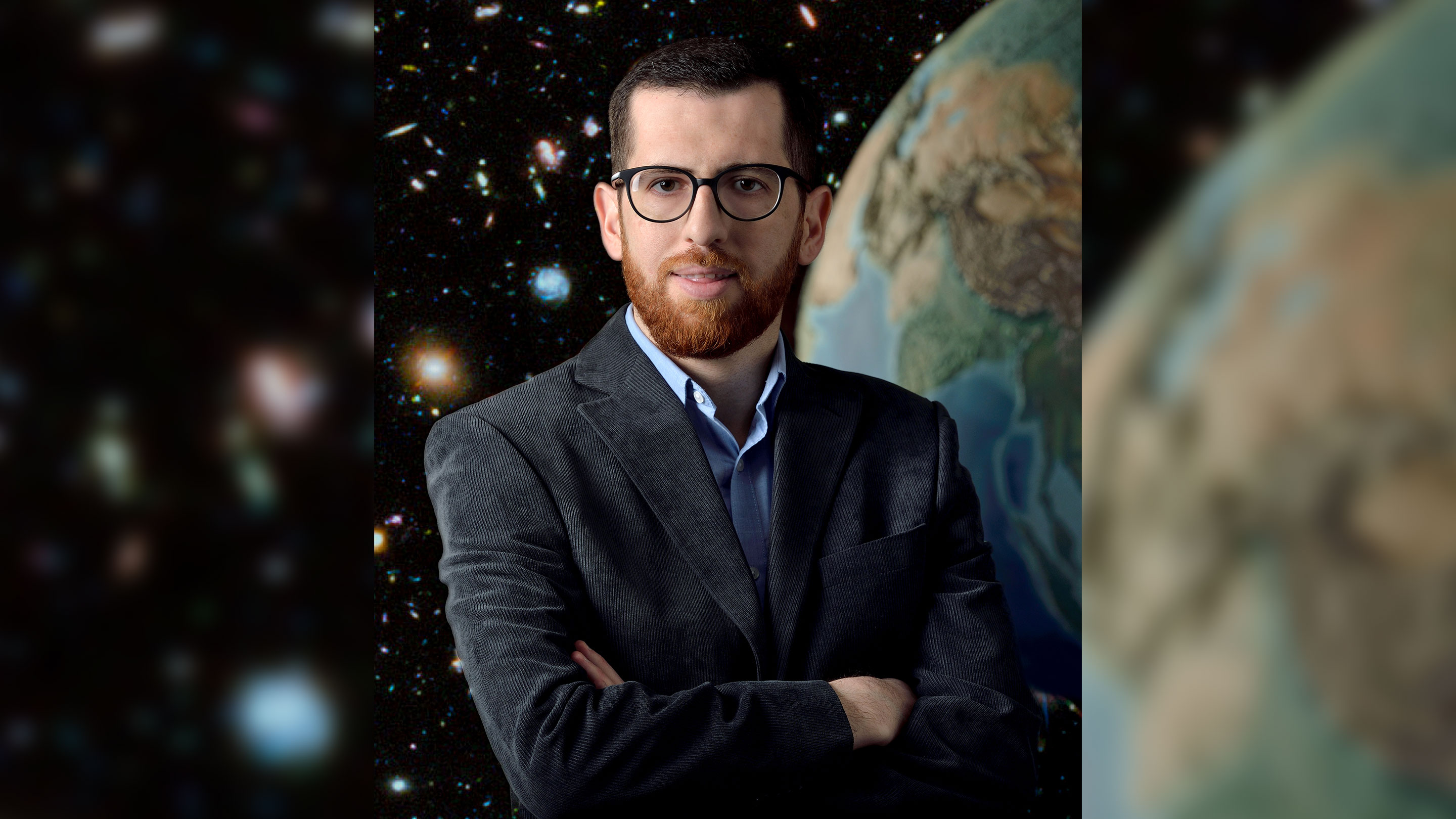

Elias Aydi, along with other astronomers, used a cutting-edge technique to observe two stellar explosions in real time, opening the door to countless new insights.
An international group of astronomers led by Texas Tech University assistant professor Elias Aydi published a paper titled, “Multiple outflows and delayed ejections revealed by early
imaging of novae,” in the peer-reviewed journal “Nature Astronomy” Friday, Dec. 5.
The study used a cutting-edge technique called interferometry at the Center for High
Angular Resolution Astronomy (CHARA) Array in California, the same technique that
made it possible to image the black hole at the center of the galaxy. This approach
allowed scientists to combine the light from multiple telescopes, achieving the sharp
resolution needed to directly image the rapidly evolving explosions.
Aydi, who teaches in the Department of Physics & Astronomy was lead author of the study that obtained detailed images of two stellar explosions—known
as novae—within days of their eruption. The breakthrough provides direct evidence
that these explosions are more complex than previously thought, with multiple outflows
of material and in some cases, dramatic delays in the ejection process.
“These observations allow us to watch a stellar explosion in real time, something
that is very complicated and has long been thought to be extremely challenging,” Aydi
said. “Instead of seeing just a simple flash of light, we’re now uncovering the true
complexity of how these explosions unfold. It’s like going from a grainy black-and-white
photo to high-definition video.”
Novae occur when a dense stellar remnant called a white dwarf undergoes a runaway
nuclear reaction after stealing material from its companion star. Until now, astronomers
could only infer the early stages of these eruptions indirectly because the expanding
material appeared as a single unresolved point of light.
Revealing how the ejecta are expelled and interact is crucial to understand how shock
waves form in novae, which were first discovered by NASA’s Fermi Large Area Telescope
(LAT). In its first 15 years, Fermi-LAT detected giga-election volt (GeV) emission
from more than 20 novae, establishing these explosions as Galactic gamma-ray emitters
and highlighting their potential as multi-messenger sources.
The team imaged two starkly different novae in 2021. The first, Nova V1674 Herculis,
was among the fastest on record, brightening and fading in just days. Images revealed
two distinct, perpendicular outflows of gas—evidence that the explosion was powered
by multiple interacting ejections.
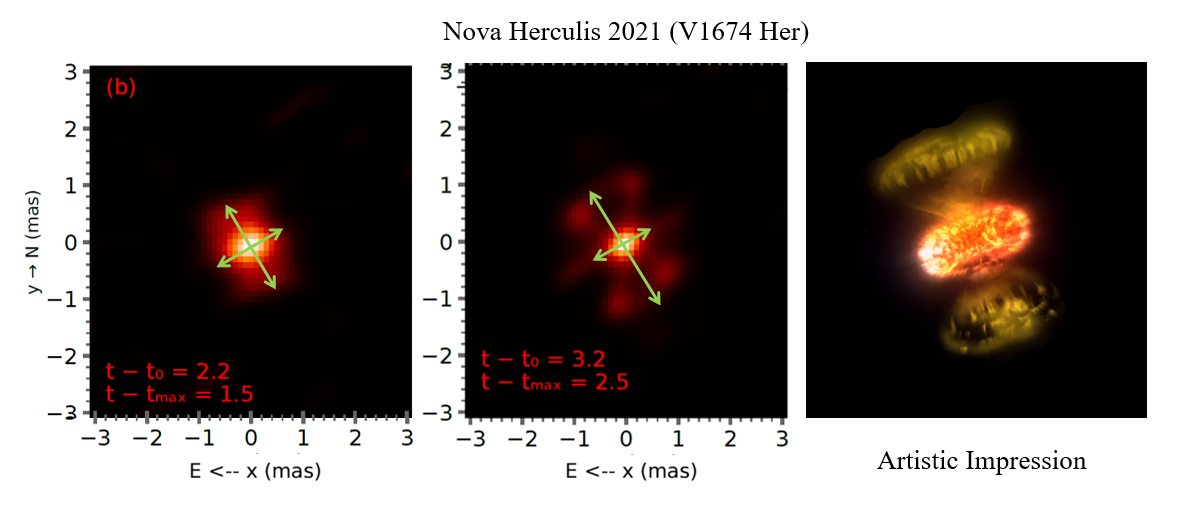
These newly emerging flows appeared in the images while also NASA’s Fermi Gamma-ray
Space Telescope detected high-energy gamma rays, directly tying the shock powered
emission to the colliding outflows.
The second, Nova V1405 Cassiopeiae, evolved much more slowly. It held onto its outer
layers for more than 50 days before finally ejecting them, providing the first clear
evidence of a delayed expulsion. When the material was finally expelled, new shocks
were triggered—again producing gamma rays seen by Fermi.
These sharp images were further complemented by spectra from major observatories such
as Gemini, which tracked the evolving fingerprints of the ejected gas. As new features
appeared in the spectra, they lined up with the structures revealed in the interferometric
images, providing a powerful one-to-one confirmation of how the flows were shaping
and colliding.
This study was funded by NASA, and its Fermi telescope was a key instrument in discovering
these results, as was the CHARA Array interferometer.
The findings challenge the long-held view that nova eruptions are single, impulsive
events. Instead, they point to a variety of ejection pathways, including multiple
outflows and delayed envelope release, reshaping understanding of these cosmic blasts.
“This is just the beginning,” added Aydi. “With more observations like these, we can
finally start answering big questions about how stars live, die and affect their surroundings.
Novae, once seen as simple explosions, are turning out to be much richer and more
fascinating than we imagined.”
The paper can be accessed using this link: https://www.nature.com/articles/s41550-025-02725-1.
Aydi also produced a short video that corresponds to the study, which can be accessed
here.