
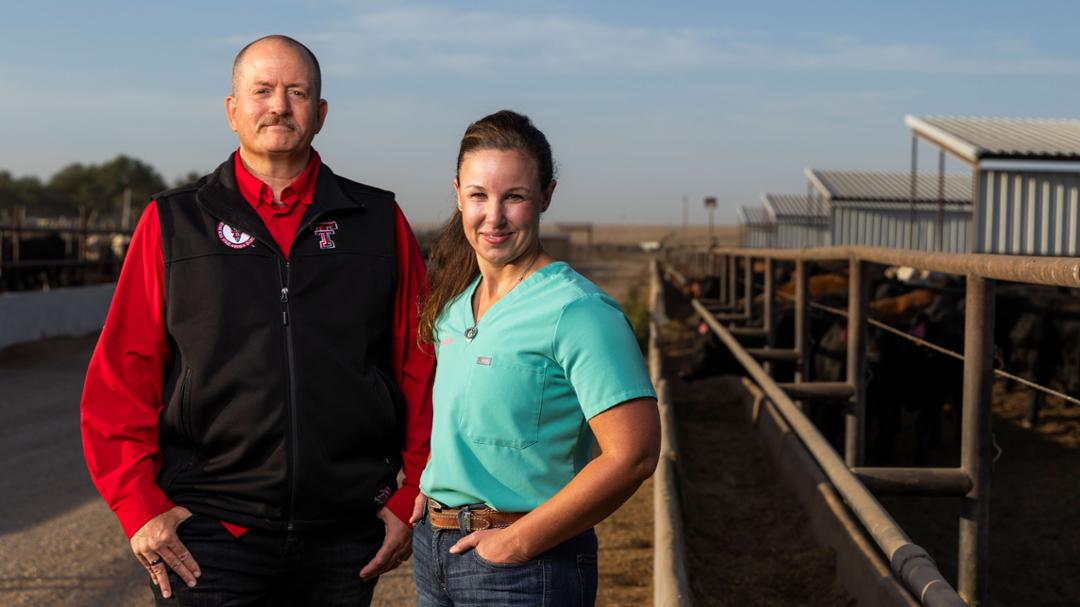

Dr. Jennifer Koziol and Chad Cross have used their expertise in research and education to combat the New World screwworm threat at both a state and national level.
New World screwworm was a lesson topic Dr. Jennifer Koziol and Chad Cross never forgot.
The images they viewed in textbooks resembled wounds from a horror movie. It’s a reminder that those with weak stomachs aren’t called to be veterinarians or entomologists, studying the aftermath of a metallic blue-green fly with orange eyes laying eggs in a cut or other body opening of warm-blooded animals such as wildlife, livestock and pets – or, in rare cases, humans. Upon hatching, the larvae burrow into flesh like wood screws and feast with their mouth hooks.
It is not only a gruesome sight but is also reportedly accompanied by a foul smell. Infestations like these were an unfortunate yet common problem for ranchers and other animal caretakers before the New World screwworm was eradicated from the U.S. in the 1960s. Afterward, some Texans recall going 20 years without seeing deer because of how badly the parasite devastated that population.
Once Koziol and Cross covered that topic in the textbook, they closed the chapter for good. Or so they thought.
Although they attended different veterinary and graduate schools at different times, their career paths led them both to Texas Tech University’s School of Veterinary Medicine.Koziol was one of the school’s original hires who became an associate professor of food animal medicine and surgery as well as director of continuing education.
Cross planned to retire after more than two decades as a researcher and professor within the Department of Epidemiology and Biostatistics at the University of Nevada, Las Vegas School of Public Health. However, in fall 2024, he couldn’t pass up the opportunity to interview for a professor of One Health position to further develop the doctoral program at Texas Tech’s School of Veterinary Medicine.

It was during that same semester that Koziol received an unexpected call from one of the School of Veterinary Medicine’s practice partners.
Dr. Christopher Womack is a distinguished veterinarian in San Angelo with more than 30 years of experience in mixed animal practice. He had recently returned stateside from a trip to Panama, where he made a concerning observation: New World screwworm flies had crossed the Darién Gap and were headed north to the U.S.
“I was driving home on Wednesday evening for Thanksgiving when I got the call, and Dr. Womack said, ‘I’m getting really worried about this,’” Koziol recalled. “It wasn’t very long after that that we closed the southern border [to live animal imports].
“That’s really how it got on our radar, and I’m thankful to have connections like that. I think that’s one of the great things about Texas Tech: we have these veterinarians who are very connected and in tune with what is happening and are able to feed us information far sooner than we would get it otherwise.”
The new year would bring a new emphasis to the School of Veterinary Medicine, with its leadership attending a federal tabletop exercise in preparation for an infestation and students learning an urgent lesson about the New World screwworm.
“Faced with an incredible threat, Texas Tech stood tall and collaboratively delivered what was needed,” said Guy Loneragan, dean of the School of Veterinary Medicine. “We are so fortunate to have the right kind of expertise and relationships with the industry at Texas Tech in general, and the School of Veterinary Medicine in particular.”
Jennifer Koziol – Communicating Through Crisis
Koziol has a knack for learning from the veterinarians who came before her. Womack shared with her how he treated screwworm-infested cattle around San Angelo from incursions that lasted into the 1970s. At the time, they used Smear 62: a thick, Vaseline-like chemical paste developed by U.S. Department of Agriculture (USDA) researchers in the 1940s.
Just as Koziol had only learned about New World screwworm from a textbook and word of mouth, she realized there were whole generations of producers and animal owners who also wouldn’t have experience protecting their animals from the threat. She set out to ensure they were prepared.
“Dr. Koziol is keenly aware of what the industry needs and communicates that so well to the rest of us,” Loneragan said. “She launched into New World screwworm continuing education for the industry 18 months ago. This was well before the rest of us knew it was knocking at our door.”
By May 2025, Koziol was among faculty and industry experts who provided updates about the New World screwworm during a regional meeting hosted at the School of Veterinary Medicine. There were more than 500 attendees in person and another 1,000 watched virtually.
“We were very fortunate to pull an expert panel together and be one of the first ones to put out that information both to veterinarians and to the public,” Koziol said. “I think that’s what really kicked off our involvement, and we’ve stayed engaged, interactive and proactive about trying to educate the populations that we interact with.”
Koziol continued disseminating information throughout 2025 and into 2026 through social media videos, sharing tips that had to do with animal husbandry – preventing wounds, staying cognizant about branding and other standard practices like ear tagging, and using the injectable parasiticide doramectin only as directed by a veterinarian.
Her cautionary measures turned into a call to action in June 2026, when New World screwworm was discovered in Texas on a calf in Zavala County (near La Pryor).
The School of Veterinary Medicine, in partnership with the High Plains Veterinary Medical Association, quickly responded to the news. They hosted another public discussion at the School of Veterinary Medicine on July 2.
Koziol moderated the panel of industry experts, which included Womack and Drs. Gary Warner, Elizabeth Susen and Kristina Stafford addressing the topic of “New World Screwworm: It’s in Texas – Now What?” There were 100 attendees in person and 500 tuned in virtually.
In addition, School of Veterinary Medicine students continued to receive mandatory training about what New World screwworm looks like, steps for submission of samples, prevention and treatment options so that they could share this information in their communities. This extended knowledge to the clinical partners where fourth-year students are stationed throughout Texas and into New Mexico.
“People within our network were some of the first to diagnose cases in Texas,” Koziol said. “So, I think that speaks to how strong our network is in the places where people and animals are being affected. I think that’s really impactful.”
As of early October, the presence of New World screwworm had increased to 53 total animal cases in Texas and New Mexico. Koziol remains dedicated to spreading knowledge throughout Texas Tech’s region and beyond, including through interviews with local and international media outlets.
“I think we’ve reached a lot of people and gotten our school a lot of exposure,” Koziol said, “and that’s exciting because it furthers our mission.”
Chad Cross – Responding with Research
Shortly after Cross began his role at the School of Veterinary Medicine in summer 2025, he joined Koziol’s outreach efforts by sharing his perspective from working with parasites and vector-borne diseases. Many of these problematic bugs are embroidered on his lab coat as he analyzes the New World screwworm through a One Health lens, which considers human, animal and environmental health together.
“We’re not happy that it’s here,” Cross clarified. “But it's certainly an opportunity for us to get to work on a phenomenally difficult and complex problem.”
Cross is involved in several research projects to detect New World screwworm, backed by the Texas University Fund. One project aims to enhance surveillance through genetic technology. Instead of relying on fly traps that may not lure the pest inside, they are focused on more common bag traps that are filled with water and catch non-target flies. If any of those flies landed on a screwworm-infested wound or came into contact with the actual fly or its eggs, the water can be tested for screwworm DNA.
In a second project, Cross teamed up with Hui Chen, assistant professor in the College of Arts & Sciences’ Department of Chemistry & Biochemistry and Wei Li, professor and associate chair for the graduate program in the Edward E. Whitacre Jr. College of Engineering’s Department of Chemical Engineering. Rather than confirming an infestation by collecting larvae, placing them inside a tube of alcohol and shipping it to a USDA lab for testing, the team is focused on detecting the pest through a product similar to a rapid COVID-19 test.
Cross hopes that enabling positive test results in the field will help the USDA prioritize actual screwworm cases.
“This has given me an opportunity as a new kid on the block to meet people I wouldn’t have otherwise met, and to learn about the really cool technology development that is going on at Texas Tech,” Cross said. “These folks are doing some cutting-edge work, and so it was neat to put our heads together and think about how we could use that technology to develop a test for this.”

The third project is based on identification, using a mathematical model to distinguish screwworm adults and larvae from other fly species. Since the characteristics are so similar, this model would rely on probabilistic analysis of traits from a smartphone photo.
The team’s first article from these projects has been submitted for review, and the researchers look forward to further refining their work. Cross notes that their research could lead to other related technologies, which has both him and Loneragan excited for the possibilities.
“Dr. Cross brings a wealth of medical entomology and ecology to the table,” Loneragan noted. “Most of all, he has a can-do attitude and understands what needs to be done. He and Dr. Koziol have been the point people for our program, and to a large degree, for Texas Tech.”
So much has happened since Koziol first received that forewarning call nearly a year ago, and there’s a long road ahead. But she, Cross and Loneragan believe the Texas Tech School of Veterinary Medicine has stepped up to the challenge and earned a spotlight on a national stage.

They don’t plan on stopping until the New World screwworm is, once again, a topic of history.
“So far, the collective response from state and federal agencies, industry and academic institutions like Texas Tech has been a resounding success,” Loneragan said. “It serves as a model for how things can be achieved when we’re all on the same page. Much of that credit falls squarely at the feet of Dr. Koziol and Cross. We are so fortunate – and I am so thankful – that they call Texas Tech home.”