
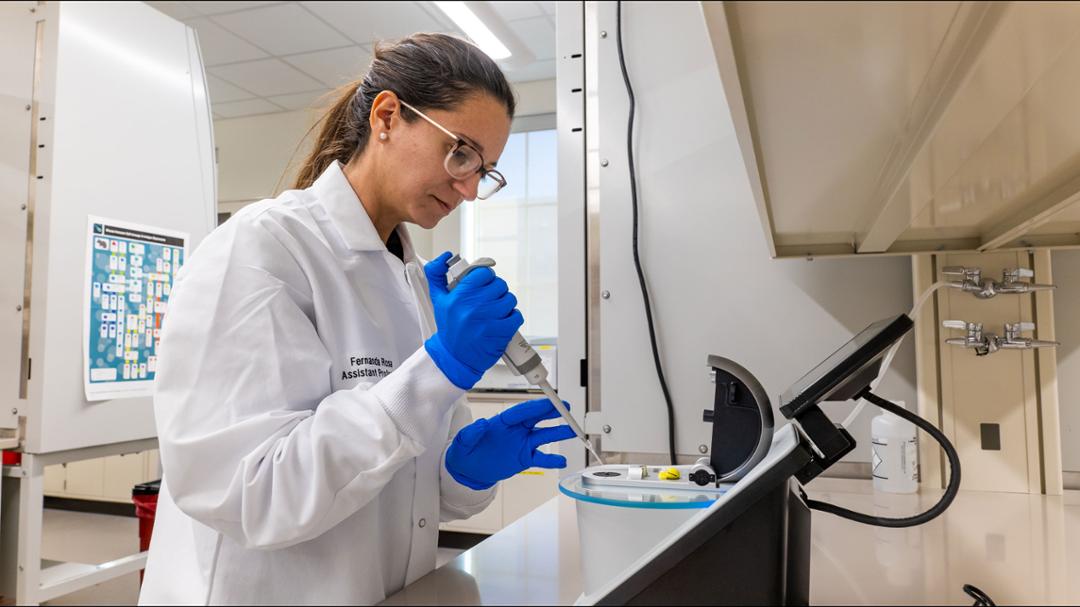

Brazil native Fernanda Rosa is thriving in Texas’ sprawling landscape and has made a name for herself in the field of dairy science.
Fernanda Rosa feels right at home in Amarillo at Texas Tech University’s School of Veterinary Medicine, surrounded by the High Plains and its ongoing legacy of lonesome but steadfast cowboys and farmers and their ranches.
The region closely mirrors the Pampas plains that dominate her home state of Rio Grande do Sul in Brazil. But instead of cowboys and Stetson hats, Rosa grew up with gauchos dressed in ponchos, who have tended to livestock on horseback for centuries and whose culture has earned the southernmost state the moniker “Texas of Brazil.”
More than just a match that looks good on paper, this blend has already proven fruitful, as Rosa received the 2026 Lallemand Award for Scientific Excellence in Dairy Science from the American Dairy Science Association.
The honor, reserved for scientists within the first 10 years of their postgraduation careers, is an indication of all the assistant professor of immunology has achieved.
Though her mother never attended college herself, she inspired Rosa to pursue education as a means of accessing a better life. Even as a child, Rosa saw her family work for everything they had.
And as she continued in her education, she came to see her studies as fun and worthwhile, using her natural curiosity as a buttress from which to ascend. Nowhere else did this manifest more than in the English classes Rosa’s mother enrolled her in.
“She knew that it would be essential for my future somehow, but I always enjoyed going to the English classes,” Rosa recalls. “For some of my classmates, I remember it was like a punishment for them, that the parents wanted them to study English and they were there by force.”
Instead, Rosa relished the extra opportunities to learn, a trait that remains with her to this day.
She specifically loved biology, biochemistry and investigating things such as how humans and animals can either fall sick to or resist various ailments. Coming from a small farm town where she attended rodeos on the weekends and frequently rode horses, animal science naturally came to Rosa as what she wanted to pursue in college.
While progressing through her undergraduate studies, Rosa always had one eye on the United States.
Several high school classmates had taken advantage of a one-year exchange program to the U.S. Rosa had wanted to go, but her family’s finances couldn’t support her aspirations.
She was also inspired by the moments she spent interacting with and guiding a few American exchange students at home.
Her hopes finally came to fruition in 2012. The 21-year-old spent a year interning at the Mammalian NutriPhysioGenomics Lab at the University of Illinois Urbana-Champaign, a period of new experiences, research and lasting connections that forever changed her life.
Rosa’s time in Illinois introduced her to intensive factory farming of dairy cattle, a model popular in the U.S. and a stark contrast to the pasture-based system used in Brazil at the time. Additionally, she had more access to research opportunities with calf health and nutrition due to greater support than what existed in her home country.
Those labs led to her attending and delivering an oral presentation at the American Dairy Science Association’s annual meeting, where the brightest minds congregate to advance the field.
“That, I think, was my best experience because I was able to see an international conference in the U.S. that involves research and scientific discoveries and I was able to present for the first time at a big conference in English,” Rosa says of her internship.
Through these experiences she developed a network that propelled her to earn a master’s degree in animal sciences at Oregon State University and a doctorate in biological sciences from South Dakota State University.
The professors of Rosa’s labs at both Oregon State and South Dakota State also specialized in dairy science, leading to projects concerning milk and calf health that would continue to define Rosa’s studies.
Newborn calves are especially important to research because they represent the future of the dairy cattle industry, Rosa says.
“For the farmers to have healthy calves, that's crucial, because if they lose those animals, they are going to not just lose economically speaking, but they will lose their future generation of lactating cows and that brings severe economic loss for them,” she adds.
A substantial component of calf health is early life nutrition, of which colostrum plays a crucial role.
Produced during the first milking after birth, colostrum varies from regular milk. It is like a live biological fluid containing more than just nutrients for growth and energy, including antibodies, viable immune cells, and several bioactive molecules such as microRNAs, according to Rosa.
Calves differ from human infants in that they are not born with the circulatory antibodies required to fight off infections that babies receive from their mothers through the placenta. While still developing an adaptive immune system that builds precise responses to intruders, calves must have passive immunity antibodies delivered via their mothers’ colostrum.
The timing of when calves receive colostrum is crucial as well, Rosa says. If they aren’t fed adequately within the first 24 hours after birth, they aren’t likely to survive the first few weeks of life on a farm full of environmental pathogens.
High calf mortality rates persist in the industry despite years of proven research of colostrum’s importance.
Rosa says farm management practices are key to successful colostrum feeding. Farms need enough staff to check the colostrum’s quality and ensure there are adequate amounts of colostrum replacements or frozen colostrum, given that not all the adult cattle produce enough to feed the calves.
Much of previous research has focused on antibodies, but colostrum also contains immune cells, various proteins, microbiota and other factors that can all contribute to calf health but have received less attention.
That’s where Rosa’s research fits. She studies microRNAs, regulatory elements that do not code for proteins but can modulate the immune system.

She’s currently investigating the amount and types of microRNAs present in bovine colostrum, including if colostrum-derived microRNAs can be absorbed by the calf's gut and reach the bloodstream.
Her work now is supported by a grant from the U.S. Department of Agriculture’s National Institute of Food and Agriculture, a testament to the staying power and research prestige the School of Veterinary Medicine has earned since Rosa came on board in 2021, its first year of classes.
When looking for her next position, she knew she didn’t want to move too far from Arkansas, where she had spent two years conducting postdoctoral research and where her husband’s family lived.
Texas Tech’s School of Veterinary Medicine emerged as an intriguing option, not only for its fit, but also for its comprehensive mission.
As Rosa became more acquainted with the Texas Tech University System, she grew more confident in the school’s leadership, trajectory and ability to earn accreditation. Her instincts were validated when she met with Guy Loneragan, dean of the School of Veterinary Medicine, during her interview process on campus.
After her conversations with him, Rosa was convinced the school was in the right hands.
When her husband asked whether she was ready to take on so much uncertainty, Rosa reflected on her own story, of leaving Brazil at 17 years old and never looking back.
“I really like to take on challenges and go through it, and I thought this would be a challenge for sure, but I was very excited for it,” she says. “I truly believed in the people who were here when I came for my interview. I had no reservations.”

Since joining the school, she’s taken pride in building the curriculum and lectures from scratch and guiding the inaugural class, all the way up to the group’s graduation in May 2025.
Another triumph occurred the month after the graduation at the ADSA’s annual meeting, where Rosa took all her graduate students and a mentee in the Doctor of Veterinary Medicine program. Watching them present their research, just as she did years ago, illustrated what Rosa loves about her career.
The academic journey is more than research, she says. The important part is the interactions she has with her students, motivating them to work in the science field and preparing them to succeed while on the research path or in their field of choice.

Rosa also attributes her receiving the Lallemand Award to the work behind the scenes with students and other collaborators over the years.
“I was beyond proud and happy when I got the official email that I was selected for the award, because it was 2019 when I got an ADSA award as a Ph.D. student, what they call the Young Dairy Scholar from the Midwest Branch,” Rosa recalls. “Now fast forward seven years, and I got one as a researcher and professional, so that feels very special.”
With her work attaining national recognition, she sees herself as on the right track and is motivated to achieve more.
“I think ‘From Here, It’s Possible™’ maybe is my life logo since I was a child, when I look back to coming from a humble family in a very small town,” Rosa says. “My mom never had the chance to attend college, yet look at what her daughter is achieving today.”