
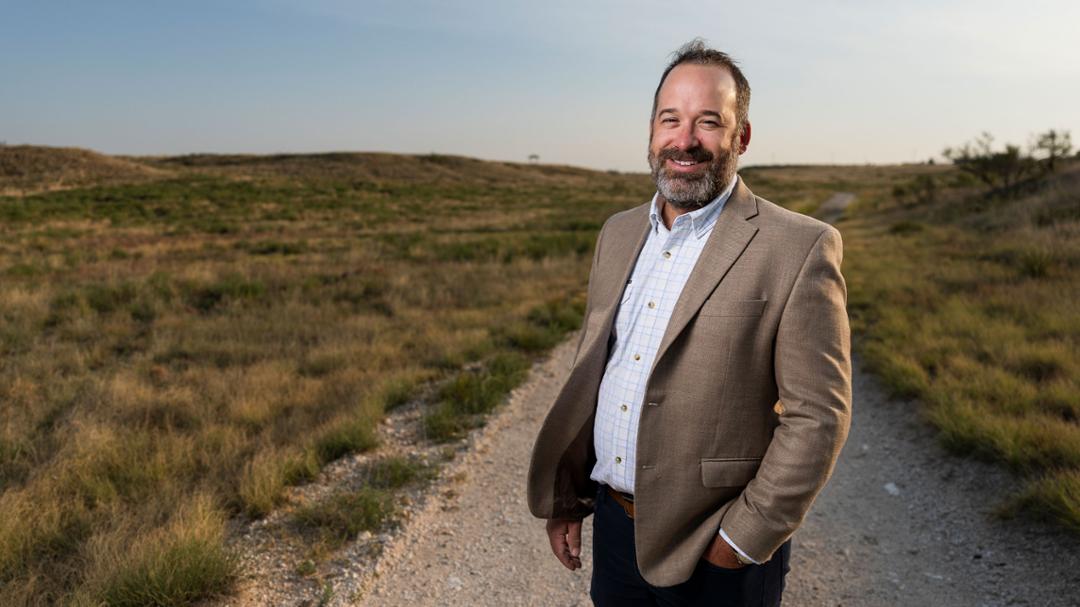

This associate professor feels right at home on campus, where he has always had a passion for learning and teaching.
John Nelson makes no bones about what drew him to, and keeps him here, at Texas Tech.
He has a dream job and works with a dream team.
He looks forward to what he does as an associate professor in the Department of History, teaching classes in colonial American history, Native American history and the Revolutionary War.
“I can remember when I read the job description, I thought, ‘Wow, this one was written for me. I can do everything they want me to do,’” he said. “I really have been able to teach all the classes that, ideally, I would have taught in my dream job.”
That’s only part of it, though. The other significant factor is the chance to be part of what he considers to be a team focused on students and each other.
“There is such a collaborative nature in our department,” he said. “It’s a big department, but it’s functional. Folks are friendly. Even though this is a big R1 university where everyone’s invested in their own research, there’s a commitment to teaching. There is a certain level of care that is noticeable among the history faculty.”
Likewise, his commitment to his students and care for them has not gone unnoticed.
“Dr. Nelson is the kind of professor who does far more than teach history,” said Tosha Dupras, dean of the College of Arts & Sciences. “He inspires students to think deeply, ask meaningful questions. His dedication to his undergraduate and graduate students and genuine investment in their growth, has had an impact that extends well beyond the classroom. His teaching and mentorship not only enrich the study of history at Texas Tech University, but also help shape confident, curious and engaged scholars for the future.”

Since coming to Texas Tech in 2020, Nelson has found his professional curiosity consistently piqued and his teaching passion repeatedly kindled. He possesses equal enthusiasm for diving into research and for interacting with students.
“What’s always struck me about Johnny is just how comfortable he is in his own skin, whether he’s teaching a large undergraduate class, a small graduate one, giving a research presentation or just collaborating with faculty and staff,” said Sean Cunningham, history professor and associate dean in the College of Arts & Sciences.
“In other words, he never puts on a show, and I think that level of authenticity makes him incredibly approachable. With Johnny what you see is what you get, and what you get is an extraordinarily brilliant scholar who, at his core, is a humble, kind and caring educator and mentor.”
From Nelson’s perspective, he sees the opportunities of his current position as one way to pay things forward, remembering those who took time and ultimately made a difference in his own life.
They adjusted his trajectory, challenging him to always aim higher than he might have thought possible, first as an undergraduate at Gettysburg College, a small liberal arts school in Pennsylvania that truly understood the importance of history, and then as a graduate student at Notre Dame.
“The reason I am where I am today as a history professor is because of the impactful teachers I had during my student experience,” he said. “Gettysburg College was very keyed into history. I had fantastic faculty who took time getting to know me.”
Nelson recalls visiting professors during office hours and discussing concepts and required readings, but he remembers more than that.
“They worked with me on how to improve my writing,” he said. “They were looking out for me as an 18- to 20-year-old student becoming an adult, and they were invested in my whole growth as a person.”
Now, Nelson enjoys doing the same thing for Texas Tech students. He lights up when discussing what it means as an educator to see students get as excited about a topic as he does. To him, it means the love he has for his subject matter is contagious.
“Seeing when things start to click for them, when they start to put the pieces together as far as causes and effects and history, that is, for me, an appealing aspect of teaching the past,” he said. “Showing students the full human experience of the past, and getting a clear picture of humanity, that’s kind of fun.”
The zeal with which he shares his knowledge with students in the classroom was recognized last spring with a Presidential Excellence Teaching Award. It is one of the professional achievements he’s proudest of.
“It has always been a goal of mine to be a good teacher before anything else,” he said. “I’d received recognition in the past for my writing and research, but never a teaching award, and that, to me, was the crown jewel I have been working toward. For me, teaching is about helping students mature and develop as a whole person, and I hope that’s what the award reflects.”
Nelson began his own college career with a double major in international relations and history. It was a way to hedge his bets, giving him multiple career options. Becoming a diplomat or working for the U.S. Department of State were on the radar, but so was the life of an academician on a college campus.
The final decision crystallized following a study abroad excursion to Northern Ireland, where he spent a summer researching materials and interviewing people involved in the long-running conflict known as “the Troubles.”
“I interviewed people involved in the Troubles, and it was pretty bleak stuff,” he said. “A lot of the guys were not remorseful about their activities, and that was kind of a wake-up call as far as thinking about going into international relations. I thought that if I went into the diplomatic field, I could possibly be sitting in these war-torn places the rest of my life.”
A decision point reached, Nelson turned his attention to studying history from the past 200 to 300 years. Many of the ingredients were the same as he might have found in international relations, but history meant time and distance were already built into the equation. That made it easier to study conflict and combatants in an objective way.
He enjoyed the view from afar and the chance to review critically what a specific time period was like. It didn’t take long to find his primary niche in Colonial America.
His affinity for that time in America likely was baked in during his early childhood. Nelson grew up in Ohio. His father also loved history, and he remembers trips around the Great Lakes to visit historical sites like Fort Ticonderoga and Old Fort Niagara.
“Those kinds of colonial era sites always intrigued me, and they were intriguing because of their overlapping nature,” he said. “You have French flags flying, British flags flying, reenactors there from multiple periods of colonial control and also a clear Native American presence throughout all that history.
“It’s probably not surprising that’s what I study now. These are what historians call borderlands – places where no one group is in charge for very long. It’s these competing empires, competing native nations, settlers, frontiersman – all the layers of groups fighting to control these frontier zones.”
Nelson’s research digs into the borderlands. His first book, “Muddy Ground,” looked at early Chicago and how overlapping groups battled for control of a strategic location to claim as their own. Nelson’s research wheelhouse, so to speak, is when he examines a local environment and how it shapes the interactions of people.
The book won the W. Turrentine Jackson Prize for best first book on the history of the American West from the Western History Association. It also was recently named a Shortlist Award Recipient by the Newberry Library & Pattis Family Foundation as one of the best books on Chicago, in any genre published in 2023.
“It felt like an especially noteworthy victory for me, as an early American historian, writing about the frontier of early America rather than what we think of as the traditional ‘Wild West’ of the late 1800s,” he said of the Jackson recognition. “I was pulling in all these borderland themes of indigenous power, conquest, environmental considerations and so forth, and saying that a place like early Chicago was very much the frontier, just slightly earlier in time than what is sometimes viewed as traditional history of the American West.”
His current book, tentatively titled “A Renegade’s History of the Revolutionary Frontier,” examines individuals who cross sides during the revolution to fight with Native American groups in the Ohio Country and Great Lakes.
“The book tries to unpack all of the motivations that go into this,” he said. “Sometimes, they switch sides for principled reasons. Native Americans are their friends and allies. Sometimes, it’s totally pragmatic where a fur trader understands if the Native Americans are pushed out, he loses his entire customer base.”
A career immersed in history has taught Nelson it’s a subject with few simple answers, and that is a lesson he wants students to take away from his classes.
“It’s not so much about teaching them what to know, but how to know it,” he said. “I see my teaching and research intertwined in that way. There are things that help us cut through the messiness of history and messiness of human existence to explain it.”
One way is to give students the chance to engage with primary sources, actual documents from that era. Nelson says documentaries and textbooks are great and have their place, but when someone has the opportunity to read the actual words of a person living within that history, it gives them a unique window into that time period.
Nelson sees this practice as not only instructive for studying history, but also for being a productive citizen.
“It’s a way to get them inside the shoes of another human and to try and understand a different perspective,” he said. “That’s a great life skill, whether they wind up being a history major or not. We trace individual lives to try and get at their motivations to tell a bigger story. Looking at individuals and getting to know them almost as fellow humans reinforces that history is a human story about people.”
In six-plus years on campus, Nelson said he appreciates Texas Tech students for the work ethic and resilience they bring to his classes. He said this makes them eager to learn and fun to teach.
“There is a can-do attitude among the student body, and that’s generally the kind of students we get,” he said. “This is an exciting place to be because we get such a rich range of students in our history classes. We draw many students to Texas Tech who come ready to work and wanting to learn. Their determination is our strength.”
But that’s only one reason Nelson enjoys what he does. He looks around and he sees a mighty university tapping into its massive potential.
“Texas Tech is on the upswing,” he said. “It is growing, not just in terms of numbers, but we are getting better all the time, and it’s nice to be at a place that feels like it’s not content to stay stagnant. So, we’re growing and drawing in more students, bucking downward trends of enrollment that you see across a lot of higher education.”
Nelson, too, has learned a lot along the way. He remembers what it was like on campus in 2020, and he understands the challenges looming today.
“We’ve had a series of uncertainties that have played out over the past six years, but we have come through that,” he said. “The resiliency of those first years will carry me through a long way forward, I think. Today, we have AI (artificial intelligence) and other question marks, so it has not been the most stable period as far as learning to teach and learning to be a professor.”
None of that changes Nelson’s mission, which is to train students to think deeply and critically and to see how what has happened has helped shape what is. That’s part of the reason he will teach an experiential course called Learning with the Land in the spring 2027 semester.
The class will expose students to the history of West Texas sites like Lubbock Lake Landmark, the National Ranching Heritage Center, Three Rivers Ranch, Caprock Canyons State Park & Trailway and Palo Duro Canyon State Park while connecting them with the region’s agriculture and energy industries. The idea is to help students develop a greater appreciation for the history of the region where they live and study.
“History can still be relevant because we can still meet students where they are, even if it requires a little more ingenuity,” he said. “There may be more trial and error, but I think that’s going to be the nature of teaching in the 21st century, and that’s OK with me. I’m ready for the challenge.”
Nelson has adapted his own teaching approach by implementing conversational exams as much as possible in the upper-level courses he teaches. Rather than an online essay that could be filled out via easily available AI technology, he meets in person with each student, spending 30 minutes talking through assigned readings.
He’s been using this method for the past two years, and while students were originally nervous about the idea of a face-to-face exam with the person who knows the material inside and out, it’s catching on.
And it’s doing something else – helping Nelson build relationships with students. He gets to know them on a personal level, just like those instructors back at Gettysburg College did for him.
“They were nervous going in, but then they enjoyed it,” he said. “I end up getting to know them better and also get an idea of what is resonating with them and what’s not. That gives me the chance to fix something in real time rather than just assign a bad grade.”
Likewise, it helps students prepare for life beyond college, where many will one day sit down across from a supervisor or human resources professional and be expected to answer specific questions in an articulate manner.
“It’s a great crossover skill for interviews and job readiness,” Nelson said. “You’ve got to be able to talk to your boss someday, and coming in to meet one-on-one with your professor is not much different from a one-on-one with a supervisor in the future, so it’s a transferable skill.”
In fact, in Nelson’s way of thinking, all students could benefit from taking at least one history class. It would not only enrich them, but it might also make the world a better place.
“Learning history forces you to put yourself in other peoples’ shoes, which is what I call in class historical empathy,” he said. “The idea of getting someone else’s perspective from another time period forces you to think about humans and what they were experiencing and thinking back then. Why were they thinking that? That kind of perspective-taking is a human skill that we would all benefit from.
“We don’t learn history just to avoid the mistakes of the past, which is the high school history answer to that question, but learning history helps us understand how we got to where we are today. Having that longer-term perspective makes you a better citizen of your community, your state and your nation.”