

Narissra Punyanunt-Carter on online dating, interpersonal communication and paddleboard yoga.
Welcome to Rise & Research, where cutting-edge discoveries are made as accessible as your morning coffee. This monthly feature offers a closer look at the transformative research happening on our campus. Pull up a chair as we talk with faculty who are pushing boundaries while creating opportunities for the next generation.
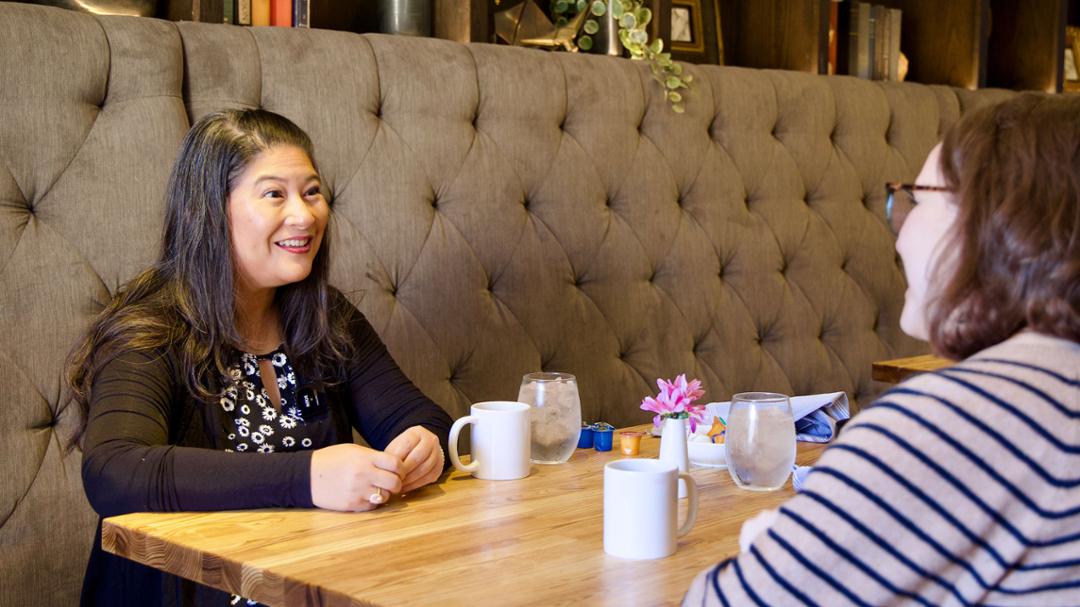
In this installment, Lucy Greenberg sits down with Narissra Punyanunt-Carter at Claraboya Scratch Kitchen to discuss interpersonal communication.
Narissra Punyanunt-Carter sits down at the breakfast table, sighing from the relief of submitting final grades. In addition to her research into interpersonal communications, Punyanunt-Carter teaches three classes at the College of Media & Communication at Texas Tech University as a professor in communication studies.

As she pours creamer into her coffee, she talks about packing for her first summer adventure.
“I’m taking a group of students to Japan for a study abroad in two weeks,” she explains. “My son has been studying there for a whole semester, so on the way home I’ll help him pack up.”
Her son is following in his mother’s footsteps as a Red Raider. While raised in Dallas, Punyanunt-Carter had a teacher in high school who constantly sang Texas Tech’s praises.
“That’s how the university got on my radar, and here we are decades later,” she laughs.
Another summer plan she has is getting certified through University Recreation to teach yoga on paddleboards. She leads a barre class there throughout the school year, but wants to do something new over the break.
She inquires if I’ve ever done a yoga class on a paddleboard, and I relay my one attempt that ended with me falling into the pool. I declined to try her class but wished her luck, turning the conversation to her other passions.
Q: What sparked your interest in interpersonal communication?
A: When I was an undergraduate at Texas Tech, one of my required courses was public speaking. For me, it came naturally. I didn’t mind getting up in front of the class and talking. But I noticed for many of my friends, it caused anxiety. They dreaded that class. The teaching assistant noticed my level of ease and said, ‘You’re good at this. Have you ever considered it as a major?’
So, I did. The more communication classes I took, the more I loved it. What really sparked my interest in interpersonal communication was that it’s the kind of communication we use all the time. We’re almost always talking with someone one-on-one whether that be at work or home. Building trust and connection with others fascinated me.
Q: How would you define interpersonal communication? A lot can be categorized under that definition.
A: When people hear “communication,” they often don’t quite know what it means. It’s a broad term. In my field, I take a lot of psychology into account, because what we say is shaped by what we think. What I’m focused on is meaning – how people communicate ideas, how those ideas are interpreted and why the same words can land completely different with different people.
Q: How does interpersonal communication affect our everyday lives?
A: Communication is both verbal and nonverbal. It’s not just what you say, but how you say it. Think about the phrase ‘I’m sorry’ – you can say it three different ways and convey three different things. The words are identical, but the meaning shifts based on things like tone, timing and delivery.
This matters a lot when you look at jobs in politics, human resources, consulting, sales and even agencies like the CIA and FBI. A lot of interpersonal communication, including nonverbal behavior and deception detection, is highly valuable in those fields.
Q: Some of your research looks at how dating apps were used during the pandemic. Can you say more about that?
A: I had already been studying dating apps before the pandemic, because I was fascinated by how differently people communicate through them. The things people would post – the pictures they chose, the way they presented themselves — it often didn’t match who they were in person.
Someone could seem funny and outgoing online and be a completely different person face-to-face. Dating apps seemed to lower anxiety in people because they didn’t have to meet in person, and younger generations are increasingly reporting higher levels of social anxiety.
We notice this in younger individuals across the board. When they walk into a McDonald’s, they’ll go order at a machine, whereas older generations still opt for a real person at the register.
Then, the pandemic hit and everything shut down. We paused the research we’d already collected and started asking: How are people using dating apps right now, during a global pandemic? It became a real-time snapshot.


Q: What did you find?
A: The main takeaway is that when people were isolated, no surprise, they craved connection even more. Many people who may have not considered dating apps gave them a try. Because they couldn’t meet up in-person as easily, people tended to disclose more personal information about themselves over the apps and reported deeper relational connection through conversation first, before ever meeting.
Women particularly reported liking this, both because of the increased sense of safety and the chance to build a stronger connection before meeting offline.
Q: You mentioned you also conduct research into this idea of “backburner” relationships. Can you tell us about that?
A: Yes, so these are when an individual maintains a connection with someone that they’re not currently romantically involved with, who, to them, could be a possible romantic partner in the future. This is not the same as infidelity.
I’ve done research with colleagues out of Purdue University and Hope College on this topic. We’ve found that older adults, particularly seniors, are very open about this.
They’ll casually say things like, “I know if I died, my wife Sue would be with Ron.” For them, it’s more about security. Whereas in younger generations, because of a higher emphasis on marrying for romantic reasons, they find this more troubling.
Q: Why do you choose to conduct your research at Texas Tech?
A: Texas Tech is home for me. I did my bachelor’s and my master’s here, and when a position opened in interpersonal communication, I thought I’d take it for a couple of years and then move on. But life happened, my family is here, and I also watched Texas Tech grow into something I wanted to be a part of.
When I came back after my doctorate degree, we weren’t yet a Carnegie “Very High Research Activity” Institution, but we were heading that way. I thought, ‘I want to be here for that, I want to help build that.’ And watching it happen in real time has been genuinely exciting.
Some people reach a certain level in academia and stop doing research. I never wanted that. Research is what I was trained to do, and Texas Tech has been a place that lets me keep doing it.
About Narissra Punyanunt-Carter
Degrees: B.A. Texas Tech University, 1996; M.A. Texas Tech University, 1997; Ph.D. Kent State University, 2002.