

Older firefighters could unintentionally face greater cardiac risk under a new wellness standard.
The rhythmic howl of a siren fills the nighttime air of a sleepy neighborhood. A firetruck seemingly appears from nowhere and pulls beside a building engulfed in bright orange-yellow flames. Firefighters pour out of their red transport, shouldering over 50 pounds of equipment. They are greeted by a wall of smoke and heat that causes their lungs to scream. With little regard for their own safety, the firefighters enter the building, poised to save the day.
If this feels like a scene straight from Hollywood, it’s not far off. Running into burning buildings is often the first, if not the only thing people imagine when envisioning a firefighter’s job.
“Many people struggle to understand that firefighters are mostly responding to medical calls, doing a lot of CPR and extracting of civilians,” said Jacob Mota, assistant professor in the Department of Kinesiology & Sport Management at Texas Tech University. “Fires are very high risk, but they’re much lower in volume.”
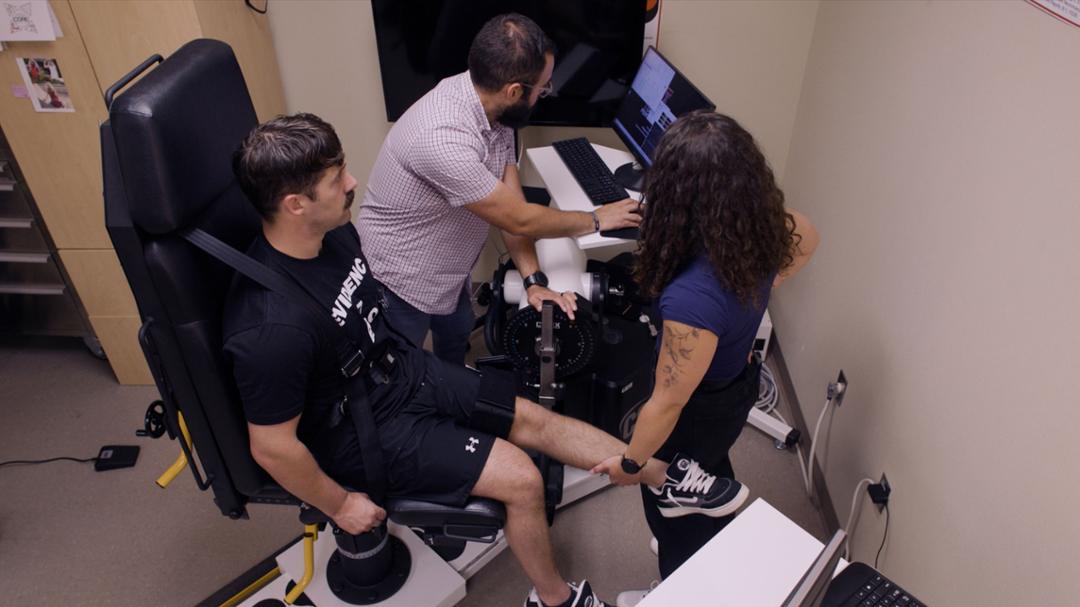
Mota’s research focuses on studying occupational athletes, namely first responders like firefighters. He wants to make sure they’re as safe and healthy as possible.
Firefighters, Mota notes, face the same health issues as the broader public, including obesity and cardiovascular disease. In fact, a 2024 study by the National Fire Protection Association (NFPA) showed that nearly 50% of firefighter deaths were attributed to a sudden cardiac event. Firefighters are far more likely to die due to a cardiac event than they are responding to operating at a fire scene.
So, imagine Mota’s surprise when his team at the Neuromuscular and Occupational Performance Laboratory (NOPL) realized the new health and wellness guidelines set by the NFPA may actually be placing firefighters in harm’s way. Older firefighters in their 50s and 60s could have an easier time passing the new standard than younger firefighters in their 20s.
And this wasn’t by a small margin either.
“We found something like a 35-times increased likelihood of passing the new framework as you get older, depending on one’s age category,” Mota said.
An eye-catching finding would have been older firefighters being two or three times more likely to pass this new standard. But this? This was a big deal.
Fanning the Flames of Research
The flame for Mota’s interests in firefighter health and safety sparked long before he returned to Texas Tech as a faculty member.
Mota grew up in a small West Central Texas town called Ballinger, about 40 miles south of Abilene. After graduating high school with 54 other classmates, Mota attended Cisco Junior College and joined the local fire department.
“I was just a ‘probie’ firefighter and did whatever I was told,” Mota joked about his brief tenure. “I was 19 and very wet behind the ears. I joined to serve my community and my state.”

Mota soon transferred to Texas Tech with the goal of majoring in music and joining the Goin’ Band from Raiderland.
However, his time in the band taught him two things.
First, music was going to be more of a hobby than an academic pursuit. After seeing fellow saxophone players breeze through the audition music flawlessly, Mota went and changed his major not long after band auditions.
The second was how athletic marching band members needed to be.
Mota recalled seeing a YouTube video where drummers went through their performance wearing an oxygen monitor and the video’s creator talking about the aerobic capacity requirements needed to perform a halftime show.
“I started to learn about exercise science and kinesiology because of that one video. And that was that: I was an exercise science major,” he said.
Mota’s introduction to kinesiology research came shortly after. He responded to a Facebook post asking for participants in a resistance training study. Matt Stock, then a Texas Tech faculty member and now at the University of Central Florida, told Mota he was too familiar with resistance training to be a participant but could help on the research side of things.
As he earned his kinesiology master’s degree at Texas Tech and human movement science doctorate at University of North Carolina at Chapel Hill School of Medicine, Mota’s passion for research deepened. He looked for ways to blend his burgeoning passion with his firefighter experience.
“I have a unique insight from a research standpoint,” he said. “I know what it’s like to wear bunker gear, to be in a structure fire or to be at a motor vehicle collision. It gives me a lot of perspective about what the job is. It’s so much more than putting on gear and running into a fire.”
Mota returned to Texas Tech as an assistant professor in 2022 to continue his work on first responders and help develop students into the next generation of researchers. He was recently promoted to associate professor with tenure, effective September 2026.
At the NOPL, Mota views undergraduate students as the backbone of the lab’s progress. They’re often running their own experiments within 30 days of starting at NOPL.
For graduate students like Payton Miller, the relationship is like that of a colleague. She isn’t in the lab to just be a yes person.
“I’m comfortable voicing my opinion and saying, ‘No, I don’t think this should be like this,’” she said. “We take each other seriously and professionally, but we’ve also developed a friendship, which I think has made this experience great.”
Miller began pursuing her doctorate in exercise physiology in 2024 and, much like Mota, has a personal interest in researching firefighters.
“I come from a family of firefighters. My grandpa worked his way up to senior captain in the Houston Fire Department, and my uncle served with the department for decades,” she said. “Knowing the wear and tear the profession can have on the body motivated me to pursue research aimed at helping firefighters stay healthy and capable throughout their careers.”

Miller thought she’d have time to ease into the program and get her feet settled. She thought it might be years into her research career that she’d begin to impact firefighters or the policies meant to keep them safe.
It was only months.
Moving Targets
Firefighters must complete mandated yearly health and wellness screenings, and NFPA 1582 was previously established as the comprehensive medical standard.
Part of the evaluation assessed the firefighters’ absolute aerobic capacity, or a measure of how well the body pulls oxygen from the air and distributes it to the muscles through the cardiovascular system. This is more commonly known as VO2 peak and is measured in milliliters per kilogram per minute. A common way to assess aerobic capacity is to have the subject run on a treadmill for a specific amount of time while wearing a mask and other physiological sensors.
Aerobic capacity could be considered akin to the engine that runs the body. Essentially, the lower a person’s aerobic capacity, the more likely they are to suffer from cardiac events during strenuous exercise.
Under NFPA 1582, all firefighters had the same VO2 peak target of 42 mL/kg/min to be considered fit for duty.
NFPA 1580 was established in 2025 as the new standard. Rather than a singular target for all firefighters to hit, the new target was determined based on age and sex. Firefighters needed to make sure they were above the 35th percentile of the general population to pass, which changed the required ranges and failing scores.
On the surface, accounting for age and sex makes some sense. One would expect the body of a 20-year-old would operate differently than a 40-year-old.
Mota connected with one of his professional collaborators, Mike Conner from Front Line Mobile Health, who helps fire departments administer yearly medical exams. As part of the work, patients’ data are collected to be utilized in studies by researchers like Mota. Though Mota has run studies and collected the data himself by working with fire departments in the Lubbock and West Texas areas, partnering with his collaborator in this instance allowed him to have a data pool consisting of thousands of firefighters across the country.
Mota tasked Miller with running the first set of analyses, and she generated models which compared the benchmarks between the new and old standards.
To visualize the results, Miller organized the data into a stacked bar graph with each bar having three color portions: green represented firefighters who met the unrestricted-duty standard, who had a VO2 peak over 42; yellow represented firefighters who had a VO2 peak between 28-42 and should or must participate in a prescribed aerobic program; and red represented firefighters with a VO2 peak below 28 and were restricted from duty. The firefighters were separated into five age groups: 20-29, 30-39, 40-49, 50-59 and 60+.
Under the older NFPA 1582, the results looked exactly as Miller expected. As the age groups increased, the proportion of firefighters meeting the unrestricted-duty standard steadily decreased. The green bars at the top get smaller, almost creating an upside-down descending staircase. Meanwhile, the red bars at the bottom become larger, creating an ascending staircase. The yellow bars stay toward the middle but move up slightly as the age groups increase. The age-related decline was clear throughout the dataset.
When she analyzed the same firefighters under the new NFPA 1580 standard that required firefighters score above the 35th percentile of their age group, gone were the multicolored staircases showing gradual change. The results were unrecognizable.
“I was like, ‘Oh my gosh. There’s something really big here,’” she said.


For starters, the 20-29 group’s results were completely inverted in this new standard. Less than 20% would have passed while over 60% would have failed.
The next age group saw a massive spike in passing results, with about 70% passing and less than 20% failing. This result was consistent in the next two age groups as well.
Perhaps the most concerning result came with the 60+ group, in which the passing rate jumped over 80%.
Miller was worried she made a mistake in the analysis and brought her concerns to Mota, who reran it himself and got the same results: The NFPA 1580 was requiring lower VO2 peak scores for older firefighters, enabling those with a potential higher risk for cardiac events to pass the wellness standard.
“It’s understandable why they wanted to change these standards,” Miller said. “But now, are we pushing older firefighters along because of the new lower requirement? They’re able to stay on the job longer, but is that good for them or their families? If cardiac events remain one of the leading causes of firefighter deaths, we need to ask whether the standard is accomplishing what it was designed to do.”
Ringing the Alarm
The study was published in Applied Physiology, Nutrition, and Metabolism in September 2025 and was soon featured in the national conversation surrounding NFPA 1580.
Mota recalls attending a conference with Miller and the professional collaborator in November and talking to people who sit on committees for health and wellness standards.
“People were coming up to us and saying they read the paper and circulated it around their committees,” Mota said. “We’re at this conference, jumping for joy, like, ‘Hey, we made it!’”
Despite the excitement over the potential impact the study could have, the goal wasn’t to rebuke or criticize the NFPA, its new standard, or the International Association of Fire Fighters (IAFF), the labor union that represents over 360,000 full-time professional firefighters.
Mota is cognizant of the recruiting issues faced by the fire service, which the NFPA and IAFF are attempting to manage. The average age of a firefighter is 38, and the NFPA notes that less than 25% of firefighters were under the age of 30.
“We weren’t pointing fingers, and we don’t have an easy solution,” he said. “There is way more to being a firefighter than just the number that comes from this aerobic capacity test. But at the same time, aerobic capacity is directly correlated to a person’s risk of having a sudden cardiac event. We could be taking away a warning sign for older firefighters and shoving them into risk.”
In January 2026, the IAFF released a position paper in support of NFPA 1580 and cited Miller and Mota’s recent study. However, the concerns about the new standard lowering the acceptable aerobic capacity range for older firefighters were never explicitly discussed.
This didn’t necessarily surprise Mota.
“The premise of research across the board is that more data are needed, and sometimes that’s difficult for the general public and policy makers to understand,” Mota said. “We don’t have all the answers yet. Humans are complicated and science is messy.”

For Miller, this experience has reinforced the importance of a researcher communicating their work with the public. It’s a lesson surely to pay dividends once she has a lab of her own.
“We’re researchers; we’re not totally in their circle,” Miller said. “It can be hard for firefighters to embrace change, and they might not want outsiders coming in and telling them what to do. We just have to continue sharing the data and keep being vocal about this.”
All this effort comes back to the personal connection both Mota and Miller have for firefighters, especially the more senior ones like Miller’s grandfather.
“Our goal is simple: How can we keep these guys and gals alive longer,” Miller said. What can we do to help make sure they’re protected on the job and make sure they not only reach retirement, but enjoy a long and healthy retirement as well?”
Learn more about the Department of Kinesiology & Sport Management at Texas Tech.