
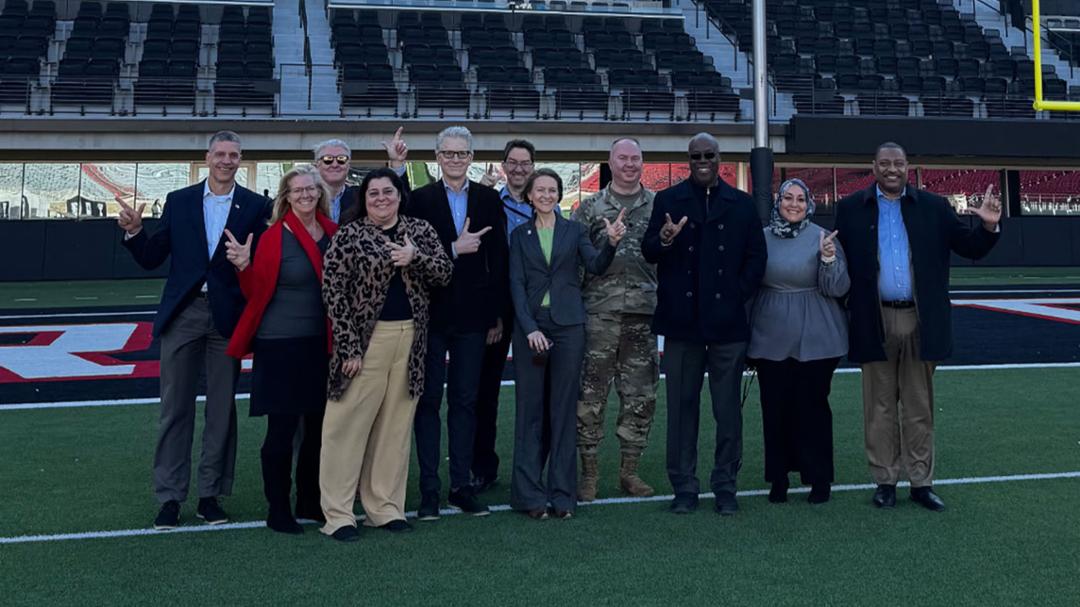

U.S. Army visit highlights university’s role in advancing defense-focused research.
Representatives from the U.S. Army Combat Capabilities Development Command (DEVCOM) Army Research Lab (ARL) and West Point recently visited Texas Tech University to learn more about the university’s role in power grid, cyber defense, telecom, EMP and high-energy research. The visit highlighted the role of Texas Tech’s National Security office related to cybersecurity, directed energy and cyber-physical systems.
“We want our partners to see what Texas Tech can offer,” said Stephen Bayne, vice president for national security and executive director of the Critical Infrastructure Security Institute (CISI). “Our researchers are addressing real-world challenges that impact both communities and national defense operations. Bringing Army representatives to campus allows us to strengthen those connections and explore new areas of mutual interest.
Throughout the visit, representatives, including ARL Acting Director Eric Moore and ARL’s Army Research Office Acting Director Anne Marie Petrock, engaged with faculty and research teams at Texas Tech’s research facilities. The discussions emphasized Texas Tech’s integrated national security program, which allows researchers space to safely test real-world scenarios and find solutions to threats to U.S. communities and infrastructure, from extreme weather recovery to cybersecurity protection for utilities.
The National Security office is actively aligning these strengths into a focused national security research strategy that connects technology development, policy considerations and workforce training.

“As the Army’s sole foundational laboratory, it is our mission to ensure we are leveraging cutting-edge academic research for our warfighters,” Moore said. “Developing partnerships with academia and industry is key to ensuring we are able to drive and access ideas and technologies to solve the Army’s tough challenges now and in the future.”
For CISI, the visit represents the importance of establishing long-term collaboration between Texas Tech and national defense partners. CISI is positioned to serve as the point for federal agencies seeking research capabilities in critical infrastructure resilience from energy systems and atmospheric impacts to cyber-physical security.
“Visits like this underscore the important role Texas Tech plays in advancing research that supports national security and critical infrastructure resilience,” said Texas Tech President Lawrence Schovanec. “The opportunity to visit with Dr. Moore and his colleagues allowed us to explore meaningful ways to partner and expand the impact of our national security initiatives. I am optimistic about the long-term opportunities to collaborate with DEVCOM and other federal partners.”
The visit provided the opportunity for discussions about aligning the university’s research capabilities with pressing national security needs. Texas Tech is focused on accelerating research that moves innovative ideas from demonstration to real-world deployment, furthering CISI’s goal of establishing the region as a strategic research partner.
About DEVCOM ARL
DEVCOM ARL is the Army’s sole foundational research laboratory serving as the nexus between the military, academia and industry. ARL expertise drives cross-cutting advancements in science and technology to ensure the Army wins now and in the future. For information, visit https://arl.devcom.army.mil/.
About West Point
As the nation’s first military academy, the U.S. Military Academy at West Point prepares men and women to become officers in the U.S. Army. Cadets complete a four-year program, graduating with a Bachelor of Science degree and a commission as a second lieutenant.