
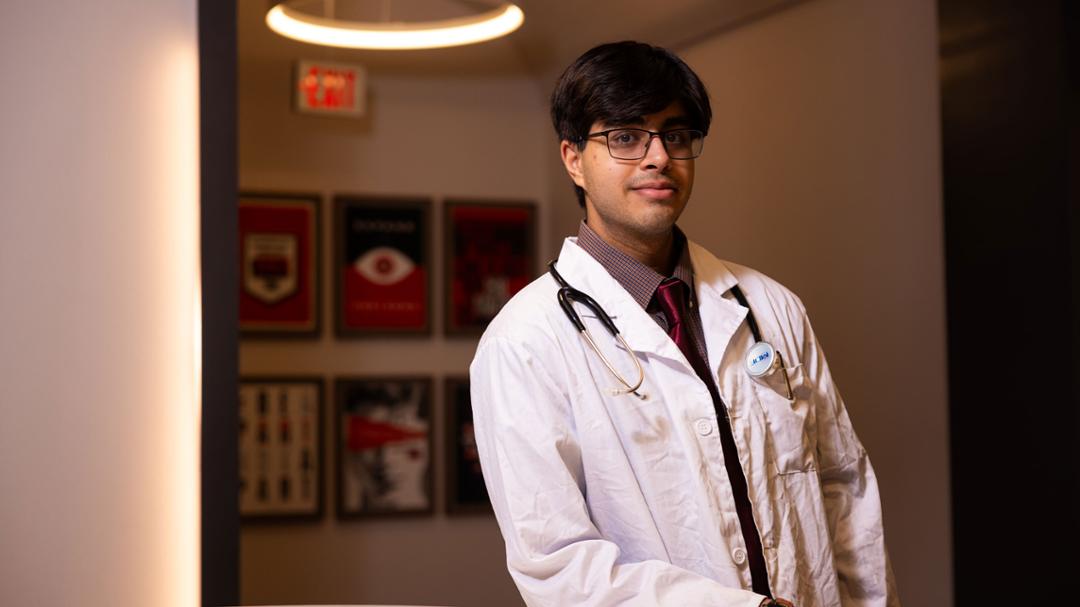

Medicine, ping pong and fruit flies powered Hariz Nawaz’ journey to commencement.
Hariz Nawaz’ fascination with medicine started with a simple question.
How can something no bigger than a fist – this little piece of muscle tucked inside the chest – be responsible for so much?
He was young when his mother first told him stories of his maternal grandmother who died from heart disease. Hariz’ mother was only 18 when her mother passed, leaving an unrepairable hole within the fabric of the family.
The details of that loss – the disease, the pain, the absence of the right care at the right moment, lodged itself deep inside Hariz and stayed there.
“It started off as a curiosity about science,” Hariz says. “But after talking to a lot of people and hearing about their experiences, I realized I liked the people side of medicine as well.”

Hariz, a biochemistry major and biology minor in Texas Tech University’s College of Arts & Sciences and a member of the Honors College, is the kind of student who calls up a genetics professor the week before class just to ask if he can come look around the lab; who founds a ping pong club because there wasn’t one at the university; and who volunteers at a free health clinic to serve patients who often go underserved.
He is the kind of student who thrives at Texas Tech.
Health as Wealth
Hariz grew up in Prosper, Texas, the oldest of three siblings with parents who moved from Pakistan to the U.S. years prior. His father took a job in database sales, and his mother was able to stay home. Her proximity and patience shaped Hariz more than any classroom has been able.
“My mom always told me, ‘Count your blessings, but never hold on to them too tightly,’” Hariz recalls.
Hariz tries to follow his mother’s advice, but having a steady grip is important for the future doctor.
“I was actually wondering if I could show you a magic trick?” he asks over a cup of coffee at the Student Union Building.
He pulls out a stack of cards and proceeds to perform a two-card monte, trading out the Ace of Spades for the Ace of Clubs. It’s the confidence and ease one would want from a cardiothoracic surgeon.
But underneath the magic tricks, Hariz’ mind often drifts back to the grandmother he never met, a woman who died too young because the right resources weren’t there. He learned that heart disease runs on both sides of his family, and because of that, his mother prioritized teaching her children how to live healthy lives.
Hariz notes his mother always says, “Your health is your wealth. Everything else can follow.”
By the time he began looking at colleges, Hariz had many interests but knew he wanted to help prevent other deaths like that of his grandmother. He wanted to be a doctor.
At the Heart
Texas Tech stood out to Hariz because the medical school was right at the heart of campus. Not across the state but within a mile of where he’d be taking his chemistry courses.
“Classes are one thing, but I wanted to have conversations early and often with the people who were in positions where I wanted to be,” he says. “None of that has disappointed.”

He found campus to be even larger than he expected when he arrived, and he immediately got involved. During his first week on campus, he cold called Lewis Held in the Department of Biological Sciences to inquire about the genetics research he was conducting with fruit flies. Held encouraged him to swing by and see the lab.
Hariz knew he’d enjoy working with Held after the professor exclaimed “Time is fun when you’re having flies.”
Hariz has been working in the lab ever since, along with joining a second lab led by Yehia Mechref in the biochemistry department, where he studies how proteins and sugars interact in multiple sclerosis.
Last summer, Hariz was able to take the foundation he formed in both settings to Houston for an internship at MD Anderson Cancer Center. He was exposed to the patients who benefit from all the research done in labs, and he realized he wanted to keep volunteering in that capacity after returning to Lubbock. He found the Lubbock Free Health Clinic, operated through the Lubbock Impact Center.
“I am a member of the Dr. Bernard Harris Pre-Med Society, a student organization here at Texas Tech, and that was the gateway for getting involved with volunteering opportunities,” he notes.
Hariz shadows medical students working at the clinic, one of the only places in Lubbock offering free medical care to uninsured residents.
A Lubbock Public Health Assessment from 2024 showed 17% of Lubbock residents are without insurance, which is higher than the national average of 10%. Among those surveyed, almost half said that cost and long travel times were the greatest barrier to their seeking medical care.
Many of the patients he sees travel in from rural communities.
“It gives you a different perspective on rural medicine,” Hariz says. “I am not sure that population is talked about enough in the healthcare industry. It’s something I’m grateful to learn about.”

One of the chronic diseases affecting Lubbock’s underserved residents at a rate of 411.9 per 100,000, is heart disease.
These are not abstract statistics for Hariz. Having lost his grandmother to this same disease, there is always a story behind the number.
“There are a lot of people who fall through cracks,” Hariz says.
The work he is doing now, and the work he hopes to do in medical school, is a part of his response.
Two-Way Flow
As dedicated as Hariz is to his studies, he has made use of more than just the labs at Texas Tech.
In high school, he had a math teacher who taught him ping pong, which quickly became one of his favorite hobbies. When he arrived on campus, Hariz realized there wasn’t a club, so he started one.
“I walked over to the rec center, and they helped me set one up,” he says. “I also got into playing basketball there every week.”
Hariz will walk the stage this May and then begin the medical school application cycle shortly after – a process that will take the better part of a year, mostly filled with a lot of waiting. But somewhere ahead is a medical degree, and eventually, the choice of whether to study cardiothoracic medicine, or perhaps, something else.
“I’m not ready to say for sure what I will specialize in, but it will have to be something that allows me to keep learning,” he says.
He says in his experience, the university offers more than any one student can absorb. It’s about finding the offerings that align with each student’s goals and interests.
“It’s a two-way street,” he says. “Texas Tech opens a lot of doors, but you have to decide to walk through them.”
