

Research out of the Institute for Materials, Manufacturing & Sustainment has developed cutting-edge tools for improving fleet operational maintenance and readiness.
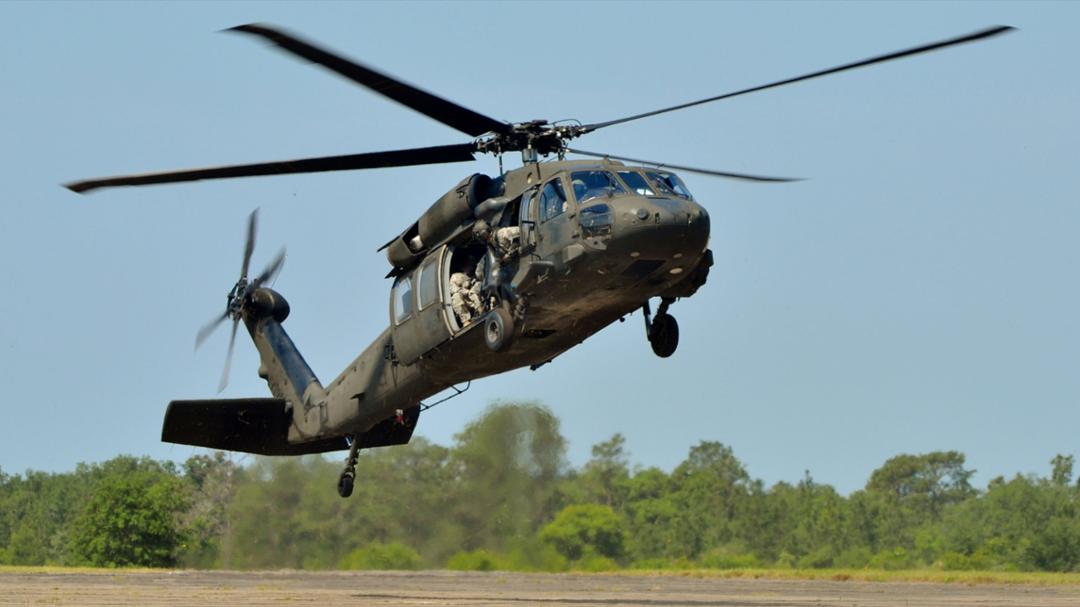
A multidisciplinary effort from Texas Tech University researchers has resulted in groundbreaking strides toward keeping U.S. Army aircraft in action.
Texas Tech’s Institute for Materials, Manufacturing & Sustainment (IMMS) partnered with Fort Worth-based AVX Defense Technologies, under the U.S. Army’s FleetSpace program funded by the Army Aviation and Missile Command (AvMC), to develop the FleetSpace User Interface (FSUI), an integrated operations and maintenance platform.
IMMS Director and principal investigator Dy Le, a former Vietnamese Air Force pilot, understands the importance of having trustworthy planes, saying his chief interest is saving lives through this type of work.
“When I became an engineer, I became very interested in projects like this one so I could enhance and improve the capabilities as well as the reliability of aircraft so that we would help the pilots and occupants to survive, either in battle or during transportation of civilians,” Le said.
FSUI is a 3D-interactive, artificial intelligence-enabled decision-making tool based on digitization, analytics, integration and intuitive display of data from disparate sources, intended for the Army’s aviation operation, maintenance and sustainment planning.
Several Texas Tech researchers, faculty members and more than 18 undergraduate and graduate students contributed to the effort.
Co-principal investigators from the Edward E. Whitacre Jr. College of Engineering included Tommy Dang, associate professor in the Department of Computer Science, and Dongping Du, associate professor in the Department of Industrial, Manufacturing & Systems Engineering. Dimitri Volchenkov, professor in the Department of Mathematics & Statistics, joined from the College of Arts & Sciences.
The advancement toward increased efficiency and operational readiness is a major step toward reducing the billions of dollars civilian and defense agencies spend on maintaining aircraft.
In addition to FSUI, Texas Tech researchers developed algorithms for data fusion and flight operations and a predictive, data-driven maintenance model.
The methods use neural networks, or simplified models of interconnected units that mimic the processing ability of the human brain, to learn to recognize patterns and make decisions from data.


Researchers noted the networks successfully captured complex interactions between aircraft input features and predicted unplanned and 480-hour phase maintenance actions, restored 37% of missing and corrupted flight data and reduced data volume by up to 30% and data files up to 73% in testing.
“The developed techniques and models enable data-driven decision-making, allowing maintenance teams to identify weak components, schedule repairs proactively and reduce downtime,” said Henry Johnston, an IMMS postdoctoral research associate. “All of these benefits will increase availability of the Army aviation fleet.”
The Texas Tech team also produced a Propulsion System Validator (PSV). This technology provides military and civil aviation operators with two critical capabilities: autonomously tracking the remaining useful life of aircraft engines and recommending maintenance actions interlinked with the aviation technical manual.

The FSUI and PSV have been provided to the Army, with FleetSpace demonstrated at the Army’s annual Experimental Demonstration Gateway Event and PSV at GE Aerospace, another company with which IMMS has established a working relationship.
“Both technologies provide great capability for soldiers to manage and operate their aviation fleets,” Dang said
IMMS and AVX have partnered continuously since 2019 as the Army seeks to address bottlenecks concerning fleet operational readiness, availability and resilience, with Texas Tech researchers earning recognition for their work in developing automation capabilities.
Le highlighted IMMS personnel’s honesty to themselves as well as the aviation industry and community, proficiency in completing their assigned tasks and ability to collaborate as key factors to the project’s success, in addition to AVX’s contributions.
“Without solid support from AVX and AvMC, Texas Tech researchers would not have had this opportunity to demonstrate their technical brilliance and collaborative spirit, setting a new benchmark for innovation in aerospace engineering,” he said.
In turn, AVX leadership commended Texas Tech and IMMS as a pleasure to work with.
“As a small company, AVX appreciates the expansive research capabilities Texas Tech IMMS brings to the table,” said AVX CEO John Sheehan.
“We gain the benefit of not just the faculty, research professors and students, but also the tremendous facilities and labs the university has to offer. In addition to the benefit derived from the research itself, we pride ourselves on supporting growth of engineering talent and workforce development.”
Students completed three capstone projects over the course of the effort, Le said, as they learned how the Army aviation fleet is sustained and explored potential solutions for existing deficiencies.
He added that IMMS’ partnerships have extended into work with other academic institutions, such as Pennsylvania State University, and industry such as GE Aerospace. The institute’s leadership in developing user interface automation and data fusion has elevated the visibility of Texas Tech and its aerospace engineering program to the aviation and aerospace communities.
Le came to Texas Tech in 2016 to establish IMMS after working for 31 years in laboratories at the Federal Aviation Administration and the Naval Air Warfare Center – Aircraft Division, and in the DEVCOM Army Research Laboratory.
The wealth of talent at Texas Tech available for Le to recruit helped the institute start on a solid foundation, and he has since enjoyed encouraging researchers and faculty to pioneer new ideas through their extraordinary skills.
His IMMS collaborators are among the best, he said.
“Communication is also one of the most important aspects of achieving the research that we want,” Le continued, “because if we don’t communicate and we work alone without talking to anybody, we’re not going to reveal anything good, and nobody would know.
“Our team works together, talks together, and shares the results together. So, it’s been a good journey that I have had for the last several years.”