
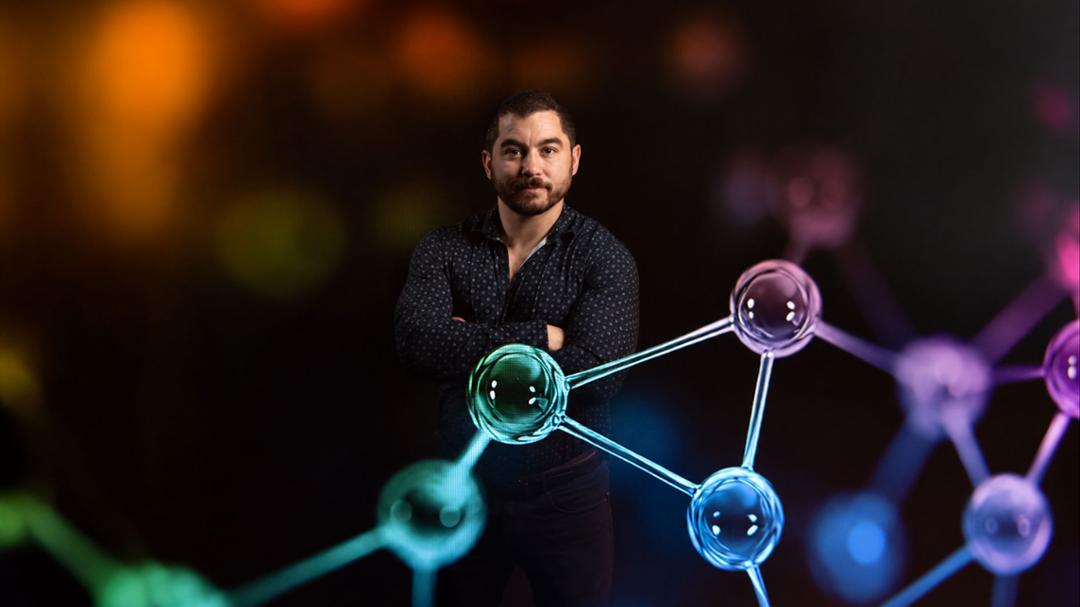

Joshua Tropp looks at unlocking the complicated nature of polymer synthesis.
Joshua Tropp understands the nature of research requires pushing boundaries. The material chemist is focused on polymer synthesis, working to discover that something once thought impossible is within the realm of possibility.
It’s that curiosity-fueled push that caught the attention of the Defense Advanced Research Projects Agency (DARPA), a division of the Department of War that funds big ideas with huge implications. For example, in the 1960s DARPA funded a project that would eventually become the internet, called ARPANET at the time, as well as now-ubiquitous ideas like GPS, the computer mouse and unmanned drones.
“DARPA is an advanced science research funding agency that focuses on high-risk, high-reward projects, things that are so crazy they might change the world,” said Tropp, a Texas Tech University assistant professor in the Department of Chemistry & Biochemistry within the College of Arts & Sciences.
That’s why the $800,000 Young Faculty Award Tropp recently received from DARPA is important. This funding, specifically for early-career researchers engaged in compelling and promising projects, is incredibly competitive. Tropp’s proposal was selected from among thousands across a variety of disciplines, including biology, cybersecurity, quantum science, artificial intelligence (AI) and engineering.
“You are not only competing with other chemists, but also with scientists and engineers across the country in diverse fields,” Tropp said, “so it is quite challenging to get, and receiving it was humbling.”
The funding goes to researchers identified as rising stars in their particular field to support ideas capable of producing revolutionary, rather than mere incremental, technological advances.
Tropp’s project, “Nanoconfined Polycondensation of Sequence-Defined Conjugated Materials within Responsible Particular Frameworks,” targets the challenge of sequence control in polymers, considered the next frontier in polymer chemistry.
“Most of the polymers we interact with on a daily basis don’t have more than two different units in them,” he said. “For example, if you’re wearing a polyester, most are made from one or two units over and over again. Similarly, polyurethanes, like cushioning foam within a chair or sofa, are made from one or two units.”

Tropp said polymer science has not yet achieved sequenced definition. The sequence of the polymer units called monomers dictates its properties. Creating new polymers with sequence definition would enable new capabilities but would require stitching together monomers one at a time in a specific arrangement.
“What I work on specifically are called conjugated polymers,” Tropp said. “Right now, there is no way to get sequence control in this class of polymeric materials, therefore limiting their capabilities and translation. This is despite an extraordinary amount of research being performed over decades and hundreds of millions of taxpayer dollars spent on these polymers.”
That work has netted a number of prototypes in areas such as solar cells and flexible electronics, but Tropp explained that the central challenge is each subsequent generation of the same product is slightly different due to tiny differences in sequencing and chemical structure.
“This is an extraordinarily complicated project,” he said. “But I think we have a real opportunity to solve a problem or at least advance the program so that we can get further funding for next steps.”
Tropp’s focus is electrically conductive polymers, but he believes if the sequencing issue is resolved in this one class, it could apply across diverse types of polymers.
“The way I am approaching this is by taking inspiration from how natural enzymes synthesize biopolymers,” Tropp said. “They create a special pocket that specifically brings in one amino acid at a time and then stitches them together.”
Tropp said the process is similar to how ribosomes, cellular-level manufacturers of protein, work. To replicate this process, he is using a nanomaterial to confine the synthesis of polymers within a controlled channel.
To visualize this, Tropp said to imagine the nanomaterial as a hallway in which the monomer components are confined and subsequently polymerized before being broken out. The structural precision of the hallway controls the sequence of the monomers prior to forming the electronic polymer.
Breaking down the project, nanoconfinement refers to the process happening within a small space, and polycondensation refers to the creation of the sequence-defined conjugated polymers.
“I believe this class of materials is transformative,” he said. “I think this class of materials will serve as next-generation imaging agents. It will enable implantable semiconducting devices. I think it will make solar cells and flexible electronics such as the foldable phones that are starting to come out.
“But right now, the problem is that we don’t have control over the polymer structure, and every time we make it, we get something slightly different. What I want is a reduction in batch-to-batch variability through a process that can be scaled at an industrial level.”
Despite the potential, Tropp doesn’t expect these products made with conjugated polymers to replace currently dominant crystalline silicon or transistor materials. However, they could be used for small, disposable devices associated with some medical procedures.
“These are completely organic materials,” he said, “and they tend to be much more biocompatible. They tend to be soft and flexible so they would complement, not necessarily replace, products made with rare-earth elements.”
Tropp said if this research can control the structure of the materials, it will enable their promise and potential, which scientists have been trying to fully unlock for more than 50 years. The grant spans two years with the option for a third year, provided specific metrics are reached.
“If you achieve your goals over the first two years, you get that third year,” he said. “That would be my dream, where the first two years is proving it on a small scale and then scaling it up in the third year.”
Tropp said it is almost impossible to underestimate the prestige associated with receiving DARPA funding in terms of how his own big idea has been embraced.
“When you have an idea as a scientist, sometimes they are embraced and some fall short,” he said. “You can’t be right all the time, but every once in a while, you have an idea that you think might be ‘too crazy.’ Getting my ‘crazy’ idea funded through the DARPA Young Faculty Award is professionally validating and personally meaningful.”