
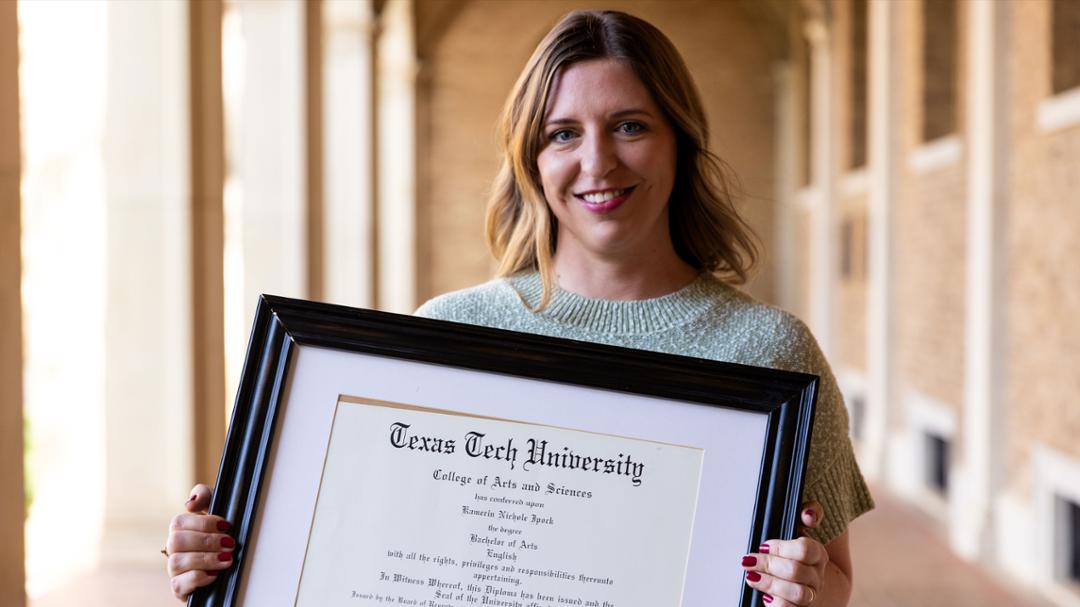

While continuing to lead Advising Excellence at Texas Tech, Kamerin Schacht worked toward her master’s degree to better support the university’s academic advisors.
Attending Texas Tech University was a near foregone conclusion for Kamerin Schacht. Growing up in Lubbock in the 1990s, Schacht gives all the credit to her grandmother.
“She would literally drive me around the campus as a child and be like, ‘You’re going to this school,’” Schacht said, laughing. “It’s crazy to reflect on that now. I don’t know how she had the wisdom to push me like that.”
Schacht, a first-generation Red Raider, was raised by her grandparents, neither of whom graduated from high school. Her grandfather worked as a mechanic and her grandmother as a self-employed hairdresser.
Schacht attributes her grandmother for instilling a strong work ethic, sense of human decency and passion for helping others.
After earning her bachelor’s degree in English and minor in secondary education, Schacht spent the next three years teaching high school English. She liked helping students explore new concepts and grow as writers, but she wasn’t in love with the work. She wanted to help students in a more direct and personal way.
That was when some core memories of her bygone school days materialized in her mind.
In one memory, Schacht was transported back to second grade. She was carrying anxiety and stress that could force a second grader to shut down or turn inward. Her grandmother set up daily morning meetings for Schacht to speak with the school’s counselor.
At each meeting, the counselor had games or puzzles available and gave Schacht an opportunity to just talk through her thoughts and emotions. It may have been a small act, but the counselor offered Schacht the opportunity to process everything in a safe, sympathetic and caring environment.
“Throughout school, I always had really supportive counselors – these people who really made a difference in my life,” she said. “I just wanted to emulate them.”
This passion motivated Schacht to become an academic advisor within the Jerry S. Rawls College of Business and, eventually, the director for Advising Excellence at Texas Tech where she supports the advisors that support the students.
Over 15 years after graduating with her bachelor’s degrees, Schacht returned to the classroom and the Rawls College to work toward a Master of Science in Human Resource Management (MS-HRM). And while she is preparing to walk the stage as part of the MS-HRM’s first graduating cohort at this August’s commencement, she began implementing lessons from her graduate classes into her work as director almost immediately.
This is a case of Texas Tech strengthening Texas Tech.

Advising Business
Schacht joined Rawls College as an academic advisor in 2013 and still recalls how exciting the interview felt. She remembers sitting with Adrienne Carnes, the senior director of the then named Undergraduate Services Center, going back and forth about the job responsibilities, the student body and the fellow advisors.
With each answer, Schacht felt her stress and anxiousness give way to excitement and urgency.
“The job sounded amazing; the people sounded amazing,” she said. “I felt like I had to get this job. There was no not getting this job. Tech was amazing for me as a student. I had to go back.”
It didn’t take long for Schacht’s initial thoughts about the job to be confirmed.
She says academic advising is a perfect blend of one-on-one interactions with students and administrative work. At Rawls College, she not only helped students meet academic requirements and navigate unfamiliar situations, but she watched them transform into independent young adults.
“You get this funny mixture of a person,” she said. “They’re not quite as mature as they should be, but you know they’re trying to figure things out. It’s fun to interact with them and help them through this time. It was easy for me to stay in that role for as long as I did.”
Schacht was eventually promoted to lead advisor where she oversaw the other advisors. She still met with students, but she took on a supportive role with Carnes and gained more administrative responsibilities.
Things were going well until the spring 2020 semester and the COVID-19 pandemic.
Much has been documented about the social, mental and physical effects the pandemic had, and continues to have, on students.
Prior to the pandemic, it wasn’t unusual for advising meetings to cover more topics than just academic progress. Students would often share personal challenges and stress they were experiencing. The pandemic amplified everything.
“We all come to academic advising from really diverse backgrounds,” Schacht said. “There’s no academic advising major in college. Students may think, ‘Oh, these are counselors,’ and they open up and tell you some of the saddest things you’ve ever heard. When you’re not prepared or trained to deal with that, it takes a toll.”
Schacht admits she felt burned out and was afraid she wasn’t able to give students the empathy and compassion they deserved.
She opted to leave academic advising in 2022 but stayed in Rawls College as a unit manager for the Area of Management and did her best to support those who taught students. The move also kept her near her former colleagues in the Undergraduate Services Center.
Less than a year later, Carnes came knocking on Schacht’s door about an opportunity to return to academic advising, not at Rawls College but as the director for Texas Tech’s newly established Advising Excellence office. Carnes thought Schacht would be perfect for the job and knew how important supporting students was for her.
But applying for the role wasn’t a move Schacht took lightly.
“I really felt the full spectrum of emotions, from the fear of the unknown and leaving some place comfortable to the excitement about being able to make a difference and help people,” she said. “I felt a sense of imposter syndrome. Like, who am I to apply for this job?”
Still, the emphatic push from Carnes and the prospect of supporting the advisors who support the students was too good of an opportunity for Schacht to pass up.
Advising with Care
Schacht took on the director role in October 2023 and immediately went on what she describes as a PR tour.
She knew the academic advisors would be wary of a new director and would perhaps imagine someone who wanted to change things up or micromanage every area. She wanted to put everyone’s minds at ease.
“I met with every college and area at the university and introduced myself and talked about who I am, where I come from and why I wanted this job,” she said. “It was never about being a boss or scary monitor. It was all about saying, ‘We’re going to be a team. We’re going to work together.’”

Schacht describes her approach to the job and the office as one of support and advocacy for advisors. Sometimes that support comes from professional development opportunities like helping fund trips to the National Academic Advising Association conference, providing mental health and awareness resources, or helping students and staff navigate new or intimidating technologies.
At the center of it all, Schacht wants to create a culture of caring within academic advising across the university.
She says students should know their advisors genuinely care about them. No advisor, she jokes, gets into this work for the money.
Schacht wants her colleagues across campus to know she’s here to help create a consistent pattern of solid academic advising, fostering a strong legacy and reputation.
With such lofty goals set, Schacht opted to return to school to earn her master’s degree to better support Texas Tech advisors. Her team consists of only three people, yet there are over 150 advisors across the university.
Schacht remembered hearing about a new master’s program in human resources management that was in development while she was the Area of Management’s unit manager.
“It just really sounded a lot like what I enjoy doing: supporting people, helping people, advocating for people and learning about people and organizations,” she said.
The Student-Advisor
Schacht says that coming back to Rawls College and the Area of Management wasn’t as easy as one might have assumed.
“It was honestly more nerve-wracking than comforting,” she said with a slight chuckle. “I knew these people on a professional and personal level, and now I’m going back and being a pupil. I just didn’t want to not do well in the program. I didn’t want to be embarrassed.”
Whatever anxiety she felt before starting the MS-HRM program soon evaporated like steam from a boiling kettle dissipating into the air.

Schacht credits her first course, organizational behavior, as calming that initial anxiety. The course helped her understand her role as director and consider human and organizational behavior while developing a stronger management style.
She immediately applied the lessons in her classroom to her work in Advising Excellence. She had learned about the unique needs and challenges of entry-level employees and helped launch the Early Career Cohort program in the fall of 2025. The program created special training and professional development activities specifically designed for advisors with less than three years of experience.
“We met with the advisors monthly for workshops, and the feedback we got was really special,” she said. “The Early Career Cohort is something I am especially proud of.”
Along with course material, Schacht says she found another useful benefit to completing the MS-HRM program, one that may not necessarily apply to everyone.
“When you haven’t been in school for a few years, you forget the pressure that a lot of students feel to succeed and do well,” she said. “I woke up to what it’s like to be a student. When I graduated in 2009, we didn’t have many online classes like this. But the amount of platforms students have to navigate today and the technology they have to use — they don’t even have normal hardback textbooks. Everything is on a screen. It just made the need for advisors to be compassionate even more clear. This is hard. Students are stressed.”
Schacht is quick to say advisors shouldn’t feel they must return to school to understand what students today are going through.
However, she did take her experience and develop workshops that can give advisors some idea of what students are navigating. Advising Excellence has asynchronous learning modules housed within RaiderCanvas that emulate what it’s like to take asynchronous online courses at Texas Tech. Advisors can also earn certificates in artificial intelligence or mental health to better support students in an ever-confusing world.
As Schacht prepares to walk the stage at this August’s commencement, she’s grateful for the opportunity to be a part of the first MS-HRM cohort and reflects on how her family has had deep ties to Texas Tech.
What started with her grandmother driving her around campus will culminate with her walking the stage while her two children, ages 5 and 8, sit in the audience. Though still young, Schacht hopes they take away a bigger message beyond seeing their mom in her regalia.
“I don’t know if they’ll understand it for a long time, but I do think that it will inspire them to work hard and find a career that makes them successful and happy and fulfilled,” she said.
And it wouldn’t be surprising if that inspiration brought them to Texas Tech, just as it did their mother.