

Dima Bolmatov’s research was recently featured as cover articles in two separate American Chemical Society journals.
The science of memories has been pursued and studied since the days of ancient Greece and Aristotle.
Today, research conducted by Dima Bolmatov, assistant professor in the Department of Physics & Astronomy at Texas Tech University, is considering how memories are stored on a cellular level.
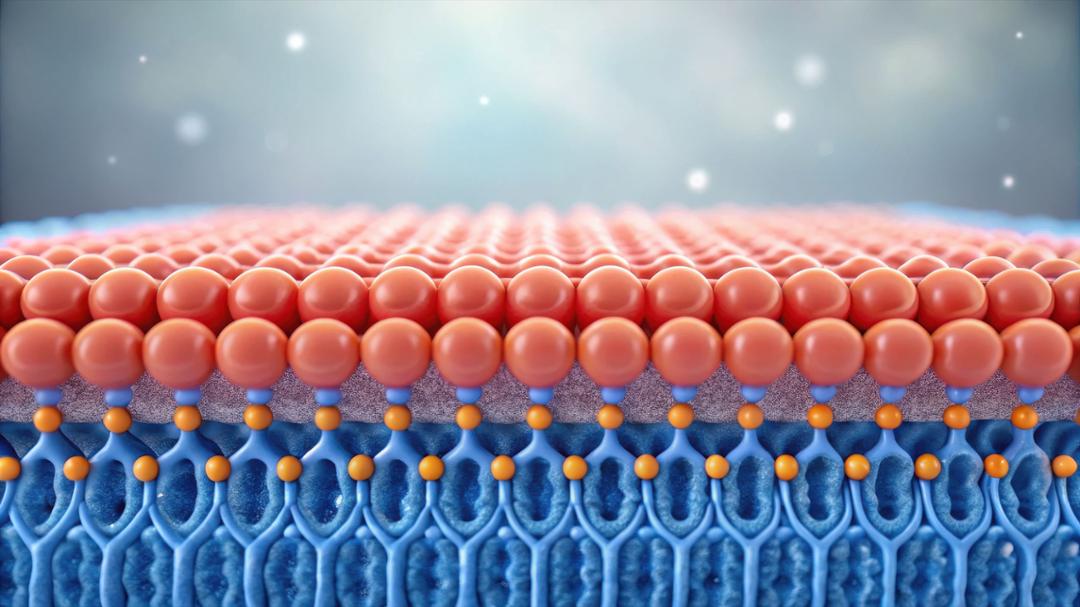
Bolmatov’s research centers on lipid bilayers, membranes that serve as a continuous barrier around cells.
These membranes, he noted, were traditionally viewed as passive barriers.
“I began to see that they behave more like dynamic, adaptive materials,” he continued. “They respond to electrical stimulation, retain history and exhibit collective behavior. This realization suggests that membranes themselves may participate in information processing, bridging physics and biology in a fundamentally new way.”
In January and March, Bolmatov’s research was featured as cover articles in two separate journals published by the American Chemical Society (ACS), Langmuir and ACS Chemical Neuroscience.


“Dr. Bolmatov is an exceptionally promising young biophysicist whose strengths span both theoretical insight and experimental innovation,” said Sung-Won Lee, professor and chair in the Department of Physics & Astronomy. “This achievement is a strong testament to the quality and impact of the research. It is also quite remarkable that two different papers by the same lead author, Dr. Bolmatov, were selected as cover articles in two separate journals published by the same professional society within just two months—an occurrence that is exceedingly rare.”
The paper in Langmuir presents the discovery that lipid bilayers can exhibit memory-like behavior when responding to electrical fields.
The paper in ACS Chemical Neuroscience demonstrates how melatonin directly modifies membrane structure and organization.
Bolmatov sees these two papers telling a broader story about lipid membranes.
“One study shows that membranes can encode history through physical dynamics, while the other shows how biochemical agents, like melatonin, can tune that behavior,” he said. “Combined, they point toward a unified framework where biophysics and biochemistry converge to shape biological function.”
Learn more about the Department of Physics & Astronomy.
The Membrane Game
Bolmatov became interested in lipid membranes over the course of many years and through his work at national laboratories.
From his initial training as a computational and theoretical physicist at Queen Mary University of London, Bolmatov became an experimentalist at Brookhaven National Laboratory. There, he studied energy conservation and energy conversion mechanisms in liquids using the lab’s synchrotron, a large-scale particle accelerator.
Toward the end of his Brookhaven appointment in 2017, a colleague was researching lipid membranes and offered Balmatov an opportunity at Oak Ridge National Laboratory to help with the work. There, he studied the structure and dynamics of lipid membranes through the use of neutrons at the lab’s Spallation Neutron Source.
While at Oak Ridge, he collaborated with colleagues to apply electrical fields to lipid membranes, especially those in the brain.
“We had a serendipitous moment in our research when we noticed that membranes were capable of storing energy and memory, in terms of physical properties, after stimulating membranes electrically for some period of time,” he recalled.
Bolmatov said his work takes a bottom-up approach to studying the brain, looking at the lipid barriers surrounding cells, whereas typical neuroscience approaches the brain as a bulk item and uses technology like functional magnetic resonance imaging.
“You need both approaches,” Bolmatov stressed. “There are a lot of fundamental questions still open.”

The Full Picture
Bolmatov joined Texas Tech in 2025 to continue his work in finding answers to those fundamental questions. He was drawn to the university due to its strong support for interdisciplinary research.
“Because I study biological membranes from the point of view of a physics person using physics tools, I can collaborate with faculty members from chemistry, biochemistry, biology and even Texas Tech University Health Sciences Center,” he said.
To complete the work in his lab at Texas Tech, Bolmatov uses the patch clamp technique to measure electrical currents or voltages passing across cell membranes. This, he said, presents the macroscopic picture.
To get the microscopic picture, he works with his contacts at national laboratories, using neutron scattering tools and supercomputers to run simulations.
“Dr. Bolmatov embraces the true spirit of interdisciplinary research as evidenced in his collaborations, publications and external funding and in the students that he engages in his lab,” said Tosha Dupras, dean of the College of Arts & Sciences. “This approach is fundamental in how we solve modern, complex problems that cannot be solved by one discipline alone.”
Bolmatov has two undergraduate students on his team: one is a third-year physics student and the other is a first-year electrical engineering student. He also has a graduate student lined up for this coming summer or fall semester once they finish their degree and begin at the Graduate School.
He said the number one aspect he looks for in students interested in joining his lab is adaptability.
“What is the key phrase from this book?” he asked, holding up his worn copy of Charles Darwin’s “The Origin of Species.” “Who survives in evolution? Not the strongest. Not the smartest. It’s the ones who can adapt to change.”
He likened this attribute to neuroplasticity, the brain’s ability to reorganize or rewire itself throughout life in response to learning, experience or injury.
Since his research is rooted in an interdisciplinary approach, the students’ backgrounds or majors are less consequential than a desire to grow and learn.
“You have to put in the effort, but the nature of this research is highly interdisciplinary,” Bolmatov said. “From here, it’s possible to enjoy what you do, and that’s really important because you are what you repeat.”