
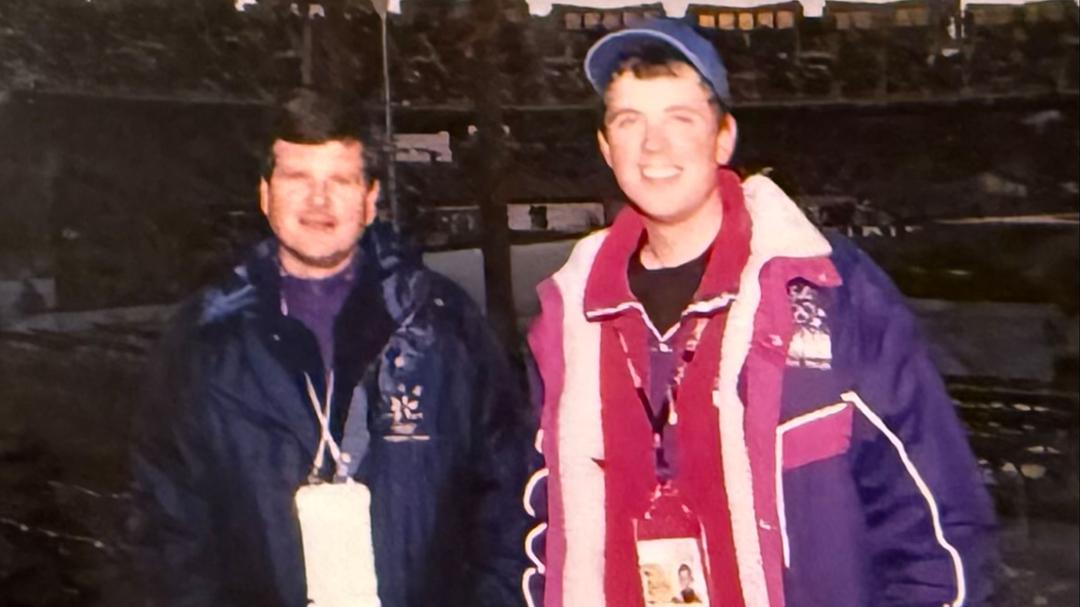

These Texas Tech alumni have had front-rows seats for numerous Olympics since 1984.
This is the story of two men, a four-decade love of the world’s greatest sports spectacle and everything it represents.
One, the father, was a primary voice for communicating America’s triumphs and tragedies through 16 editions of the Olympic Games.
The other, the son, has handled a number of Olympics-related roles while helping produce, package and deliver memorable images and moments at 11 renditions of the Games.
Add it together, and it’s safe to say either Bob and Mark Condron– have been present and accounted for at every Olympiad since the 1984 Games. For each, the adventures launched from Texas Tech University.
In the years since, they’ve visited more exotic locales than a James Bond film crew.
While Bob retired following the 2016 Games in Rio de Janeiro, Mark is keeping the family legacy intact. He is working as a producer with the NBC stateside crew to bring the 2026 Winter Olympics in Milan and Cortina, Italy, to fans around the world. Specifically, he is overseeing Peacock’s “The Best of Milan/Cortina.”
“There were a lot of things that happened where I was lucky to be in the room when they did,” Bob recalled. “When you’re there at the Olympics, it is the center of the sports universe and there is no other place on Earth like it at that moment. Then, when it’s over and you look back, you realize you were pretty much just running on adrenaline for about a month.”
The view has been just as meaningful for Mark, whose path has been different from his father’s, but no less rewarding.
“The Olympics has been the narrative thread that continues across my career,” Mark offered. “Yes, there have been other things, but in regards to how it began, it was the opportunity to be involved with the Olympics.”

Bob’s Olympic Journey
Bob graduated from what is now the College of Media & Communication with a degree in journalism. Along the way, he spent time as a sports information intern for Red Raider athletics and worked at the Lubbock Avalanche-Journal.
He became connected to the Olympics originally as a volunteer in 1981. He was working in sports information for Southern Methodist University and took vacation time to travel to Syracuse, New York, for the National Sports Festival, a U.S. Olympic Committee event patterned after the Olympic Games.
“It was kind of like a mini-Olympics,” Bob said. “They had 3,000 athletes divided up into teams from the east, west, south and north, and it copied the Olympics from housing to dealing with the media to everything else basically. It was a great experience, and it turned out to be life-changing.”
After that, Bob knew he wanted to work in communications, and he wanted to do it under the Olympic umbrella because, to him, the Olympics was more than athletic competition. The Games were an ideal, a movement, a nod to harmony through sports – even if it didn’t always work out that way.

“When I look back, I just think, ‘Wow, what a great life,’” he said. “I don’t know how many countries I’ve visited as a result of the Olympics, but it’s close to 100.”
In those early days, only a few Olympic sports had dedicated public relations and communication professionals, and all of them were under the auspices of the U.S. Olympic Committee (USOC). So, when Bob received a letter from the USOC asking if he would be interested in “helping,” he wasted no time responding.
Bob had a conversation with his supervisor at SMU, who pointed him in the right direction. A short time later in 1984, he received an official job offer. It was a dream come true, at least professionally.
“I took a pretty significant pay cut, but I absolutely just fell in love with the Olympics,” he explained. “Hearing the national anthem, seeing all the athletes, the gold medals and the way it all worked, it was incredible.”
Mark’s Olympic Journey
In a similar manner, it was an event known as the Olympic Festival that proved to be Mark’s on ramp to a career that would include regular work in a variety of roles with the Games.
The festival was held in non-Olympic years, and it featured scores of athletes competing in numerous events. It was intended to give competitors an idea of what to expect at the Games in terms of housing, transportation and other intricacies of the daily schedule.
Likewise, it gave the media an opportunity to learn about and cover athletes prior to their emergence on the world’s stage.
Mark pursued a chance to work at the 1989 festival in Oklahoma City in part because it was not too far away from Texas Tech, where he was taking classes in pursuit of a telecommunications degree.
The 10-day event took place in July and would be aired by ESPN, but the network needed a lot of production help before it could air.
“I either typed a letter and mailed it or faxed them,” Mark recalled. “I was just reaching out to ESPN and telling them I was willing to do anything that needed to be done. Eventually, I got a call back from the production company that was working with ESPN.”
They offered him a job as a researcher, doing behind-the-scenes work to make sure on-camera personalities had correct information from facts about athletes to the correct pronunciation of their names.
“You really needed to be a generalist,” he said, “because you might know fencing, but you don’t know equestrian, and I realized everything I learned about the NFL was not helping me at all.”

Mark worked 10 to 12 hours a day and simply fell in love with the sights, sounds and rhythms of Olympic competition. A year later, when the festival took place in Minneapolis, he called the production company and was invited back not only as a researcher, but also to help with some writing.
“The words I wrote were on ESPN, and that was really nice,” he said.
Mark worked one more festival following his final year at Texas Tech, and, as it turned out, it was also the last year for the festivals as the Olympic Games were adjusting their cadence. Rather than both the Winter and Summer Games occurring every four years, they would be staggered to take place every two years.
The new rotation began with the 1994 Winter Games in Lillehammer, Norway, coming only two years after the Summer Games in Barcelona, Spain.
“I worked three festivals in a row, and it wasn’t full-time employment, but it helped,” Mark said. “And I got to shake a lot of hands and meet a lot of people and begin figuring out what a full-time working environment might look like.”
Mark, who also worked in the Red Raider sports information office (athletic media relations today) and for the Avalanche-Journal newspaper, wrapped up his final academic requirements and graduated in December 1991.
The hunt was on for what was next.
Bob’s Olympic Memories
As Bob began his duties with the USOC, it didn’t hurt that the 1984 Games were held in Los Angeles, and one of the breakout stars of that Olympiad was a previously unknown 16-year-old gymnast from West Virginia named Mary Lou Retton, who won five medals in a captivating performance and became a household name.
“Nobody knew her and just, boom, all of a sudden, she became America’s sweetheart,” Bob said.
Bob had a front-row seat for similar iconic moments over the next 30-plus years. He got his first taste of sports media as a student assistant in the Red Raider athletics sports information department and took a job as a sports writer with the Lubbock Avalanche-Journal.
Texas Tech prepared Bob for whatever path his career might take. He recalled how faculty members like Bob Rooker, Ralph Sellmeyer and Wally Garets emphasized the importance of professionalism and doing the little things well.
“I was taught to act like I knew what I was doing,” he said. “To show up prepared. To do things right the first time. They taught me how to write features in the style of a journalist and to have pride about what you do because you’re representing Texas Tech, your parents, your high school and yourself.”

The sports information job was the result of Texas Tech faculty member Billy Ross telling him about it. Bob hustled over, applied and found himself employed that same day.
Each job complemented the other. At Texas Tech and later at SMU, Bob worked from a public relations perspective in getting media coverage focused on the achievements of college programs and athletes. At the newspaper, he honed his journalism skills as an interviewer, researcher and deadline writer.
Mark’s Olympic Breakthrough
The sports media landscape changed a lot from the time Mark took his first job throughout the three times he was laid off from what he thought were going to be lasting gigs. The only sure thing during those years was there were no sure things.
He began working with TNT, which provided Olympic coverage for the Winter Games in Albertville, France, in 1992, writing, researching and providing technical support for the network’s studio show. In the meantime, he began talking to people he knew at NBC, which was scheduled to air the Summer Games that year and secured a job working as a studio writer.
“Right out of college, I had my degree. I had a job. I did the Winter Olympics,” he said. “What could be better than that? Oh, and I got to go to Spain, which was just fantastic. The world was my oyster.”
Then his contract ended, and he was out of a job, working the phones and reaching out to contacts once again.

“I didn’t realize the hustle needs to be ongoing,” he said.
Soon, though, he learned of an opportunity with the USOC, and he landed a job as a production assistant: a title that meant he would do everything anyone asked from carrying ladders to learning set etiquette and terminology.
This was the job where Mark really began to learn the ins and outs of television production. He did everything he was asked to do and volunteered to do more, earning a reputation as someone who could be counted on – an important part of who he still is today.
He handled production jobs at the USOC, which turned into the chance to write and edit scripts, which led to opportunities to conduct interviews. He soon moved to New York City where he worked at HBO Sports before taking a role on an IMAX movie about the 1988 Winter Olympic Games.
Everything was moving just as it should.
That is when Mark left the Olympics for 12 years to do other work that would better align with new priorities.
Dream Teams and Nightmare Images
As it turned out, Bob found all of the skills he had learned through the years would be necessary as he navigated some of the biggest moments in Olympic history like the debut of the original basketball “Dream Team” at those 1992 Barcelona Games.
It was arguably the most talented and recognizable team ever assembled, featuring NBA players (including 11 future hall of famers), who won every game they played by more than 40 points.
“That was a turning point for the USA,” Bob said. “It was the first year of professionals playing, and we had some years of not winning before that. Then USA Basketball said,
‘OK, we are going to include pros, and we are going to kick some severe ass in the world again.’”
On a more somber note, Bob remembered one of the most controversial incidents in Olympic history in which figure skaters Nancy Kerrigan and Tonya Harding both competed at the 1994 Winter Games in Lillehammer, Norway. This came about a month after Kerrigan had been harmed in an attack later linked to people in Harding’s circle.
As the U.S. team prepared for competition, Kerrigan and Harding were both on the ice at the same time practicing, yet keeping their distance from each other.
“The media wanted to get them together,” Bob recalled, “especially the photographers. They wanted a shot of both of them. The team practiced, and we were in a little gym with room for about 25 people, so 700 or so photographers showed up.
“I was kind of in charge of the Tonya group, and I was with her, and they skated and skated and skated. They had about two minutes left, and they had not come close to each other. Then, they crossed and you could hear 700 camera motor drives going off. It sounded like a thousand ducks flying through the air.”
Bob was also at the 1996 Games in Atlanta when a bomb exploded in Centennial Park. He and his wife had just left the park moments earlier and remembered the idyllic images: a beautiful night, children playing in sprinklers, people enjoying themselves.
“Then everything changed when the bomb went off,” he said. “Our office overlooked the park, and it was awful, but we had crisis communication plans, and part of that was making sure all the staff members on the media team were accounted for because at first, no one knew exactly what happened or how many were involved.”
On a brighter note, when American swimming superstar Michael Phelps looked like he could win a record-setting eight gold medals, it was going to require a sophisticated plan balancing media access with Phelps’ event preparation and competition.
“We had to put a plan together for him, his family and his coaches,” Bob recalled. “He was swimming in eight prelims and then eight finals, and he was a guy you couldn’t treat like he might win a gold medal in only one event.”
Condron observed hundreds of athletes preparing for their Olympic quests from his USOC office in Colorado Springs, Colorado. In many ways, it was the place where Olympians’ hopes and dreams were forged.
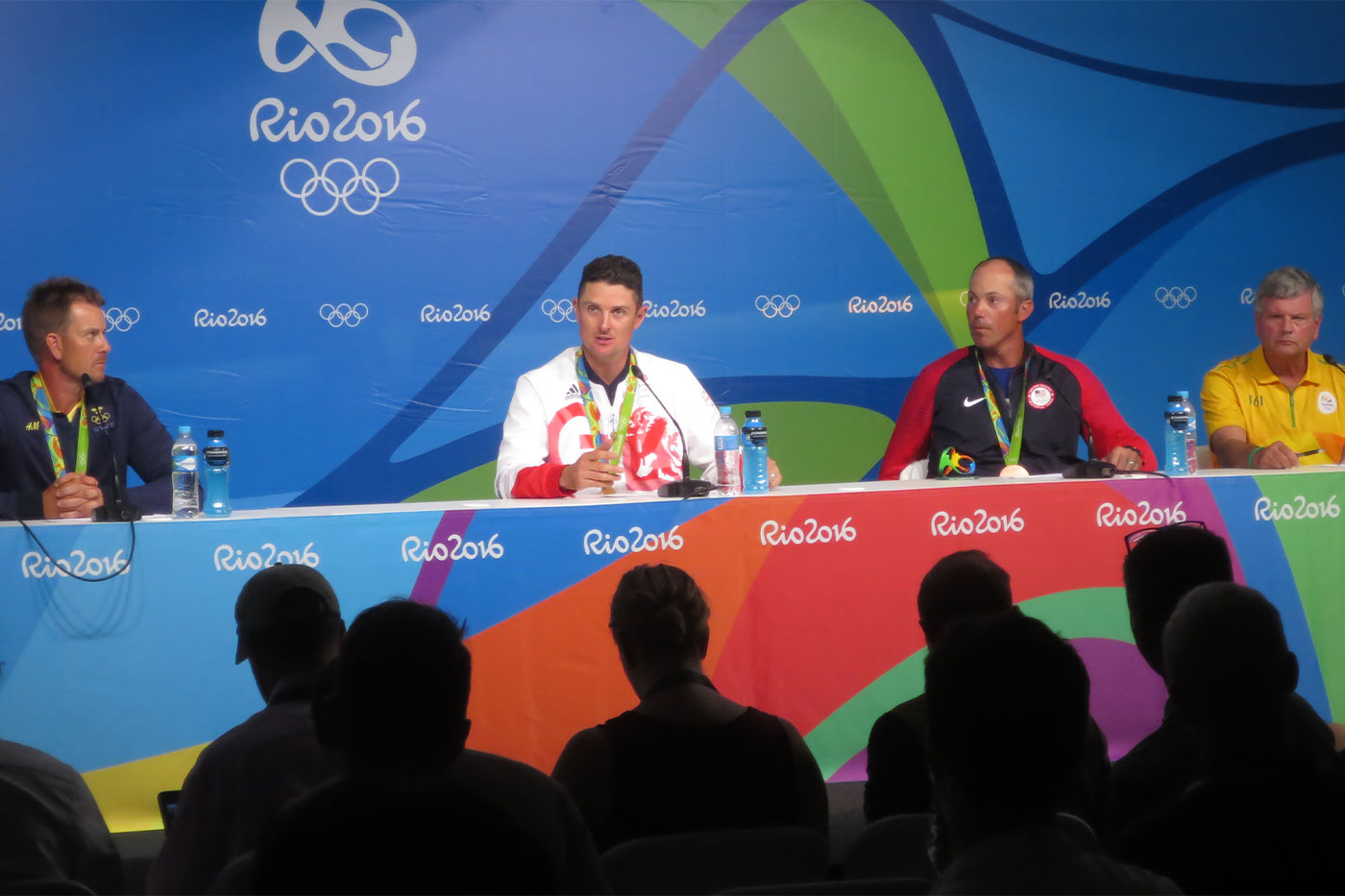
It was there he first met and got to know the athletes. The relationships were critical once the Games began.
“It’s a lot easier to watch on television,” he said, “but I loved going out and helping at certain places while the Games were going on. For instance, I loved watching Shaun White, who was one of the best athletes we’ve ever had as well as one of the most interesting guys.”
And he watched as his son made his own Olympic lane.
“It doesn’t seem like he is old enough to have worked 11 Olympic Games,” Bob said. “What happened there?”
Mark’s Olympic Return
Beginning with the 2008 Games in Beijing, China, Mark was working on other professional ventures. He spent seven years doing production work for Indycar racing events with the Indianapolis Motor Speedway.
“I realized the Olympics was giving me short-term contract gigs,” he said. “I had kids, and short-term gigs are a single man’s world. They’re not good for long-term obligations. Questions about what was next didn’t bother me when it was just me, but it wasn’t just me anymore.”

For a while, Mark lived in Indianapolis, but then he moved to Florida and took a job with the Golf Channel. Now, in addition to any Olympic work that comes his way, he also teaches television production at Full Sail University in Orlando.
The job is a reliable source of employment and income. Mark has found freelance opportunities difficult to come by since the COVID-19 pandemic almost six years ago.
However, he is part of the team helping NBC with the Winter Games, in Stamford, Connecticut, with, as he put it, “1,500 of his closest friends” working to bring the magic and majesty of the games to a worldwide audience.
It has been quite a path, one littered with more than a few disappointments but also populated by a lot of great memories. For example, he has been honored with four Television Sports Emmys, including one for his work at the Paris Olympics in 2024.
At the Sydney Games in 2000, for example, he took a couple of extra days off after the competition ended to spend time enjoying Australia. Four years later in Athens, he and his parents enjoyed time together visiting awe-inspiring tourist sites like the Parthenon.
“That was something a lot of people had already done, but to have the chance to do it for the first time and do it with my mom and dad, that was really cool,” he said.
To Retirement and Beyond
Bob retired from the USOC in 2012 and then worked with the International Olympic Committee press commission through the 2016 Games before fully retiring.
“I actually assess things when they’re happening,” he said. “Sometimes, you think back and come up with other ways to create memories, but I knew at the moment that the Dream Team was like having the Rolling Stones come to town. I knew when (freestyle wrestler) Rulon Gardner beat that Russian (Aleksandr Karelin) for the only time he ever lost, I was watching greatness.”
Gardner was a Greco-Roman wrestler who won the gold medal at the 2000 Games, handing Karelin his first loss during 13 years of international competition. It is still considered one of the greatest Olympic upsets of all time.
Bob says a lot of the memories were sheer luck, being in the room when it happened. By the same token, some big moments unfolded when he wasn’t in the room. Every Olympics is a bookshelf full of memories and two-plus weeks of running on adrenaline and caffeine.
But it’s all worth it in the end.
“When you’re on the flight home, you’re brain damaged,” he joked. “But every little thing that happened while you were there just comes back to you.”

Bob, who was named an outstanding alumnus by the College of Media & Communication in 1999 and inducted in the college’s hall of fame in 2009, spends a lot of time these days giving back to the communications profession. He serves on the college’s national advisory board, and he often visits with classes in person and via Zoom sharing tips and pointers about how to be a successful media professional.
He also mentors young people who aspire to work in sports media or journalism, and he takes that responsibility seriously.
“I remind them that they represent Texas Tech, and if I recommend them for a job or an internship or something, then they represent me,” he said. “And if they turn out to be a total screw-up, people will look at me as a total screw-up, and Texas Tech will not benefit one bit from that.”
The secret formula is no surprise. Be prepared. Be interested. Know how to write. Know how to communicate. Anticipate challenges before they occur. Volunteer for every job you can and practice, practice, practice being a pro.
Don’t forget the importance of continuing to learn. At the Olympics, high-profile sports like boxing, basketball and track and field can be easy to cover and seek coverage for, but lesser-known sports also have gifted athletes and great stories.
“Part of the charm of the Olympics is the sports off the beaten track where somebody gets 15 minutes of fame because of something cool they did or their back story was incredible,” Bob said. “Our job was to make sure everybody heard that, and that’s one of the things I love about the Olympics.
“Another thing is every sport has its own sound, especially in the Winter Olympics.”
His passion for the Games comes through, but more than that is the idea of athletes representing their countries seeking to be the best in the world at what they do. The Olympics have produced numerous images seared into the country’s collective consciousness, but for Bob, the little things will always matter greatly.
At the 2008 Games, Kobe Bryant was the leader of the U.S. Olympic basketball team, and Bob watched how he worked to set an example for his teammates day after day.
“He always sat at the front of the bus, and he would get off the bus there at the gym,” he remembered. “There were these three Chinese ladies looking at the American team getting off the bus, and Kobe walks over to them and just starts talking, telling them how glad he was that they were there.
“That was cool, and he did that every day. I watched him one day do three interviews in three different languages. He became my favorite Olympian because of the way he represented us and was truly American.”
Olympic Torch Still Burns Brightly
Mark, recognized as an outstanding alumnus by the College of Media & Communication in 2008 (nine years after his father), has learned a lot since those days as an Olympic Festival researcher.

“This is a very self-driven industry,” he said. “You must absolutely have confidence in yourself, and you get confidence by doing things and being able to execute and deliver – not just talk about delivering things. In a best-case scenario, what you’re saying is of value to other people, and they pick up on it.”
Like his father, Mark said Texas Tech prepared him for what to expect, even if he didn’t know everything the word unexpected would encompass.
“Nothing was expected in terms of the willy-nilly insanity of the media industry,” he said. “But in general, Texas Tech prepared me to understand just how important writing was and to really make sure you are buttoned up in terms of crafting a story, understanding its focus and learning how to interview people.”
Aside from those lessons, Mark also learned it takes grit and resiliency to be successful, and the ability to rebound from professional adversity, despite the bumps and bruises, is vital.
“You have to continue to grow you own skills,” he said. “You cannot sit on your laurels. If you are good technically, you have to continue to be good. That’s the game within the game, keep making sure you can do these things and communicate that ability to others.”
