
Chemical Engineering
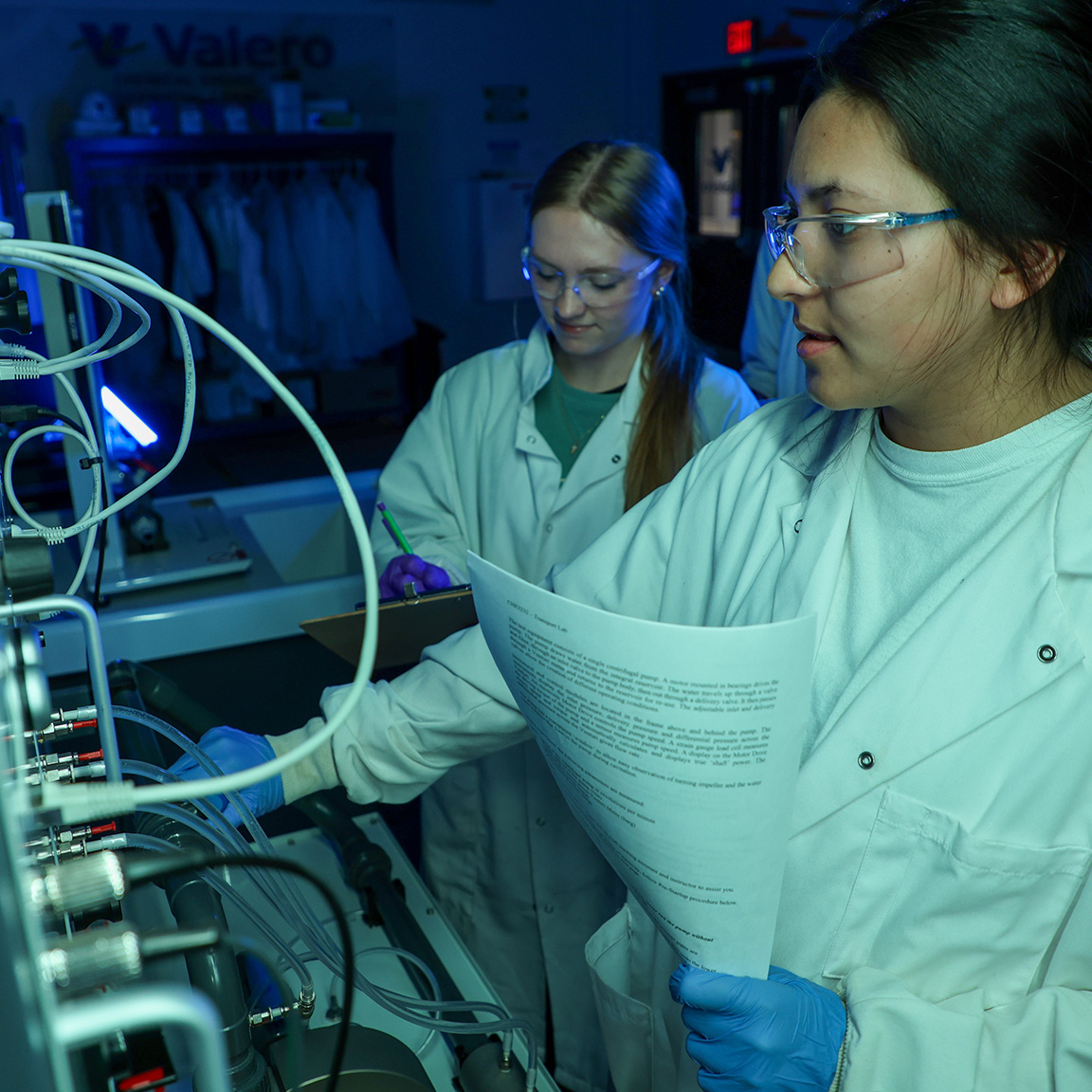
Chemical engineers take raw materials or synthesized chemicals and convert them into more useful secondary products Chemical engineers play an expanding role in efforts to reduce environmental pollution and create sustainable practices, like carbon capture and sequestration.
Engineer With Purpose
Learn more about Chemical Engineering at Texas Tech through student testimonials, faculty highlights, and facility tours.
Degree & Course Details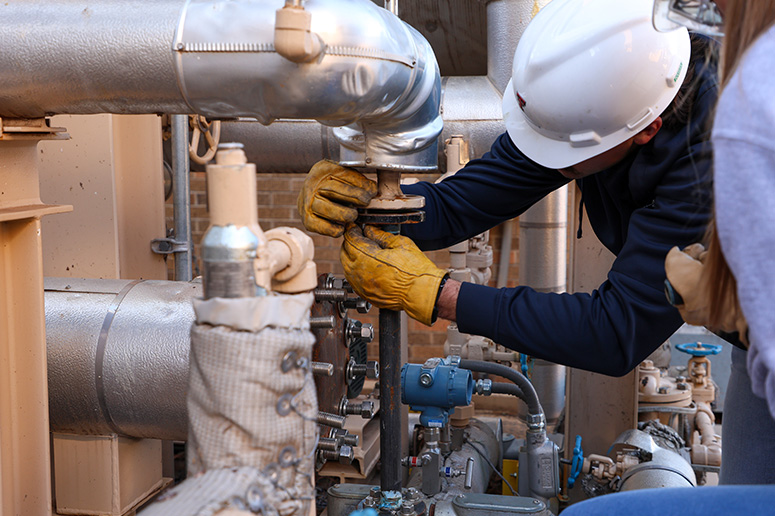
State-of-the-Art Facilities
Students have access to modern teaching labs equipped for hands-on learning in fluid flow, heat transfer, and pilot-scale operations with the Morrow Energy Pilot Plant.
Undergraduate Research
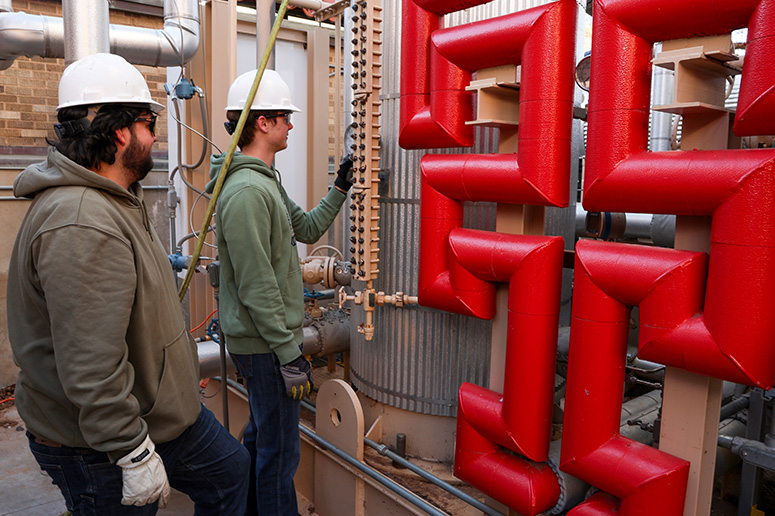
Expand your education experience by immersing yourself in faculty-led research in reaction engineering, polymers, catalysis, machine learning, and biomedical devices.
Employment Placement
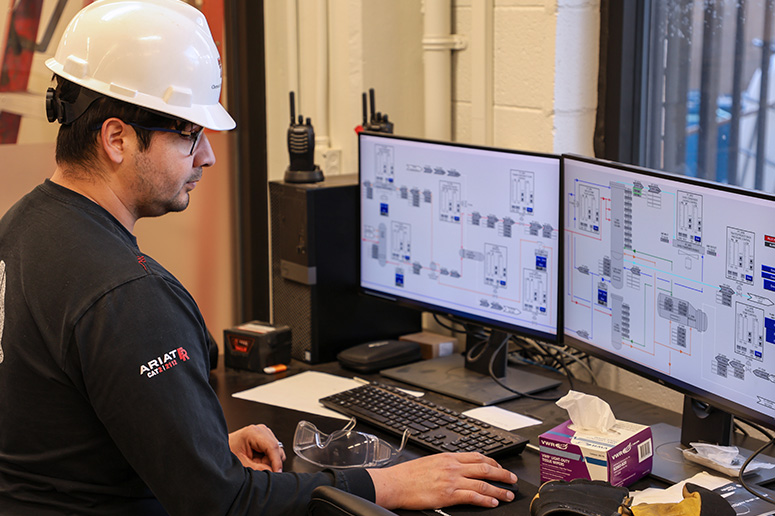
Hire rate at graduation is over 90%, with a median starting salary of $92,000.
Key Courses
View Degree Courses in Catalog
CHE 2310 - Introduction to Chemical Process
Units and conversions, process variables, material and energy balances, process flow sheet analysis, phase equilibrium, elementary transient balances.
- View in Catalog
- Credit Hours: 3
- Prerequisite(s): ENGR 1330, CHEM 1307, ENGL 1301, MATH 1451, and PHYS 1408 (concurrent enrollment allowed).
CHE 3323 - Chemical Reaction Engineering
An introduction to the kinetics of chemical conversion processes and the design of chemical reactors.
- View in Catalog
- Credit Hours: 3
- Prerequisite(s): CHE 3322 and CHE 3326.
CHE 3341 - Mass-Transfer Operations
Theory and practice of mass transfer. Particular emphasis on the operations of distillation, absorption, and extraction.
- View in Catalog
- Credit Hours: 3
- Prerequisite(s): CHE 3322.
CHE 4353 - Process Control
Study of the principles of process dynamics and control and their applications to feedback control.
- View in Catalog
- Credit Hours: 3
- Prerequisite(s): Senior standing; CHE 3315, CHE 3341, CHE 3323; MATH 3350 or MATH 3354.
Accelerated B.S. to M.S. in Chemical Engineering
Accelerated programs allow students to earn both degrees in five years instead of the typical six. By selecting electives during junior and senior years, students complete graduate-level courses that count toward a 30-hour master’s degree, finishing the Bachelor of Science in four years and the Master of Science in the fifth year. This streamlined path saves time and tuition costs while helping students enter the workforce sooner with advanced skills that enhance career opportunities.
Career Paths & Salary Ranges
Our Chemical Engineering graduates are making an impact across industries. Explore where our alumni are working and what they're building.
Financial Aid & Scholarships
Incoming students are considered for merit scholarships when they apply for admission. Admitted students can find additional internal and external scholarship opportunities through Scholarship Universe.
All ScholarshipsWhitacre College of Engineering Scholarships
Support for high‑achieving engineering students demonstrating leadership and academic excellence.
View WCOE ScholarshipsChemical Engineering Department Scholarships
Program‑specific opportunities for students in good academic standing.
View CHE Department ScholarshipsStudent Spotlights
Meet a few students sharing their experiences in engineering at Texas Tech.
-
Blair Dodge
Chemical Engineering
-
Job Vasconcelos
Chemical Engineering
-
Sela Boswell
Chemical Engineering
-
Cecelya Fung
Chemical Engineering
Student Organizations

American Institute of Chemical Engineers (AICHE) student chapter
American Institute of Chemical Engineers (AICHE)
Biomedical Engineering Society (BMES) student chapter
Biomedical Engineering Society (BMES)
Related Programs
-
Biological Systems Engineering
Biological Systems Engineering -
Polymers and Material Science Minor
Polymers and Material Science Minor -
Bioengineering Minor
Bioengineering Minor
Ready to Take the Next Step?
Reach out to our team to learn more about the incredible opportunities at Texas Tech.
Frequently Asked Questions
I have dual-credit or AP classes, will those credits count toward my degree?
Yes, review the listing of Texas Tech courses where credit can be earned by standardized test.
Can I switch my degree plan/major?
Yes, Chemical Engineering has the same foundational courses as all engineering majors, and very similar sophomore classes as Biological Systems Engineering. You should speak to your academic advisor to help facilitate switching majors.
What happens if I fail a class?
Typically, you will need to repeat it the next time it is offered. We do allow a few courses to be taken online or at another institution with approval of the department.
I’m interested in research, where can I find opportunities?
Connect with the Associate Chair for Undergraduate Affairs, Dr. Jeremy Marston, or directly to professors and ask them if they have openings in their labs.
Will my degree be ABET-accredited?
Yes, the Bachelor of Science in Chemical Engineering program is ABET accredited.
Programs
-
Address
Texas Tech University, 2500 Broadway, Lubbock, TX 79409 -
Phone
806.742.2011 -
Email
webmaster@ttu.edu