

The discovery captures a snapshot of missionary life in the 1700s and completes the story of the French explorer La Salle.
It is the 1720s. Spain has decided to abandon Mission Nuestra Señora del Espíritu Santo, a small missionary site located in what is now Jackson County, Texas. Unfortunately, the site and its small glimpse into Spanish frontier living would be lost to archaeologists and historians for the next 300 years.
Until now.
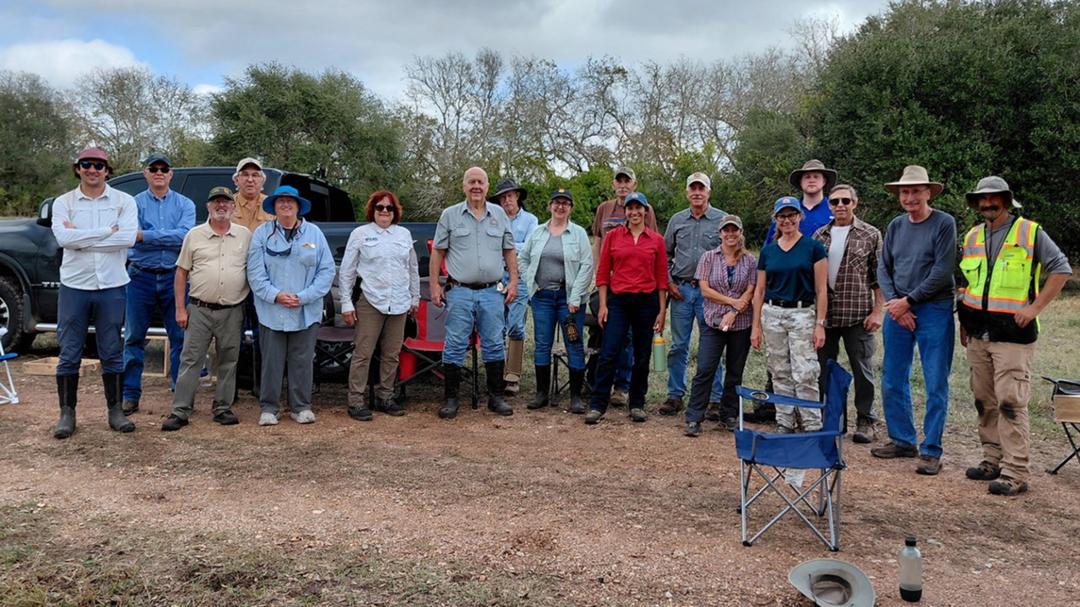
An archaeology team from Texas Tech University in collaboration with Texas Historical Commission archaeologists Kay Hindes, Jim Bruseth, Tiffany Osburn and Brad Jones found the lost site this past December on a private ranch near the Presidio la Bahía and Fort St. Louis.
The team was led by Tamra Walter, associate professor of archaeology in the Department of Sociology, Anthropology and Social Work.
The site was initially established in the 1680s by the French explorer René-Robert Cavelier, Sieur de La Salle, as part of France's efforts to colonize the New World, which would include proclaiming the entire Mississippi basin for France and naming it Louisiana.
La Salle left the colony to try to find the mouth of the Mississippi River before being killed by his own men. The remaining colonists were later killed or captured by the native Karankawa tribe.
Spain eventually settled on the site as part of its missionary efforts. However, the country's habitation was short-lived, and the site was lost when the Spanish left in the mid-1720s.

Walter credits the support of the Summerlee Foundation, the Texas Historical Commission and the private landowners for making this discovery possible.
"There was a lot of help, and people had been trying to find the site for so long," Walter said. "We couldn't have done this without the collaboration from so many people."
Much of the excitement of this find revolves around the site not only completing the story of La Salle but also providing a snapshot into missionary life in the 1700s.
"There are missions that are about the same age, but the problem is they had been occupied for almost 100 years," Walter said. "Earlier occupations are obscured by the later ones. At this mission, activity dates from about 1721 or 1722 to 1725 or 1726. We have a snapshot of what it was like to live on the Spanish frontier of Texas at that very moment."
Accompanying Walter on this discovery were three Texas Tech students: Nathaniel Asquith, a second-year anthropology graduate student; Joshua Etheredge, a first-year historical archaeology graduate student; and Carissa DeAnda, a senior anthropology major.
The students were primarily tasked with conducting a metal detector survey of the vast area.
"Our initial trip to the site in April 2025 was much more difficult, as we had to cut our way into the brush with machetes," Etheredge recalled. "After the clearing of much of the brush, the site became much more accessible, allowing us to work systematically to define the site boundaries."
It is an experience Walter knows they will value throughout their careers.
"I was so thrilled my students were with me," Walter said. "How many students can say they found a lost mission? Not many."
Etheredge, for his part, felt the gravity of this discovery.
Walking around the area with the metal detector could have been a fleeting experience. After all, this site was lost for hundreds of years, and archaeologists have been looking for it for decades.
But Etheredge recalled the sudden rush of adrenaline that spiked the moment he heard a confident beep on the detector — how that was followed by the reserved excitement of carefully digging into the earth and uncovering an artifact, connecting his physical body in 2025 with the people at the mission in the 1720s.
"Knowing that this discovery will close the book on La Salle's legacy in Texas and allow us a pristine look at Spanish frontier life in the 1720s, something so few have ever seen at a Spanish mission site, is pure archaeology magic," Etheredge said.

For DeAnda, who is on track to graduate this May and transition into Texas Tech's archaeology graduate program, the opportunity to conduct hands-on field research solidified archaeology as her career path.
This, despite having to navigate brutal weather conditions and persistent mosquitoes.
"A lot of people get out into the field and realize it's not for them," she said. "After being in the field for a week, you need to ask, ‘Do you like field work? Do you want to be an archaeologist?' Getting to do all this field work with Dr. Walter, I know I can be an archaeologist. Texas Tech has offered me this sense of security and confidence that I can do this work."
Asquith directly sees the discovery of this site correlating with his own research project.
"The sites I'm investigating in my thesis represent the end of the Spanish missionizing effort in Texas; meanwhile, this site is representative of the beginning of that effort," he said. "Getting to see the beginning and the end of this period is so cool."
Tosha Dupras, dean of the College of Arts & Sciences, echoed the value of hands-on experiences for archaeology students.
"These kinds of projects are experiences that students can't get any other way," Dupras said. "They can't get it from textbooks. This is a great discovery for our department, college and university. Students will want to come here specifically to work with Dr. Walter and on this mission."
Walter is busy planning the next steps for this site, which include a magnetic survey to better understand the site's exact boundaries and excavation of artifacts, for which she plans to bring a team of Texas Tech students to complete.
She sees this discovery as an example of the impact Texas Tech can have in understanding Texas history and culture.
"I can't think of a better example of embodying ‘From Here, It's Possible™' because from Texas Tech, we made the impossible possible," said Walter. "I think it just goes to show that you don't have to leave Texas to do world-class archaeology at a world-class site."