
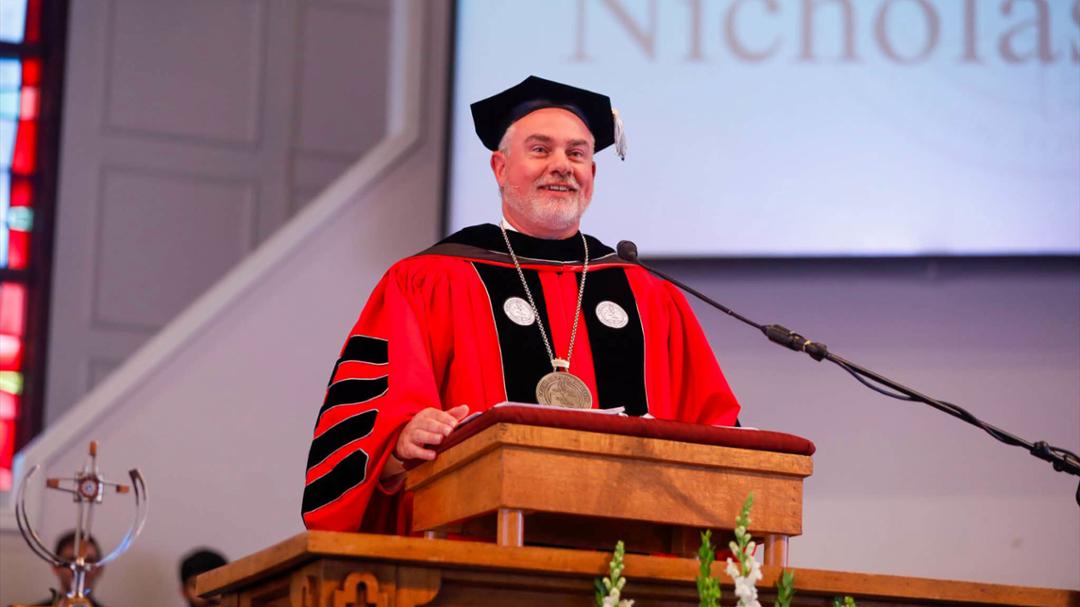

Nicholas Willis took the lessons learned while obtaining his doctorate in mathematics and has applied them throughout his career in Christian education.
For as long as he can remember, Nicholas Willis has felt pulled toward being a mentor for young people, and Texas Tech University played a part in making those aspirations a reality for him.
It was at Texas Tech where Willis earned his doctorate in mathematics, and that provided part of the foundation for him as he moved into a career of Christian education. Willis’ journey recently reached an apex when he was named president of Roberts Wesleyan University in Rochester, New York.
“I had been given gifts in mathematics,” he recalled, “and I was going to follow that path to be able to have the opportunity to really disciple young men and women. At Texas Tech, I experienced professors who had a way of saying, ‘This is how it feels to be challenged.’”
Willis said the math department was of such high quality that he not only received an excellent graduate education, but he also felt like his professors really cared about him as a person.
“I had come out of a small Christian college where you really had deep connections with your professors,” he said. “When I moved into graduate school at Texas Tech, it was much the same. I was really poured into by the faculty, and they were trying to grow me and equip me.”
Some faculty members encouraged Willis to remain in the mathematics field and pursue research at Texas Tech, but they understood he felt compelled to follow a different, equally rewarding, path.
He left Texas Tech with a lot of tools as far how to be an effective teacher and how to challenge students. He thanks people like David Weinberg, who was his dissertation advisor, and remains grateful for the influence of professors like Brock Williams and Roger Barnard.
“Texas Tech broadened my vision for what higher education could be,” he said. “I incorporated bits and pieces of what I thought were the best of what I learned from these professors into what I eventually did as a professor and then as a leader. My time at Texas Tech was invaluable.”

Among those from whom he learned was the math department chair at the time, Lawrence Schovanec, who has served as Texas Tech president since 2016.
“It’s been amazing to me to watch his career since I’ve been gone,” Willis said. “Then one day he was named president, and I thought, ‘I know that guy.’”
Willis said observing Schovanec’s leadership style provided him with great insights for handling difficult situations in his own career.
“I got to watch him walk the department through some challenges, and that was a great learning experience for me,” he said. “You have these different points in your life, and I have been at different institutions, but there I learned the importance of remaining calm and relational through challenges.”
After successfully obtaining his doctorate, Willis embarked on a career in Christian education. His first job was at Whitworth University in Spokane, Washington. Four years later, he took a position at George Fox University, where he had obtained his undergraduate degree earlier.
During his time there, he became involved with the university’s faculty senate, which whetted his appetite for moving into administration.
“I knew around that time that I was being called into administrative leadership at some level,” he said. “You might dream a little bit about maybe being involved in a presidency, but I wouldn’t really say it was on my radar quite yet.”
Between 2012 and 2020, George Fox was in a period of accelerated growth, and Willis saw it as a good time to try something new professionally. He and two colleagues started a strategy consulting firm that worked exclusively with Christian universities looking to grow.
For five years, the company helped more than two dozen schools hone their institutional strategies around enrollment, marketing, financial aid and other key areas.
The company was doing well. Willis was professionally happy, and he wasn’t looking to make another career change.
However, he grew up in the Free Methodist denomination, and one day at a conference he crossed paths with a former colleague who mentioned that Roberts Wesleyan, a Free Methodist university, was in the market for a president.
“I went home and was reading through the job description, and it was like reading my resume,” he said. “I thought, ‘Wow, this is kind of incredible.’ I’d always dreamed that maybe at some point, I didn’t know when, I would be president of a university, but I wasn’t necessarily looking for it that year.”
So, he mentioned it to his wife, who has a master’s in higher education administration from Texas Tech, and asked what she thought he should do. She wasted no time telling him to apply.
“I did, and I walked through the process,” he said. “And I am humbled and thankful and blessed that they chose me, and I am excited to be here and to be a part of what’s next at Roberts Wesleyan.”
While his extensive background prepared him for what to expect, Willis said there is nothing that truly gets anyone ready to step into the job of university president.
“The learning curve is steep and there are so many aspects to a university,” he said. “I’m doing my very best to become an expert on every piece of Roberts, so there’s a lot of learning to do. We have a fairly new leadership team so we’re all learning together.”
As for short-term goals, Willis said the No. 1 priority is growing enrollment. He said private universities face their own unique challenges, but keeping the focus on attracting the students Roberts needs will get a lot of attention, as will spiritual formation and spiritual life at the university.
“I have two axioms I share with people about Christian higher education,” he said. “The first is the goal of Christian higher education is to make students more like Jesus, and the second is there are lots and lots of ways in our world now to learn things. But habit formation only happens inside of relationships, and I believe strongly that at Roberts Wesleyan, we are in the relationship business.
“The reason you come to Roberts Wesleyan is because you’re going to benefit from relationships that change you. Relationships with peers and with faculty. That’s what we’re all about.”
Willis also knows the work won’t necessarily be easy. Roberts Wesleyan is one of only two evangelical Christian colleges in the state of New York. Just by way of comparison, there are three in Abilene, Texas, a community of about 130,000 people.
“We are serving the state, and this is really important work that we have to do,” he said. “And there is a market for this because I strongly believe there are still kids out there who want a Christian education and who need a Christian education.”